Resurrecting birtherism, questioning leadership

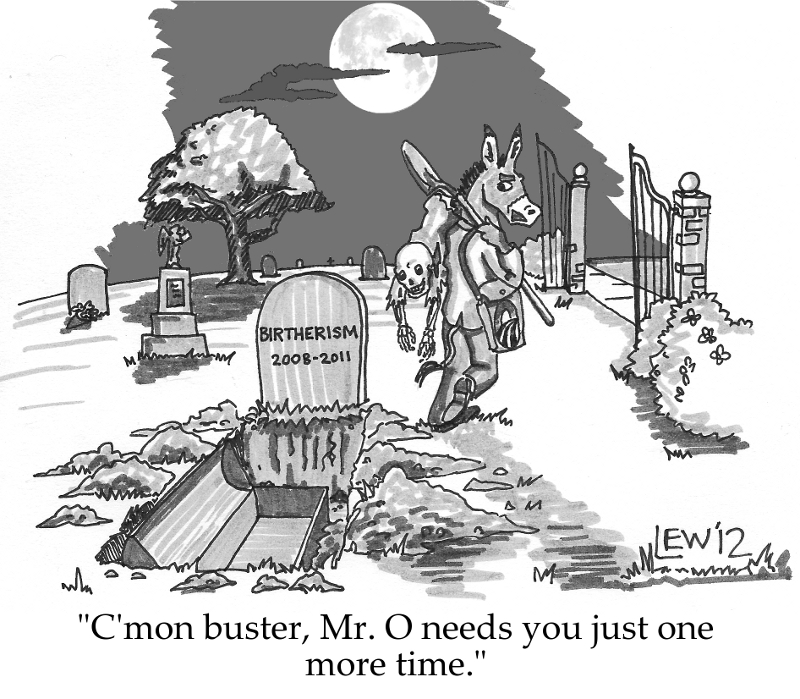
The Obama campaign resurrected the birther bogeyman this week with the release of a video questioning Romney’s ability to lead in light of his ties to Donald Trump.  This is an odd accusation coming from a president who forfeited leadership in shaping Obamacare, his crowning achievement, to his Democratic allies in Congress.  Meanwhile, his best claim as a bipartisan leader is the glorified photo-op of playing golf with John Boehner.  Much good that did.

Ed Klein’s new book, The Amateur: Barack Obama in the White House, reveals just how incapable a commander the president has been. In a recent Michael Medved interview, Klein contrasted Obama’s lack of day-to-day communication with President Reagan’s warm and regular phone calls to Democrat House Speaker Tip O’Neill. Today, Obama’s allies, to say nothing of his opponents, complain they never hear from him.  Maybe he’s been out on the links too much?

The biggest danger President Obama presents is not his race, his place of birth (Hawaii, USA) or his alien religion (secular liberalism). It’s his incompetence. This, combined with his unpopular, stubbornly-held big government liberalism, is why his campaign must constantly churn out red herrings like the birther issue.

Make no mistake.  Romney may not be the warmest character or give you leg-tingles, but his substantial experience heading up real, successful, and reputable enterprises give him a serious advantage over the incumbent, whose rock star status sheltered him and left him clueless as to how an executive should actually operate.

Prairie fire and cowpies make campfire politics

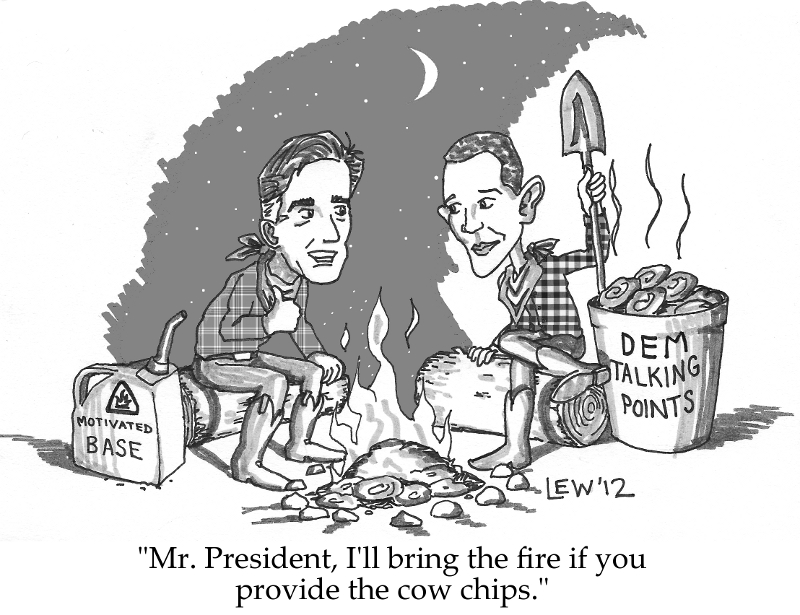
What happens when an unstoppable force hits an immovable object?  Who knows.  The more pertinent question for this past week: What happens when a prairie fire hits a pile of cowpies?

Both Mitt Romney and Barack Obama have been tweaking their rhetoric for Iowan ears.  Responding to Romney’s accusation that he’s tended over a “prairie fire of debt,” Obama has described his opponent’s criticism as a “cowpie of distortions.”  Our President continues to debase the discussion with a vulgar allusion to a steaming pile.

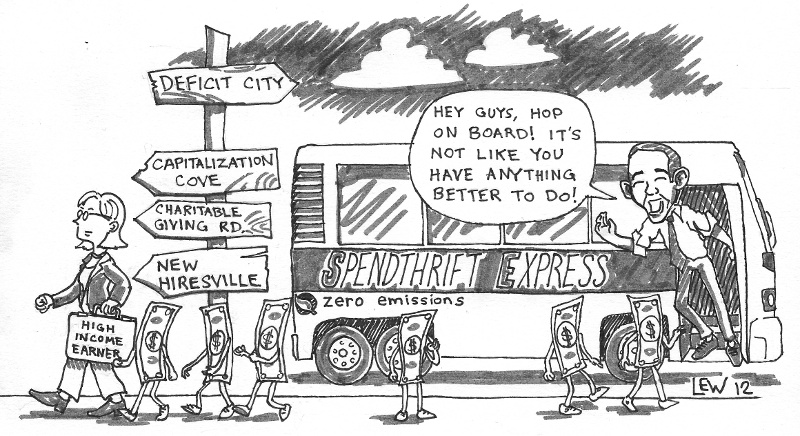
Meanwhile, the White House and the Left have tried to play off of the ill logic of Rex Nutting, who contended earlier this week that Obama has grown Federal deficits at the lowest rate since the Eisenhower administration.  Many observers have debunked this idea.  James Taranto put it well when he noted that Obama has treated Bush’s one year, necessary TARP swell as a baseline for subsequent years’ Federal budgets.

It’s as if you, the head of a household, assented to spending $10,000 to repair a sudden, gaping hole in the roof one year, but decided to keep spending that same extra amount for each of the three following years.  And this spending is not on other emergencies, but pet projects.  All the while, you claim to be a fiscal hawk because your spending hasn’t grown significantly since the initial boost that you approved when you first came in.

So Romney’s prairie fire claim isn’t so . . . smelly after all.  What we’re left with is a challenger with a base itching–on fire, in fact–to vote out an incumbent whose campaign and allies never seem to be in short supply of well, cowpies.  At least you can dry them out and use them for fuel.

President Obama’s off-base

The White House’s campaign messaging has been all over the place in recent weeks.  And contrary to his 2008 promise, the President has come off as more of a divider than a uniter.  Not to be confused with President Bush, who was mocked for proclaiming himself the “Decider.”

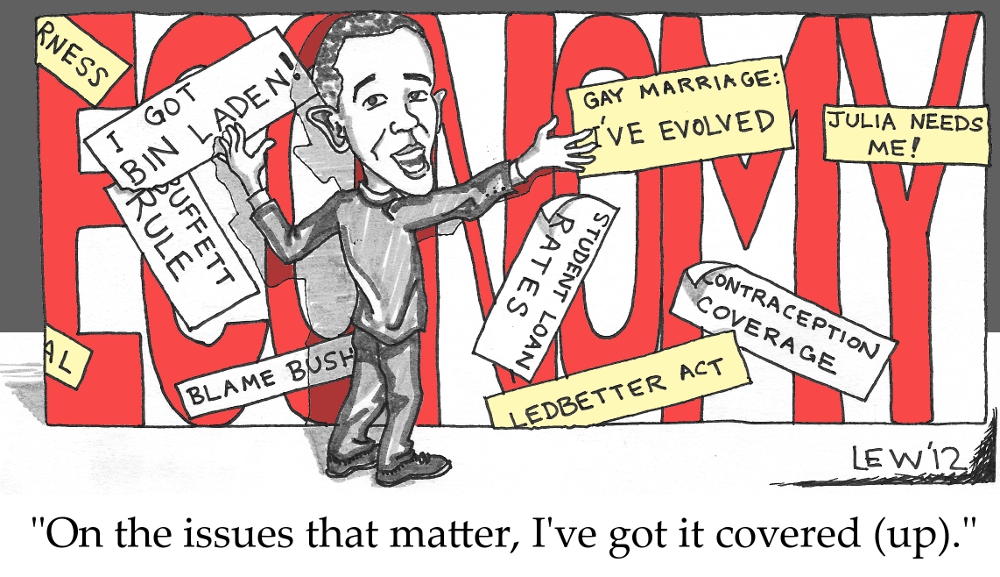
The Obama team’s trail of message wreckage started with February’s awkwardly handled contraception mandate work around, which, for all the trouble, still leaves some religious organizations paying indirectly for services they find unconscionable.

Then, erupting inconveniently last week was President Obama’s personal “evolution” on gay marriage. Many observers saw the President’s hand forced by discretion-challenged Vice President Joe Biden.  What’s most vexing about this iteration of the marriage debate is not the particular stance taken, but the justification as to how one arrives there.  Biden baffled us all with the idea that the 1998-2006 sitcom Will and Grace was for him some pivotal, moral tour de force.

As one poll shows, Obama and company seem to have alienated swing voters on the social issues.  But  they have tried mightily to boost their standing with female voters, trumpeting the 2009 Lilly Ledbetter Fair Pay Act as a great and early first term accomplishment.  All the act does is give women more time to sue their bosses for the phantom menace of wage discrimination–a boon for Democrat’s loyal base of litigious attorneys.  Touted as historic and consequential, the act is only known because the Obama team has dusted it off as a showpiece for the 2012 campaign.

Indeed, the Ledbetter Act featured prominently as part of the Life of Julia, a fictional every-woman whose slideshow biography was quickly and widely ridiculed for its earnest portrayal of a hopelessly lonely, overly dependent, Obama-centered life.  Rather than making the conventional, family-oriented “Harry and Louise” kitchen table-type pitch, The Life of Julia deliberately caters to the fervent, perennially disaffected fringe that is Obama’s base.

To see just how hard the Campaigner-in-Chief has tacked toward those who self-identify as embattled and aggrieved, we need only look to the recent “dueling” commencement speeches delivered this past week.  Conservative commentator Michael Medved noted that of all the colleges in the country he could have spoken at, President Obama chose the elite, astronomically expensive Barnard College.  His audience at the women’s liberal arts college was a particularly concentrated sample of privilege: women now far surpass men in educational achievement by the numbers, from undergraduate enrollment to attainment of advanced degrees.  Yet, the faculty and students were ebullient when the President was introduced as one who appointed so many women and minorities to the highest offices.  Meanwhile, Mitt Romney’s receptive audience at Liberty University, with its larger student body and more affordable tuition, was a far more representative cross-section of America, on the socioeconomic level not to mention anything of gender representation.

The White House has garnered a few days’ media attention on other issues: “spiking the football” at the anniversary of Osama bin Laden’s death, and the economic distractions of the Buffett Rule and the student loan rate relief.  The former was no help to the incumbent, with liberal Arianna Huffington calling one Democratic campaign spot “despicable.”  The paltry Buffett Rule captures more class resentment votes than it would actual marginal revenue from the wealthy.  Likewise, the playing up of the student loan rate extension nakedly caters to the college age vote, while dangerously distorting market decisions about the relative value of earning a degree.

All told, the President seems pretty set on stoking his base with the visceral fuel of social, class, and identity politics.  Meanwhile, substantive solutions for the economy, as well as the sensibility of swing voters, remain neglected.  Sending Biden around with the fib that he’s working class will only go so far.  We’ll see in the months ahead if the Obama team can refocus, or if Romney, sticking to the economy and clearly rising, can build and maintain a respectable distance.  Let’s hope so for our country’s sake.


D’Souza strikes (out again) on problem of evil

Dinesh D’Souza was on Michael Medved’s radio show a couple of weeks ago, promoting his new book God Forsaken.  From the unabridged (and unwieldy) title of the work, you’ll see it’s intended as something of an apologetic on the problem of evil.  Normally, I’d be positively inclined toward such a volume. But in the course of the interview, I found myself taking exception on a couple of counts.

The first foul stems from the author’s missed opportunity to affirm one of the most basic tenets of the Christian worldview.  Medved, the host, asked D’Souza and the call-in audience, “Why do bad things happen to good people?” A serious Christian theist can’t dance for long around that question before issuing the clarifying rejoinder: “Who is good?”

Indeed, Paul’s letter to the Romans makes it clear “all have sinned and fall short of the glory of God.”  It baffles me that D’Souza, a prominent defender of Christianity, could talk of how “bad things happen” without saying that God does not owe sparing us the consequence of our rebellion.

So then how does D’Souza sell his book in the course of a commercial radio hour?  On the oversubscribed basis of pop science and pop psychology.

Uninterested in traditional theodicy, that is the defense of God’s existence in light of evil, he tries to get people on board with God’s existence by a cursory dismissal of the New Atheists.  He explains away their fervor with a back-of-the-napkin psychoanalysis of the late Christopher Hitchens’ unpleasant childhood.  For all we know, psychology may play a major role in the New Atheist community, but the interviewee seems to lack the tact to avoid a borderline ad hominem attack.

Interestingly enough, Mr. Medved had previously been skeptical of D’Souza’s earlier work, The Roots of Obama’s Rage.  In one sense, that whole book was a pop psychology ad hominem writ large.

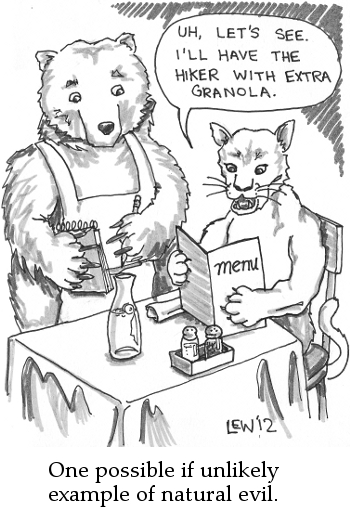
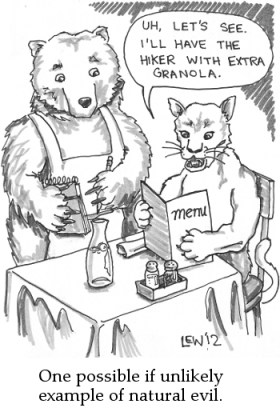
Back to the interview.  Once D’Souza establishes that God exists but people are just angry at him, he moves to science, suggesting that certain findings justify the necessity of natural evil, as distinguished from man-made evil.  That means chance calamities like earthquakes and disease, rather than suffering that results from human volition.  So as chilling as they are, mountain lion attacks must be racked up as natural evil.

With this focus on science, the author makes some nifty declarations: life on Earth couldn’t develop without plate tectonics.  If we couldn’t face the consequences of defying gravity, we wouldn’t have true free will.  But these kind of arguments don’t persuade materialistic determinists or skeptics inured to the anthropic principle.  Especially not after you’ve insulted them.

In an hour of radio, the author manages to insult atheists, avoids affirming the fallenness of man, indulges popular appeals to science and psychology, and fails to offer substance for the weighty question of evil.

Yes, he is a former fellow of the Hoover Institution, and the current president of The King’s College in New York City.  And the respectable Evangelical biographer Eric Metaxas gives glowing praise for God Forsaken, so the book may not be a wash.  But considering his previous sketch on Obama, his radio interview, and his second-place finish in last year’s Intelligence Squared debate, I have some doubts as to whether Mr. D’Souza is an effective apologist for Christians or the American Conservative movement.

Good public discourse is not built on sensational psychology or svelt scientific findings.  Whether it’s Dinesh D’Souza or Richard Dawkins answering life’s big questions, we deserve from them solid epistemology and a coherent metaphysics.  We shouldn’t expect less from our top-shelf minds.
How Buffett bluster boomerangs; or, Taxosaurus Rex

The unvarnished rhetoric coming out of the White House over the past two weeks has been just too delectable for conservative commentators.  In a recent WSJ piece, Daniel Henninger suggests that Democrats’ furious assault on Paul Ryan’s budget plan is desperate “thermonuclear” overkill.  Indeed, all the accusations of Social Darwinism and “trickle-down” economics cannot make up for Democrats’ utter lack of seriousness when it comes to the national debt.

As the White House rolled out the practically inconsequential yet politically expedient Buffett Rule this week, I was amazed at the justification given by allied economist Alan Krueger.  The Christian Science Monitor quotes:

“In addition to fairness, in fact it’s a step in the direction of economic efficiency,” said Alan Krueger, chairman of the Council of Economic Advisors. The Buffett rule allows people to “devote more effort what their focus should be, which is to their jobs and job creation … rather than restructuring their income to minimize their taxes.”

He’s alleging that the tax increases economic efficiency.  But how does government spend anyone’s money better than they themselves would?  During the global high tide of state central planning in the 1940s, F.A. Hayek explained cogently in his The Road to Serfdom who spends money best: the one who earns it.

When given other people’s money, legislators face the temptation of buying constituents’ votes with pork rather than allocating it wisely.  Then the money goes to bureaucrats, who are not careful enough with it.  Their lack of accountability flows from the political difficulty of de-funding them.  It is the original income earner who best appreciates the sweat and effort it took to get the money.  She appreciates the reality that her income might dry up tomorrow, and so will handle it more carefully than the central planners.

According to his critics, the car elevator in Mitt Romney’s mansion is a bad thing.  But he used his own money, which he only earned in the first place by benefiting others in voluntary transactions.  And the construction provided gainful employment to all sorts of craftsmen.

President Obama, meanwhile, either had to grow our debt or tax money out the economy to give us public project flops like Solyndra and the constipated stimulus weatherization projection.  Money that otherwise would have been carefully spent in private hands was squandered by legislators and bureaucrats.

Of course, not all government spending is bad; some spending is necessary.  But Krueger’s claim that a tax increases efficiency overlooks government’s great tendency towards inefficiency.

The case against the Buffetteers may be clearer when we look at that favorite magic word of progressives and liberals, “investment.”  Any public project from education to high-speed rail becomes an unmitigated good if it can be spoken in terms of investment.  But our current, low tax rates vindicate private investments as an even greater good.  This is why Buffett and Obama pay less in taxes than their secretaries.  The Monitor quotes Marco Rubio:

“What [Americans] need to understand is the reason why he may pay less than his secretary, in terms of the rate, is that she makes her money on a paycheck and he makes his money on investments,” Senator Rubio said. “We have always wanted Warren Buffett to, instead of putting that money in a coffee can, to take his money and invest it, because that created jobs.”

As much as the Buffett-minded would increase taxes on private investment earnings, they would demolish the incentive to invest and crash the stock market.  In this way the Buffett Rule boomerangs back on itself.

Class envy can’t lift up the poor, but it can bring us all down.  Let’s all move past the Buffett distraction.

William-Sonoma Republicans: The Exotic Other

I’ve been reading Yahoo! News for years.  Once upon a time, they relayed to the net denizen a spartan diet of AP and Reuters articles.  Now, they’ve cultivated their own crop of value-added content.  The term “value” must be used advisedly here.

You’d think that when it comes to presidential campaigns, journalists should be delving deep into the issues.  But the currents of today’s media markets dictate other priorities.  Take Mitt Romney for instance.  Instead of scrutinizing his policy positions, Yahoo!’s The Ticket blog has waged a systematic campaign of making Romney and his wife Ann look bumbling, aloof, and inscrutable.

Every time the Yahoo! bloggers post, the news spin is so swirly and the story so inconsequential.  In the hope of highlighting his awkwardness, one January post was dedicated in large part to Romney’s hurling bags of Cheetos to unfriendly journalists on his campaign plane.  When the primary came to Arizona, the fact that Romney’s supporters’ signs appeared to be hastily printed on resume paper figured prominently in another post.

And then there were multiple reports on Ann Romney’s Pinterest account.  First, that she followed no other Pinterest members.  Should we really expect more tech savvy from a grandmother in her sixties?  I don’t even have a Pinterest account.  Then, one Viriginia Heffernan took up a wordy post to scrutinize why Mrs. Romney would pin Anna Karenina on her Pinterest board.  Seriously, do we have a misallocation of journalistic resources here?  In magnifying and dragging out these silly details, this crack team of liberal bloggers is hoping to quash Romney’s chances by a death of a thousand embarrassing paper cuts.  The all-too-cool President Obama certainly doesn’t get the same treatment on The Ticket.

To top it all off, one of Heffernan’s latest contributions catalogs for us the traits of what she calls “William-Sonoma Republicans.”  She cites an old story by the Los Angeles Times to launch her own confused musing on The Other: in her case, middle and upper-middle class Republicans who support Mitt Romney.  You can’t help but suspect a bit of journalistic retaliation when she tries to cast this Other as a counterpart to the “sushi-eating, Volvo-driving” latte liberal.  How exotic is this strange group of people who would support Mitt Romney?  Among their most salient traits: they live in large suburan houses, take pride in their living spaces, and–most shocking of all–cook food in their own kitchens!

The nadir of this journalistic exposé comes when the author consults the William-Sonoma website. Noting that it prominently features an Easter sale, she concludes erroneously and with lament that the clientele is meant to be exclusively Christian.  She plays up an ad that suggests W-S customers might like to eat leg of lamb with sea salt and shallot butter.  I’m sure lots of Jews, Muslims, and atheists wouldn’t mind a bite of leg of lamb in April either.  And if having an Easter sale signifies some sort of oppressive exclusion, Heffernan had better not look at the transcript for the White House Easter prayer breakfast.  How far overboard can a liberal blogger go with her disdain for traditional lifestyle and faith?

We shouldn’t blame the media for their failure to cover the substance of the 2012 Presidential campaign.  After all, they have to pay the bills somehow.  Just remember to do your homework before you go the polls in November.  Hint: Yahoo! News won’t help.

A workable green energy solution

We all know the things we’re supposed to spurn the Republican contenders for: vomiting on hearing JFK talk about church and state, offering statehood to a yet-unfounded lunar colony.  The litany against front-runner Mitt Romney is long, if insubstantial: having buddies who are NASCAR team owners, driving two Cadillacs (not Porches or even Mercedes, mind you), being an Etch-a-Sketch candidate.  Since there is no major scandal or outrageous hair-flaming position the man takes, mainstream media must squeeze every ounce it can get out of the latest Romney gaff.  It’s getting old for anyone with half a brain, and fortunately those are the people who tend to show up at the polls.

Republicans have been scrutinized intensely, but what has been coming out of mouths in the Democratic corner?  You wouldn’t know watching NBC or reading Yahoo! News.  Sure, Maxine Waters called Eric Cantor and John Boehner demons.  Nonetheless, it’s the recent speeches of household-name White House officials that are worth looking at.

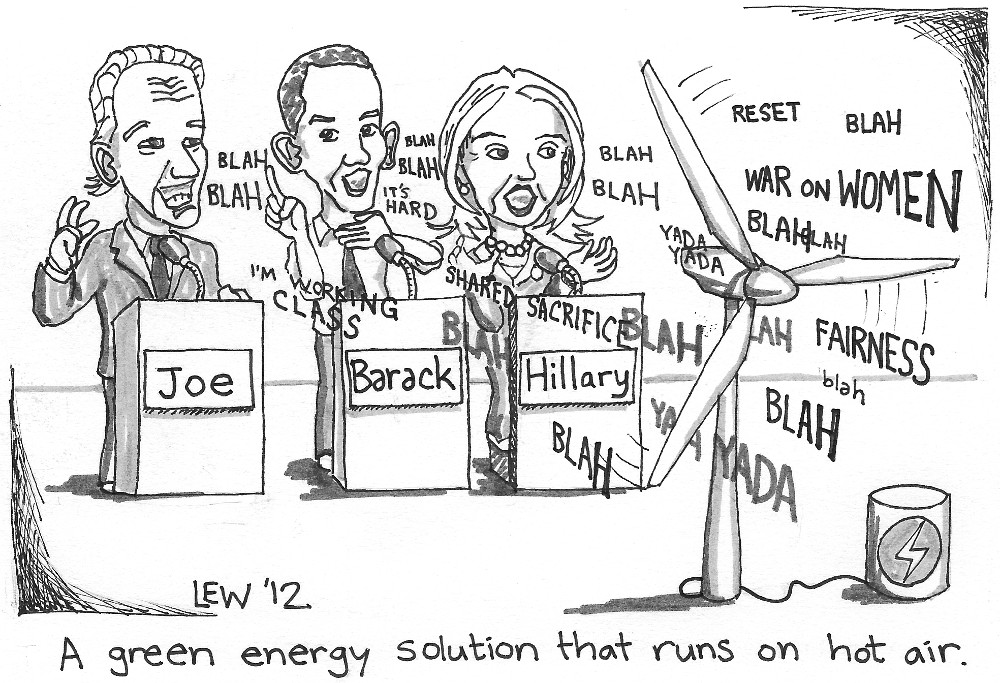
President Obama kicked things off earlier this month, comparing himself to Ghandi and Nelson Mandela.  He claimed that, as with those men in their noble struggles, the fight is hard and it takes time.  But how is the Democratic agenda in 2012 comparable to the effort for Indian independence or the campaign to end Apartheid?  Does this mean the GOP is as brutal as the British Raj or as unjust as the old South African regime?  This sloppy pandering is reminiscent of the racially-tinged “dollar bill” accusation Obama hurled at McCain and Republicans in his 2008 campaign.  But these remarks get scant media scrutiny when they come from this president.

Next, Secretary of State Hillary Clinton spiced things up at the 2012 Women in the World Summit.  She equated more ardent American conservatives with the more egregious human rights abusers in the Muslim world, slapping them both with the common label of “extremists.”  Opposing compulsory contraception coverage is nothing akin to what women deal with every day in Afghanistan, or Egypt for that matter.  Secretary Clinton scores bonus points for lugging domestic politics into foreign affairs.

Finally, Joe Biden rounds out the good times with a speech given to the UAW in Toledo last week.  The Vice President branded his ticket as one offering a “fair shot and a fair shake.”  With this language we might as well have entered a time warp and come out in FDR’s bad old New Deal.  This is the kind of sloganeering given to those who think capitalism is wrong, broken, or dead.  In its place comes Uncle Sam who “takes care of things” for you.  Just like when you need Vito Corleone to get your landlord off your back.  More like fair shakedowns than fair shake.  This rhetoric values shameless deal-making over the rule of law.

It’s no surprise the highest officials in the land get the soft treatment; they’re liberal and progressive after all.  Their rhetoric should have generated some push back from the mainstream media.  If only we could harness all their hot air, we could generate electricity instead.  Then they could deliver on their green energy solutions promises.

Get smart on social issues

Social issues have been on a role lately.  Even though conservatives have the winning logic, the Left has the tailwind of popular outrage that comes with the liberal fear of an “American Taliban.”  From Komen’s forced Planned Parenthood backtrack, to the weak Obamacare contraceptive mandate reshuffle, to Rick Santorum’s unnecessary utterances on prenatal tests, neither the media nor the White House have missed a chance to cast a troglodyte pall on any Republican within firing range.

Liberals have the tactical advantage as long as the policy discourse is defined by the paradoxical presumption that government should run citizens’ lives while maximizing their “privacy.”  Rather than get mired in the house-to-house fighting of the culture wars, Republican presidential contenders ought to turn the tables and insist that privacy is best preserved by getting government out of the healthcare business.  Gutting mandates is the real “pro-choice” position.

Winning the presidency requires a positive, sunny disposition, and delivering bad news about people’s personal conduct is the job of elders in robes: pastors and judges.  If you win the presidency, you get a bully pulpit, but more importantly, you can appoint clear-thinking judges who can stem the progressive march to positive-rights oblivion.  The problem is you need to win the presidency first.  Let’s get smarter on how we talk about social issues.

Destiny without Deity

Like lots of folks last week, I invested a bit of time looking for a good Valentine’s Day Card to give my beloved.  Whether for a birthday or some other occasion, I’m always dismayed by the selection of cards in the store.  For the most part, they alternate between mildly profane and unbearably saccharine.

I did manage to find an agreeable V-Day card.  However, another card happened to catch my attention.  It was one of those sappy ones, but different; a card that wanted to retain a sense of romantic destiny without tipping a hat to deity. I don’t remember it verbatim, but in essence, it read something like this:

“I am in awe of a universe that put the two of us together, and even more so that it knew I needed someone who could put up with me.”

It was a striking example of two powerful but opposing forces at work in the human mind. On the one hand, the propensity toward awe, and on the other, the conspicuous denial of whom that awe is owed to. What does it mean to be in awe if not to acknowledge the masterful work, power, or fury of a willing agent?

And describing a universe that knows something about the couple beforehand not just implies intelligence, but borrows from a sense of divine providence. It shouldn’t have been a big deal for the card to just say “God” instead of “universe.”  Even a pantheist could be happy with “God” wording; on such a metaphysical view, God is the universe.  So maybe the card maker was trying to be inclusive of an acutely irreligious clientele.  Whatever the reasoning, the consumer is confronted with an inconsistent sentiment on the card shelf.  Our material universe cannot be owed awe or have foreknowledge.

The late pastor and apologist Francis Schaeffer gave us a potent tool for making sense of this inconsistency in his concept of the upper story and the lower story. Imagine human knowledge as being contained in a two-story house. On the lower story, we have truths about the material world: what we can learn through empirical inquiry and science. The facts formed from the observation of physical phenomena do not support any normative end in themselves.  Even with them, we find ourselves asking, “How now shall we live?” We somehow must find those answers in the upper story, where morality and meaning reside.

On a pre-modern worldview, which allows the possibility of the supernatural, we can ascend a staircase that connects the lower and upper stories.  But with the Western Enlightenment came modernity.  Strict naturalistic presuppositions disallowed any real connection between the two stories.  On this materialism, there was no effective way to indict evils like the Nazi holocaust or European colonialism.  So postmodernism launched in an attempt to recover some sense of meaning for humanity. Yet, its claims on meaning and morality are only a “leap” of faith from the first to the second story.  It doesn’t even want to affirm any real logical connection.  Only an objective supernatural reality can ground true morality and purpose.

Without the supernatural, all our sentiments are empty.  That we picked out a nice greeting card and some flowers becomes a matter of simply going through the motions. There are still philosophers, like Luc Ferry, who suggest that we ground our meaning in the frame of reference of our fellow human beings.  But if matter is all there is, to speak of meaning as if were something real becomes itself incoherent.  Anyone who harbors such a worldview must come to terms with the idea that nothing can inspire awe, and that there is no path of destiny you can embrace. Thank God this is not actually the case.

Theocracy from the Left; or, Other people’s money

At the National Prayer Breakfast earlier this month, President Obama played up his Christian faith, declaring “for unto whom much is given, much shall be required.” Attempting to marshal scripture in support of his idea of fairness, he ended up inserting a theological foot into his political mouth by conflating God and government.  In this, Mr. Obama managed to betray an aloofness from mainstream churches as well as raise a troubling portent for civil libertarians.

With the words “much shall be required,” what else did the Central-Planner-in-Chief mean but to put the tax man’s moral authority on par with God’s?  Christians understand that God doesn’t compel anyone to obedience, but leaves each of us to our free will and our conscience.  By contrast, human government must compel its citizens.  Taxes are collected ultimately at the barrel of a gun.  That’s why the founders saw it as essential to limit what is “required” by the government.

During the Bush years, a handful of agitated liberals spawned a new book industry, warning of theocracy arising from the Religious Right.  If history’s any predictor, President Obama’s statement should launch a new wave of dire tomes warning against a theocracy of the Religious Left.  The social justice crowd that rallies behind Obama’s fairness push is out of touch with America’s exceptional ethos and experience: that a people, under the guidance of God and conscience, and free from a central meddler, have built for the world a Shining City on a Hill.

Besides conflating God and government, the President and his tax-the-rich allies have committed another type of unforced error in their moral reasoning.  Mr. Obama, investment wiz Warren Buffett, and retired Google exec Eric Schmidt have each, in recent times, implored that their own taxes be raised.  Their advocacy sweeps up all the fellow earners in their tax bracket, both the willing and unwilling.  How is this kind of appeal sensible?  It’s a perverse, inverted golden rule.  Like saying you personally don’t mind being bludgeoned, so it’s okay to bludgeon your peers.  It seems as if these folks are hoping your brain isn’t turned on.  Or maybe that you won’t notice theirs aren’t.  There’s a certain kind of arrogance in volunteering other people’s money.

So in a couple of ways Obama and company’s moral arguments are really lacking.  But don’t forget the facts about our nation’s recent Great Society redux.  Stephen Moore’s op-ed challenge to the White House fairness narrative provides us with a rich inventory of ways our big government has failed us to date .  Among the more salient is the mounting concentration of national wealth in the suburbs of Washington DC; the top three median income counties in the nation are clustered in the DC metro area.  Such a backslide of civilization would give any shameless, caviar-chomping commissar of Soviet-era Moscow a run for his money.  And we know that whatever part of our nation’s economic lifeblood that does not end up feeding a Falls Church jumbo mortgage tends to get lost in legislative backscratching or bureaucratic head-scratching.

Anyway you dice the tax dollar, Washington isn’t justified in its spending increases.  Given President Obama’s deficit deafness, and Democrats’ contorted fairness distractions, voters need to just say “No!” and oust the tax-grubbing big spenders this November.