World better without religion?

At some point, you’ve likely heard the lament that the world would be better off without religion.  You may have even unwittingly imbibed it this past New Year’s Eve, when Cee Lo Green covered John Lennon’s classic hit “Imagine.” The song starts famously:

Imagine there’s no heaven
It’s easy if you try
No hell below us
Above us only sky
Imagine all the people living for today

And in due course the listener is asked to imagine a world with “no religion too.”  What better way to kick off 2012?  I’m sure Times Square’s officiants Lady Gaga and Michael Bloomberg approve wholeheartedly.

Beyond the pop culture realm, but still in the confines of Manhattan, the Oxford-style debate forum Intelligence Squared US picked up on the same theme this October past.  For some time I’ve heard bits of their debates on NPR, but only recently did I bother to get the podcast.  Naturally floating to the top of my queue was the episode featuring the resolution, “The World Would Be Better Off Without Religion.”

The debate, held before an audience at New York University, was remarkable in that the pro- and con- teams were prohibited from discussing the existence of God.  At first this might seem absurd; whether  God exists or not is patently germane to the question of religion.  But the imposed restriction has the benefit of allowing the debaters to focus neatly on the social ramifications of religion.

Consider what religion is in the restricted sense of the debate: moral beliefs with social consequences, that happen to be theistic. Then listen to the debate participants in action, and the chief complaint becomes clear: people kill and oppress others on the basis of differing moral beliefs.  So, would any hypothetical, religion-free world be better? No.  We would only be exchanging a world filled with a diverse array of theistic moral belief for a world filled with a diverse array of atheistic moral belief.  That people hold moral beliefs, and differ from each other on those beliefs are immutable elements of humanity.  So is the fact that we are social creatures.  We cannot escape each other.  I suppose we can imagine a world of people in secluded pods, or one solely populated by clones, or else a world that is entirely monocultural.  But most people would rightly see such worlds as deeply impoverished and no improvement over our own.  An inescapable part of being human is living in a world with others who hold to different “oughts” and “ought nots.”

Let’s move from possible worlds to the historical record. For thousands of years, religion has presided over mankind, such that any given killer, oppressor, or victim for that matter, could in some sense be tagged by us as “religious.” Only after the Enlightenment do we start to see significant cases of self-identified irreligious individuals.  All we need is one instance where an atheist kills another atheist on the basis of differing morality to obliterate the idea that religion is uniquely harmful.  Consider who swung the ice pick that killed Leon Trotsky.  It seems someone thought he “ought” not have disobeyed Stalin.  Purging religion only allows new types of contentious belief to crop up and take its place. Religion doesn’t kill or oppress people, human wickedness does. Christians rightly recognize this as sin nature.

So, how did the Intelligence Squared debate turn out?  The pro-side, making the case things would be better without religion, persuaded more audience members at the end and thereby won.  Unfortunately, the con- debaters Dinesh D’Souza and Rabbi David Wolpe failed to decisively isolate the social idea of “religion” from man’s underlying wickedness.  But even if they effectively made that case, what other outcome could we expect from public broadcast patrons congregated in a New York university performing arts center?

That the finger of blame could be pointed toward oneself has been thoroughly expunged from our culture today.  It’s easier for some just to chalk our problems up to some conception of a social condition called “religion.”

SOTU 2012: The Tax Loophole Jump

SOTU 2012:The Business Tax Loophole Jump


There were some nice things about Tuesday’s State of the Union Address:  Representative Gifford’s recovery, the accomplishments of our awesome Navy SEALs, and Mitch Daniels’ well-spoken and clever GOP response.  And there were some not so nice things.

Looking at the fiscal picture, President Obama’s speech boiled down to two proposals: shuffling business tax credits and asking for more money on things we already spend a lot on.  Among the various behaviors the President aspires to manipulate through a fresh scrambling of our already deeply convoluted tax code: who businesses hire, how much they pay those employees, what  manufacturers make, and where they make those things.  Has the White House not gotten one of those memos on tax simplification?  What ever happened to the recommendations from the Simpson-Bowles report they commissioned?  All of the new tax credits (read: loopholes) will only distort market behavior.  And market distortions are “what got us into this mess.”

Then there are the new outlays he requested.  First, to create a new bureaucracy, the Trade Enforcement Unit.  I think he is going for the Jack Bauer vote by calling it a unit, as in “Counterterrorism Unit (CTU).”  Its a worthy cause, but can’t it be done by retasking existing agencies?  Next on the list is money to transform community colleges into “community career centers.”  I don’t know what they were before if not that!  Just a place to find a date for Friday night?  Finally, he asked us to fork more money over for teachers.  But it seems like school voucher programs don’t count.  Democrats only accept more money for education when it doesn’t threaten unions.

I don’t think our President has managed to outdo himself in 2012.  Last year’s “Winning the Future” (WTF) theme with $53 billion for high speed rail projects is just too tough to beat.  And that outlandish record will hopefully stand if this State of the Union address is President Obama’s last.

A modern apotheosis

A succession of Republican presidential contenders has melted under the media’s gaze, and now Mitt Romney is squarely in the unforgiving spotlight.  We witness presently a perverse quadrennial apotheosis, wherein some Republican must ascend to a celestially fixed bulls-eye, to endure for a term an uninterrupted stream of spin and slander.

The perverse quadrennial apotheosis of the GOP

Last week at a New Hampshire town hall, Mitt caught flak from a Chinese-American woman who complained that twenty years of Reagan’s “trickle down theory” (what is that?) has left her “tin can” empty.  She scored points with victimhood circles by insisting that Romney no longer “put Asians down.”  Blog site Angry Asian Man, omniscient in things potentially offending Asian-Americans, lauded this woman’s lecturing of the former governor.  But there is nothing inherently racist about calling out the very real phenomenon of Chinese currency manipulation.

Meanwhile, another prog blog acclaims the confrontational woman as a “tiger mom,” but what kind of tiger mom rattles a beggar’s cup of change?  Her trickle down rhetoric only parrots progressive platitudes against the free market.  The video exchange her cheerleaders posted cuts off Romney mid-sentence, but its here if you want to see just how formidable and commanding the candidate is.

The tin can tiger mom encounter, telling as it is, is small beans compared to the coverage other Mitt moments get.  There is the “corporations are people” that commentators like to milk.  Of course, it will never deserve as much infamy as Obama’s contemptuous “cling to guns and religion” quote.

Currently, the “I like to fire people” uproar is sucking up the precious oxygen that should otherwise have been going to journalist’s brains.  Yahoo’s Holly Bailey has given us a sense of the media’s madness while simultaneously partaking in it.  In covering a recent press conference, she gets to color Romney how she wants, insisting, “he seemed to will himself to keep smiling, perhaps knowing that even the hint of a frown could produce an image that he might regret.”  Really?  Her dramatic license aside, I didn’t know she had a press pass to inside his brain!

Ultimately, the “fire people” moment is overinflated.  The recent populist “fire your bank” campaign poignantly shows that Romney is far from alone in his desire to exercise his economic liberties.  After all, who hasn’t wanted to dump their high-speed internet provider?

Unlike his fellow GOP contenders, Romney seems to be well-equipped to endure the media’s slings and arrows.  He is scandal free, he remembers his lines, and he and his team demonstrate well-rounded discipline and competence.  He might not light everyone’s fire, but he can certainly take the heat.

Much Ado About Fox

This past Thanksgiving, giddy media liberals parroted the fallacious conclusions of a Farleigh Dickinson University study.  Daily Kos crowed: “New public study: Watching Fox News makes you dumber.”  But it’s clear the poll was rigged merely to be smear fodder against America’s most viewed news channel.

The FDU researchers titled their press release “Some News Leaves People Knowing Less.”  In their misleading parlance, a news source (mostly Fox) “leads,” “leaves,” and “makes” the study participant dumber or less knowledgeable.  The language gives the impression that some active force shapes news consumers’ responses.  From this, one might conclude that Sean Hannity and Megyn Kelly emit brain cell-killing radiation when they appear on screen.  But this is not some lab rat experiment with tightly-controlled variables. The researchers stacked the deck against Fox from the onset.

Consider how the study collects data from its telephone respondents.  If one receives any news information from a given source over the past week, his responses count in favor of or against that source.  Now Fox News is a 24/7 telvision operation.  Any channel-surfing couch potato can tune into five minutes of “Fox and Friends” and per the pollster instructions report they got some news from Fox.  Meanwhile, NPR’s reporting, restricted to the commute hours and the less accessable radio format, is shield against association with casual news consumers.  Such people might even tune in during jazz hour and correctly report they had received no news from NPR.

Media Partition in the Age of Obama

Media Partition in the Age of Obama

On top of this selection bias, the FDU researchers share a liberal outlook with their favored media outlets.  As can be seen from the wording in poll question two, they place a premium on foreign news over domestic happenings.  Mainstream media like TIME and NPR devote inordinate amounts of time fawning over the “Arab Spring,” but conservative-friendly media like Fox tend to dispense with the rose-colored glasses.  Their viewers, having a vague awareness of continuing Egyptian upheaval, are not marinated in the feel-good pieces that liberal journalists keep producing.  This disadvantage magnifies when the pollsters fail to mention Mubarak by name in asking whether his regime was toppled.  For all we know, they are asking about the military transitional council!

Then, when the questions roll on to domestic news, the poll fumbles by asking who is the Republican front runner.  This is an especially murky proposition given the fluid nature of the field.  The results vary depending on when and by who the poll was taken.

All told, FDU stacked the deck against Fox, and packaged their study results a little too neatly for Kos, Arianna, and the rest of their progressive news friends.

The problem with the problem of evil

The Problem with the Problem of Evil

While the pepper spray controversy was causing much consternation, there was a brighter side to last weekend: the 10th annual Evangelical Philosophical Society Apologetics Conference in Berkeley.  Imagine that I went to that shining city on a hill to escape the hotbed of political activism that was Davis!

This was the first apologetics conference I ever attended.  My wife and I were very excited to see Dr. William Lane Craig speak on Hawking and Mlodinow’s book The Grand Design.  But Dr. Craig was only one of many noteworthy speakers, most of whom I might have heard of but was not too familiar with.  Dallas Willard set the right tone for the weekend, reminding us of the spiritual context in which we pursue knowledge.  J.P. Moreland gave us a good historical sketch of the recent intellectual life of the Church, consistent with what I have read in Love Your God with All Your Mind.  Craig Hazen was very personable as the conference emcee and plenary speaker.  And to cap it off, Greg Koukl managed to speak pointedly yet uphold the value of civility in expounding on “The Intolerance of Tolerance.”  All the speakers were winsome, thoughtful, and inspiring.

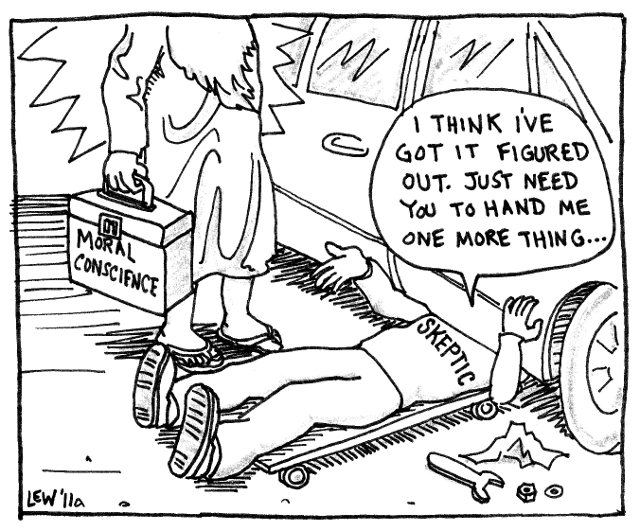
The conference theme, “To everyone an answer,” hints at the fact that outside (and within) the Christian faith are people in different states of mind, each needing to hear a different reason for the hope that is in us (1 Peter 3:15).  Some people are genuinely seeking, and some people are just angry with God.  And it was one speaker’s amusing and thoughtful flourish to ponder indeed why some atheists are angry with God.  Unicorns may be imaginary, but no one is really upset with them in their nonexistence.  So why are atheists angry with God?  Repeatedly from each speaker’s experience, I could see that despite what you can show with clear thinking and clean routines of logic, the recalcitrance of skeptics sometimes just boils down to them being hurt, broken, and emotionally unwilling.

While there are earnest seekers and angry engagers, another group that apologists can seek to address are the apathetic, or maybe what we can call the unimaginative.  My wife managed to attend a session on literature as a mode of apologetic.  And while I opted instead to sit in on a tangy session on the doctrine of Hell, I was heartened to be reminded of the role that narratives play in engaging our imaginations to receive God’s kingdom.

All told, the conference was a very encouraging and positive experience.  I will be keeping an eye out for similar opportunities in the future.

HSRA: Get stuck in traffic?

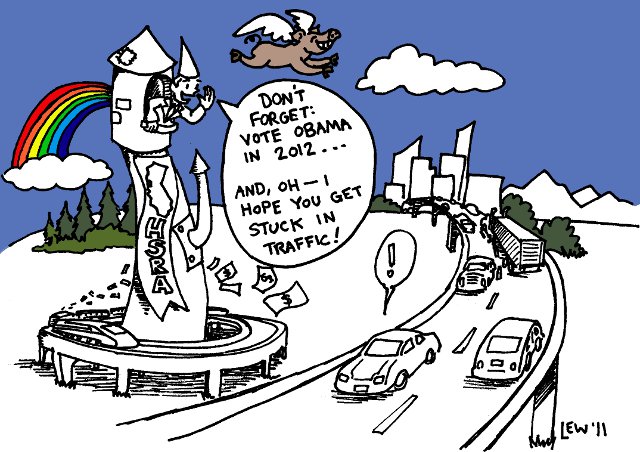
California HSRA hopes you get stuck in traffic?


The Sacramento Bee has offered us a strange, new angle on California’s budget-busting high-speed rail project.  Having interviewed the HSRA’s chair this week, they inform us that the Authority’s latest business plan hinges on a friendly Washington budget environment in the years ahead.  Basically, HSRA is betting its chips on President Obama’s re-election.  With forecasters putting his odds somewhere in the neighborhood of 50-50, isn’t this plan a little reckless?

As it is, Jerry Brown’s gimmicky budget for the current fiscal year is  well on track to trigger further cuts.  And we all know the long line of agencies begging for fiscal mercy: education, prisons, parks, sundry social services, and so on.  Given these dire straits, where will the money come from?

The global track record for high speed rail is abysmal.  These extremely capital- and labor-intensive projects don’t recoup their start-up costs, and there is no reason to believe the latest projected ridership numbers, given the stubbornness of the American Love Affair and the high level of competition airlines will bring to bear.  Train passengers might not need to stand in security lines, but the door-to-door times will be comparable, and at the end of it all they will still need to get picked up or rent a car anyway.

The funny thing about the article though is the last bit about getting stuck in traffic.  It’s not clear whether the Bee is trying to be cute, or imply something more sinister about the Rail Authority.  Even then, local traffic patterns only have partial bearing on the need for a high speed train.  When was the last time you were caught in traffic outside of Harris Ranch?

Truth in Advertising

Premiering an in-house political cartoon:

Political Cartoon: Truth in Advertising

Truth in Advertising

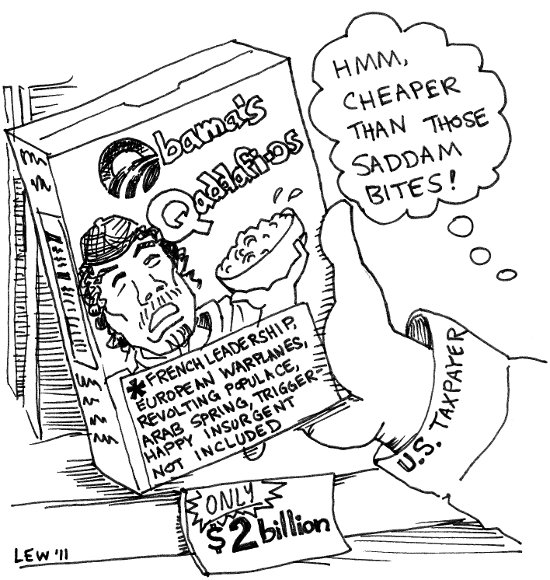
It didn’t take long after Muammar Qaddafi met his end last week for ill-conceived boasts to emerge.  And of course, they issued from deep within the biggest spin zone of our current day: the Obama White House.  Vice President Biden touted that it cost the U.S. only $2 billion to bag Qaddafi.  Not that we were after his head in the first place, right?

Such wrangling from Biden is reminiscent of the false economic paradigm everyone seems to be caught in: giving presidents too much credit for the state of the economy.  When it comes down to it, a president and even the government only have so much influence over economic performance.  The same is true for foreign affairs.  The current administration merely sent a token greeting card to the Libyan revolutionaries, and now that good weather comes their way, they take as much credit as they can grab.  But you couldn’t blame them given the current approval ratings.