Resurrecting birtherism, questioning leadership

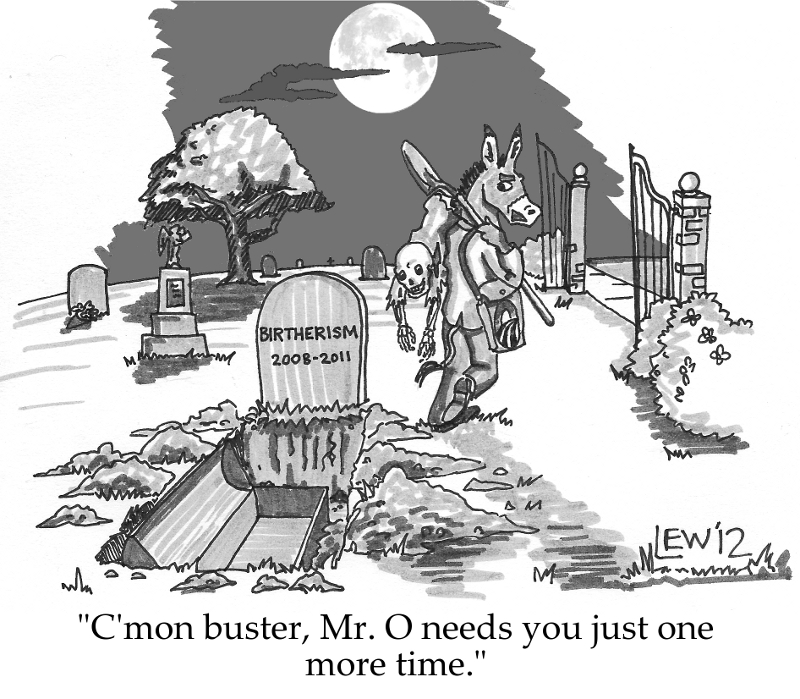
The Obama campaign resurrected the birther bogeyman this week with the release of a video questioning Romney’s ability to lead in light of his ties to Donald Trump.  This is an odd accusation coming from a president who forfeited leadership in shaping Obamacare, his crowning achievement, to his Democratic allies in Congress.  Meanwhile, his best claim as a bipartisan leader is the glorified photo-op of playing golf with John Boehner.  Much good that did.

Ed Klein’s new book, The Amateur: Barack Obama in the White House, reveals just how incapable a commander the president has been. In a recent Michael Medved interview, Klein contrasted Obama’s lack of day-to-day communication with President Reagan’s warm and regular phone calls to Democrat House Speaker Tip O’Neill. Today, Obama’s allies, to say nothing of his opponents, complain they never hear from him.  Maybe he’s been out on the links too much?

The biggest danger President Obama presents is not his race, his place of birth (Hawaii, USA) or his alien religion (secular liberalism). It’s his incompetence. This, combined with his unpopular, stubbornly-held big government liberalism, is why his campaign must constantly churn out red herrings like the birther issue.

Make no mistake.  Romney may not be the warmest character or give you leg-tingles, but his substantial experience heading up real, successful, and reputable enterprises give him a serious advantage over the incumbent, whose rock star status sheltered him and left him clueless as to how an executive should actually operate.

Prairie fire and cowpies make campfire politics

What happens when an unstoppable force hits an immovable object?  Who knows.  The more pertinent question for this past week: What happens when a prairie fire hits a pile of cowpies?

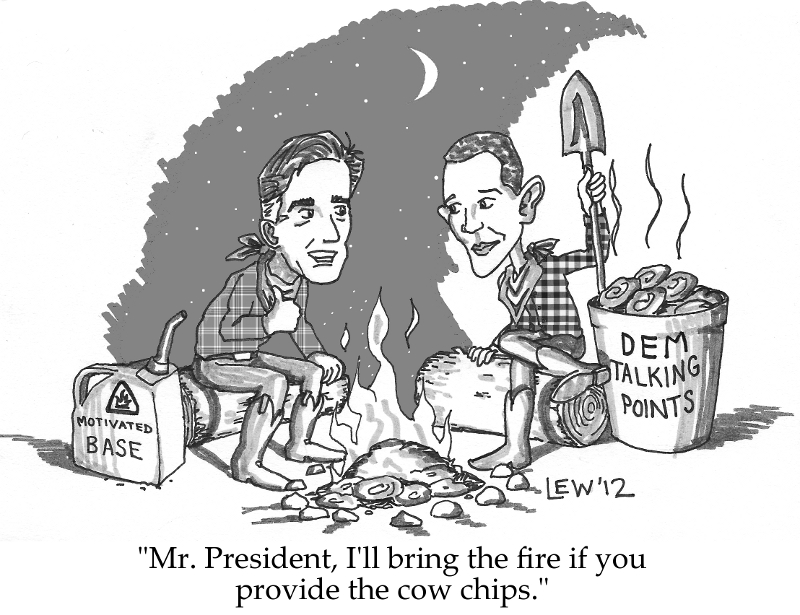
Both Mitt Romney and Barack Obama have been tweaking their rhetoric for Iowan ears.  Responding to Romney’s accusation that he’s tended over a “prairie fire of debt,” Obama has described his opponent’s criticism as a “cowpie of distortions.”  Our President continues to debase the discussion with a vulgar allusion to a steaming pile.

Meanwhile, the White House and the Left have tried to play off of the ill logic of Rex Nutting, who contended earlier this week that Obama has grown Federal deficits at the lowest rate since the Eisenhower administration.  Many observers have debunked this idea.  James Taranto put it well when he noted that Obama has treated Bush’s one year, necessary TARP swell as a baseline for subsequent years’ Federal budgets.

It’s as if you, the head of a household, assented to spending $10,000 to repair a sudden, gaping hole in the roof one year, but decided to keep spending that same extra amount for each of the three following years.  And this spending is not on other emergencies, but pet projects.  All the while, you claim to be a fiscal hawk because your spending hasn’t grown significantly since the initial boost that you approved when you first came in.

So Romney’s prairie fire claim isn’t so . . . smelly after all.  What we’re left with is a challenger with a base itching–on fire, in fact–to vote out an incumbent whose campaign and allies never seem to be in short supply of well, cowpies.  At least you can dry them out and use them for fuel.

Thoughts on San Francisco

Yesterday I visited the California Academy of Sciences in the heart of San Francisco’s Golden Gate Park.  As beautiful and therapeutic as the city’s green expanse is, folks from flyover country can’t easily forget just what an epicenter of liberalism it is either.  Less than a week after Mayor Ed Lee renamed prosaic-sounding Middle East Drive, I had the honor of seeing with my own eyes the newly-christened Nancy Pelosi Drive.

I can imagine the mayor telling the city council they would have to pass the renaming measure before they could find out what the street would be called.

Now there’s been a great ballyhoo about the U.S. Census release claiming that white babies are now a minority.  If you’re somehow concerned about this, don’t worry; all the unaccounted-for white kids can be found being pushed in strollers through the California Academy of Sciences museum.  There, they learn valuable truths, like the fact that toilet bowls do not harbor a safe supply of emergency drinking water.  Seriously though, I did enjoy exhibits like the rain forest and the planetarium show.

Like many other Americans, I drove a car to reach my Memorial Day weekend destination. Coming from the Sacramento Valley–which is worthy of the flyover country honorific in it’s own right–I decided to skip the parking lot that is called Berkeley, taking instead the scenic U.S. Highway 1/101 south.  As I passed Muir Woods, I was reminded of last year’s blockbuster remake Rise of the Planet of the Apes.  In the film’s climax, sentient apes escape a grossly distorted, Hollywood version of San Francisco, fighting authorities in a pitched battle on the Golden Gate Bridge before swinging to the freedom of Muir Woods.

What do I mean by a distorted, Hollywood version of San Francisco?  The protagonist’s neighborhood looks less like a crunched row of Victorian three-story homes than it does a line of oak-shaded tracts transplanted from the middle of Anytown, USA.  There are no hemp-adorned hippies, hat-and-beard hipsters, or any hint of Chinatown.  The film depicts no Asian-Americans save the heroine, India’s Frida Pinto.  That there would be a corporate science facility doing testing on primates in the environmentalist Mecca-by-the-bay strains viewers’ credulity.  And rather than flee before the apes, some San Franciscans would surely take to their side to hurl rocks against mounted police.

In one sense, I suppose I shouldn’t find these logical lapses strange or noteworthy.  After all, Hollywood, like much of the rest of the Golden State, is a land where make believe rules.

Why should government endorse same sex marriage?

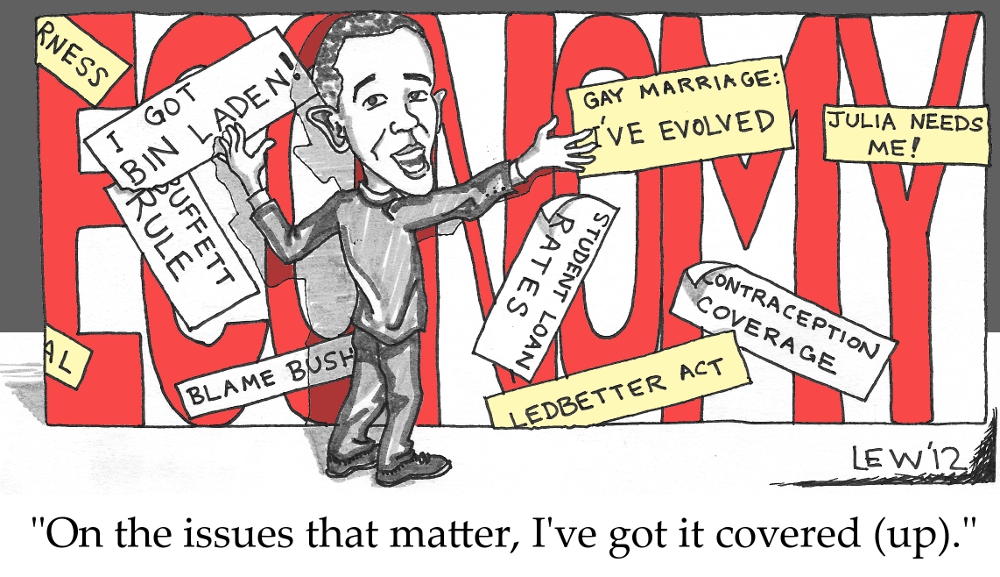
The above fictional account touches on the gimmicky raffles the Obama campaign has been using to raise money.  Small-time donors first had a chance to meet George Clooney, and now  Sarah Jessica Parker.  For Mother’s Day, there was the opportunity to win mom a tweet from the President himself.

The other issue I’ve depicted and invite you examine for the remainder of this post is gay marriage.  The tendency in the public square is to conflate cultural practice with government endorsement.  We saw this two weeks ago when some folks were upset with North Carolina’s poll but pleased with President Obama’s evolution.  If we want a lucid discourse on marriage, we need to parse the cultural practice from government endorsement.  The critical question to ask: why is this new task of endorsement—with its associated costs—necessary?

Supporters of gay marriage often say it’s a civil  rights issue, inviting a comparison to the historic plight of racial minorities.  But the gay community’s experience today is nothing like the suffering under Jim Crow.  The collective socioeconomic status of homosexuals doesn’t reflect some sort of pervasive systemic bias.  And Federal laws already protect against sexual orientation discrimination.  The relative lack of exigency is a strike against the necessity of endorsement.

Yet, through personal experience, many feel gay marriage to have the moral force of a civil rights issue.  “Equality!” is the cry.  What is government supposed to equalize: individuals or relationships?  The state certainly treats individuals differently.  Men must sign up for selective service; women don’t.  Divorcing mothers tend to win custody over fathers.  And government  justifiably treats relationships differently too:  marriages are proscribed on the basis on age, blood relation, ability to consent, or number of  partners in the relationship.  Having strong feelings about equality doesn’t make government endorsement necessary.

The question remains, why endorse?  One with an expansive view of government may say that endorsement validates or affirms the humanity of gay individuals.  But personal affirmation is not the state’s  business.  We all have God-breathed dignity in spite of what government says about us.  Dissidents living under oppressive regimes around the world know this.  It’s our patrimony as Americans to know and live this truth without such pointed help from Uncle Sam.

In opening up two weeks ago, Vice President Biden gushed about commitment and love.  But governmental recognition of marriage, which boils down to enforcing a contract, is an unsexy thing.  It’s not about feeling love or commitment.  It’s a man and woman assenting to being bound by the law, with the end of raising children well in mind.  With the contract, the couple faces an increased cost of separation, and so does the court system for that matter.  This is another reason why government shouldn’t recognize relationships it doesn’t have to.  And it doesn’t have to because same sex couples never produce children naturally, while opposite sex couples do all the time.  Simultaneously, they face pressures that would separate them from each other.  It’s a bit ignoble, but that is the human condition.

All this to say government needn’t recognize gay marriage.  In fact, the  push for recognition sends the dangerous signal that government’s role is to correct every perceived societal slight, or worse, validate our personal feelings.  Each of us should feel free to pursue any relationship or endeavor we find fulfilling.  Just keep government out of it if you’re able.

Duel of the embattled visages

You know how news websites usually have a most-read stories box.  Sometimes, the Christian Science Monitor inexplicably has an old report at the number one spot.  Earlier this week, a January story critically probing Mitt Romney’s record at Bain Capital was on top.  The lead photo struck me as over the top in conveying the anti-business tone of the article.

Christian Science Monitor

From the side, a harsh light defines the subject’s face.  Squinty-eyed, she stares off into the distance, as if in the midst of a hardscrabble existence.  We know she’s not happy.  Maybe you can imagine the photographer coaching her, “No, not quite.  Try to look a little more . . . off-put.  Turn your head just a little more to the left.  That’s it.”

The photo surely recalls an iconic image from one of the more trying times of last century.

Migrant Mother, Dorothea Lange, 1936. Wikimedia.

I wouldn’t try to question the artistic merit of Lange’s photography.  But given today’s sensibilities, to stumble upon such a spitting facsimile of her work’s form and style ought to puzzle if not disturb us.  In Lange’s time, America was reaching, in ways more benign than in other parts of the world, its own totalitarian zenith.  Government drafted artists en masse to produce, well, propaganda.  And surely, that’s what Lange’s work is: biased, and with a story to tell.  This is not bad in itself, but in our jaded, post-Vietnam, post-Iraq culture, there’s a double standard at work.

It’s routine and accepted for journalists to play up poverty as grinding.  But they can’t allow themselves to show private sector success as uplifting.  Not alarmist enough, or in tow with liberal media execs’ worldview.  When we hear or read “Bain Capital,” we expect to see grizzled profiles rather than glowing families.  Such a sustained slant is pernicious to our way of thinking, and in turn to the way we live.  At least there are those who would straighten the record.

President Obama’s off-base

The White House’s campaign messaging has been all over the place in recent weeks.  And contrary to his 2008 promise, the President has come off as more of a divider than a uniter.  Not to be confused with President Bush, who was mocked for proclaiming himself the “Decider.”

The Obama team’s trail of message wreckage started with February’s awkwardly handled contraception mandate work around, which, for all the trouble, still leaves some religious organizations paying indirectly for services they find unconscionable.

Then, erupting inconveniently last week was President Obama’s personal “evolution” on gay marriage. Many observers saw the President’s hand forced by discretion-challenged Vice President Joe Biden.  What’s most vexing about this iteration of the marriage debate is not the particular stance taken, but the justification as to how one arrives there.  Biden baffled us all with the idea that the 1998-2006 sitcom Will and Grace was for him some pivotal, moral tour de force.

As one poll shows, Obama and company seem to have alienated swing voters on the social issues.  But  they have tried mightily to boost their standing with female voters, trumpeting the 2009 Lilly Ledbetter Fair Pay Act as a great and early first term accomplishment.  All the act does is give women more time to sue their bosses for the phantom menace of wage discrimination–a boon for Democrat’s loyal base of litigious attorneys.  Touted as historic and consequential, the act is only known because the Obama team has dusted it off as a showpiece for the 2012 campaign.

Indeed, the Ledbetter Act featured prominently as part of the Life of Julia, a fictional every-woman whose slideshow biography was quickly and widely ridiculed for its earnest portrayal of a hopelessly lonely, overly dependent, Obama-centered life.  Rather than making the conventional, family-oriented “Harry and Louise” kitchen table-type pitch, The Life of Julia deliberately caters to the fervent, perennially disaffected fringe that is Obama’s base.

To see just how hard the Campaigner-in-Chief has tacked toward those who self-identify as embattled and aggrieved, we need only look to the recent “dueling” commencement speeches delivered this past week.  Conservative commentator Michael Medved noted that of all the colleges in the country he could have spoken at, President Obama chose the elite, astronomically expensive Barnard College.  His audience at the women’s liberal arts college was a particularly concentrated sample of privilege: women now far surpass men in educational achievement by the numbers, from undergraduate enrollment to attainment of advanced degrees.  Yet, the faculty and students were ebullient when the President was introduced as one who appointed so many women and minorities to the highest offices.  Meanwhile, Mitt Romney’s receptive audience at Liberty University, with its larger student body and more affordable tuition, was a far more representative cross-section of America, on the socioeconomic level not to mention anything of gender representation.

The White House has garnered a few days’ media attention on other issues: “spiking the football” at the anniversary of Osama bin Laden’s death, and the economic distractions of the Buffett Rule and the student loan rate relief.  The former was no help to the incumbent, with liberal Arianna Huffington calling one Democratic campaign spot “despicable.”  The paltry Buffett Rule captures more class resentment votes than it would actual marginal revenue from the wealthy.  Likewise, the playing up of the student loan rate extension nakedly caters to the college age vote, while dangerously distorting market decisions about the relative value of earning a degree.

All told, the President seems pretty set on stoking his base with the visceral fuel of social, class, and identity politics.  Meanwhile, substantive solutions for the economy, as well as the sensibility of swing voters, remain neglected.  Sending Biden around with the fib that he’s working class will only go so far.  We’ll see in the months ahead if the Obama team can refocus, or if Romney, sticking to the economy and clearly rising, can build and maintain a respectable distance.  Let’s hope so for our country’s sake.


The immorality of sit-ins, hunger strikes, and other protests

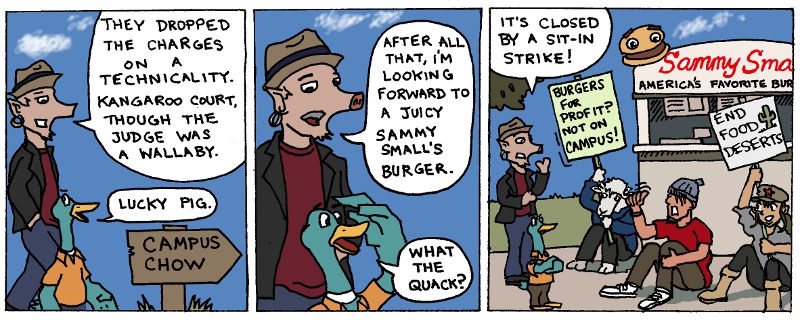
This latest comic is inspired by two anti-business movements in the Sacramento area.  In April, activists petitioned Sacramento’s city council to block a McDonald’s from opening in the midst of what some would term a “food desert.”  This followed on the heels of a January through March sit-in strike that successfully closed the U.C. Davis branch of U.S. Bank.  Both campaigns were driven by a misguided desire to narrow free market choices available to the community.

While these kinds of paternalistic projects are at odds with the values of free choice and personal responsibility, at least the anti-burger campaign was conducted within the limits of the local political process.  But the anti-bank sit-in demonstrates the widespread and reckless abandon with which too many progressive protesters pursue their cause today.

It’s common and commendable to ask if the ends justify the means.  The anti-U.S. Bank campaign is a clear case where neither the ends nor the means are justified.  In blocking physical access to the bank, members of Occupy UCD actively prevented customers and employees from engaging in mutually beneficial commercial transactions.  Such stunts that diminish the legitimate choices of others are a real threat to freedom.

The university administration, perhaps still reeling from November’s pepper-spray incident, was complicit in its failure to remove the blockaders.  Now, U.S Bank is suing the campus for breach of contract because its police did not effectively enforce an ordinance barring people from blocking public spaces.  On top of $2 million+ lost in future rent and revenue sharing, U.C. Davis stands to shed additional dollars fending off the suit.

By allowing those with gut-felt convictions to run roughshod over the rule of law, the administration betrayed the civil society it claims to honor and cherish.  In an even greater let down, Seattle Mayor Mike McGuinn allowed a large, organized, and anonymous mob of masked “black bloc” protesters to smash  numerous store front windows on May 1.  Among the infamous moments captured was the hypocritical smashing of a Niketown window by a Nike shoe wearer.

The solipsistic morality that drives most protest should give us all more pause than it does.  Besides actions that violate others’ rights of movement or property, there are protests of self-inflicted harm.  Consider the multiple self-immolations that ignited the Arab Spring last year.  Or, look at the not-so-fatal hunger strike.  This act of protest is way overrated.  It’s akin to terrorism in that the protester threatens violence if the target of coercion refuses to grant the demand.  The only difference is that the protester supplies his own body for the violence rather than that of a hapless victim.  Self-sacrifice is warranted for ends like saving children in a burning building, but harming oneself to coerce another is as immoral as harming others.

When protesters stop respecting the rights of others or even the value of their own bodies, civilization takes a step backward.  Rather than romanticize protest, which devolves to a gut appeal, our culture should uphold the truly constructive engagement that arises from our more measured, non-coercive political and economic processes.

Paul Ryan, Ayn Rand: Can a brother shrug?

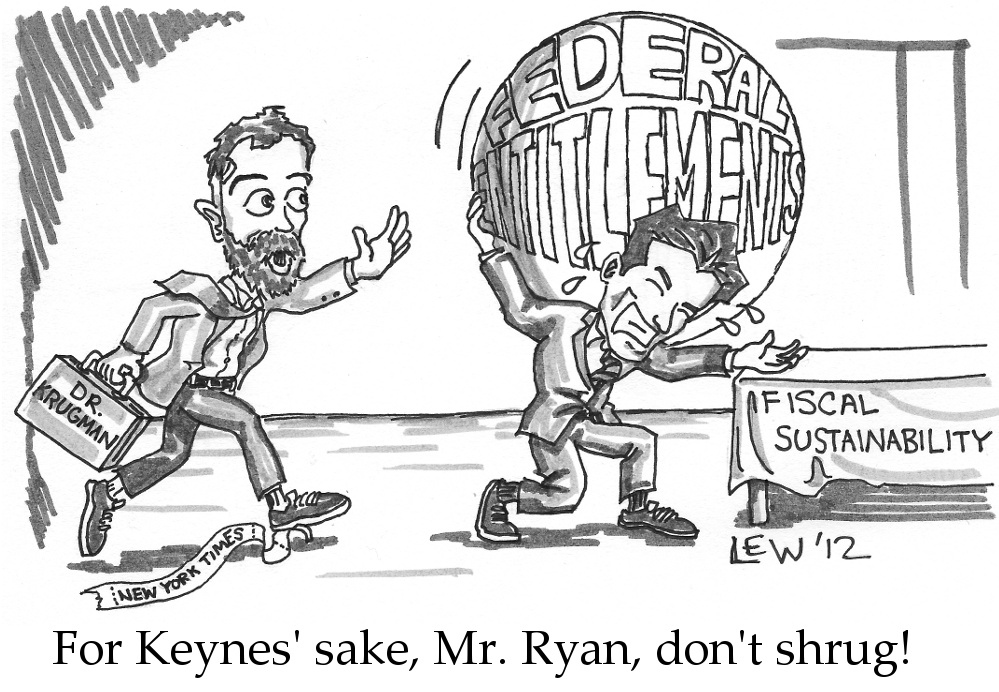
In the past few weeks, Paul Ryan has been the prime bogeyman of liberals and progressives.  His proposed Federal budget plan trims entitlement growth more than Democrats would like.  Supreme Keynesian Paul Krugman has accused Ryan, a father of three from Wisconsin, of being an Ayn Rand fanatic.  The Congressman has played down his affinity for Rand’s egoistic philosophy of Objectivism.

Liberals’ groaning over Ryan intensified after he delivered a policy speech at the Catholic Georgetown University last week.  Here he hoped to justify his policy decisions in terms of a personal understanding of his Catholic faith.  Invoking church doctrines creatively and boldly, he suggested that the moral obligation of solidarity with the poor might best be served by a prudential application of subsidiarity.  In layman’s terms, our society can help the poor better by learning from history and subsequently devolving aid responsibility from the highest offices of power to the smallest practicable unit.

Ryan’s speech was thoughful and provocative, but perhaps too threatening to the Georgetown faculty’s belief that Catholic social teaching is an automatic endorsement of unmitigated big government.  Ninety of the school’s faculty signed and sent Congressman Ryan a scathing epistle rebuking and encouraging him to bone up on the doctrines he cited.

So recently, Ryan has aggrieved his fellow parishioners and has been linked with one of the grumpiest, most selfish atheists of yesteryear.  Is he just a glutton for punishment?  No. If we heed Mr. Ryan’s call to look at history and experience, we’ll find that his Christian faith and Rand’s Objectivist philosophy furnish common ground for resisting America’s decades-long progressive drive toward cultural and fiscal oblivion.

In Ayn Rand’s most influential work, Atlas Shrugged, we get to see a worldview shaped by the author’s firsthand experiences of two historic catastrophes: Russia’s Bolshevik revolution and America’s Great Depression.  The first impressed her with man’s capacity for coercion, and the second his capacity for incompetence.  And it’s this second lesson that remains pertinent to us today.

We can trace the more salient markers of the the progressive quest for social equity: FDR’s New Deal entitlements of the 1930s, Lyndon Johnson’s Great Society of the 1960s, and lately, Barack Obama’s budget-busting program expansions.  The unending accretion of altruistic programs has done more harm than good.  We’re saddled with triplicate and quadruplicate bureaucracies that don’t produce results.  A little empirical evidence demonstrates just how ineffective Federal social programs have been for the past half century.

Progressivism, the worldview that drives the long leftward march, prefers central planners to do the thinking of everyday life rather than families or individuals. The result of such a society is what Rand’s Atlas warns against: a world where people exchange the virtues of thought and creativity for pity and manipulation.  Among the classifications she assigns to the degenerate denizens of the Atlas world: “moochers” and “mystics.”  People who’ve stopped working and stopped thinking.

It’s in vigilance against such a fate that Christians share with the Randian cause.  Apologist and philosopher J.P. Moreland warns us against the sensate society, where people make decisions less with their brain and more with their gut.  One of the central truths about humanity is that each of us bears Imago Dei, God’s image.  We resemble him in our ability to reason and to create.  Even these two activities are at the core of Ayn Rand’s Nietzschean pursuit of existential necessities.

How do we turn back from a world where centralization has elevated entitlement and choked out incentive?  Atlas only offers the dramatic cataclysm of a Capitalists’ strike.  But fortunately, in the real world, Congressman Paul Ryan encourages us all to re-think our march off the cliff of uncritical, state-driven altruism.  If we can get around the Left’s pipe dreams, maybe America can jettison the vice of entitlement and recapture the values of reason and creativity.  Then we will have a truly compassionate and just society.

In light of abundance

I caught this Facebook conversational snippet originally as another reblog. I talked about it briefly with my wife, which yielded some clarification. That’s more oft the result than not :-)

(Update: for your convenience, here’s the conversation from the original blogger.  Pardon the language.)


The literal devil’s advocate here has mistakenly assumed that Satan gave humans our moral and rational faculties. But I think God created Adam and Eve with those faculties already in place.


William Lane Craig recently defended the Abundance theory of creation on his Reasonable Faith podcast. According to this idea, God created man to extend the opportunity to partake in the kind of loving relationships that the persons of the Trinity were engaged in. And in order to love, you need some sort of ability to make moral choices.

Indeed, God’s mandate to not eat from the tree of knowledge of good and evil precedes the snake’s challenge of temptation.

And inasmuch as the the snake was able to persuade Eve through words to eat the fruit, she must have had some pre-existing rational faculty.

So Satan did not usher in for man the ability to think critically or know right from wrong. What he did do is help humanity commit it’s first sin, it’s own act of rebellion.

With the fruit eaten, man’s overall knowledge did grow. But not all knowledge is equally helpful for persons to know. Some truths are quite damaging to our souls.


D’Souza strikes (out again) on problem of evil

Dinesh D’Souza was on Michael Medved’s radio show a couple of weeks ago, promoting his new book God Forsaken.  From the unabridged (and unwieldy) title of the work, you’ll see it’s intended as something of an apologetic on the problem of evil.  Normally, I’d be positively inclined toward such a volume. But in the course of the interview, I found myself taking exception on a couple of counts.

The first foul stems from the author’s missed opportunity to affirm one of the most basic tenets of the Christian worldview.  Medved, the host, asked D’Souza and the call-in audience, “Why do bad things happen to good people?” A serious Christian theist can’t dance for long around that question before issuing the clarifying rejoinder: “Who is good?”

Indeed, Paul’s letter to the Romans makes it clear “all have sinned and fall short of the glory of God.”  It baffles me that D’Souza, a prominent defender of Christianity, could talk of how “bad things happen” without saying that God does not owe sparing us the consequence of our rebellion.

So then how does D’Souza sell his book in the course of a commercial radio hour?  On the oversubscribed basis of pop science and pop psychology.

Uninterested in traditional theodicy, that is the defense of God’s existence in light of evil, he tries to get people on board with God’s existence by a cursory dismissal of the New Atheists.  He explains away their fervor with a back-of-the-napkin psychoanalysis of the late Christopher Hitchens’ unpleasant childhood.  For all we know, psychology may play a major role in the New Atheist community, but the interviewee seems to lack the tact to avoid a borderline ad hominem attack.

Interestingly enough, Mr. Medved had previously been skeptical of D’Souza’s earlier work, The Roots of Obama’s Rage.  In one sense, that whole book was a pop psychology ad hominem writ large.

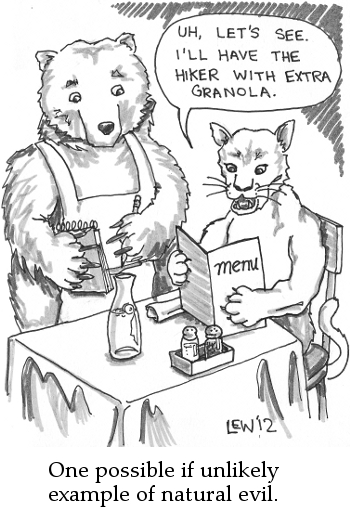
Back to the interview.  Once D’Souza establishes that God exists but people are just angry at him, he moves to science, suggesting that certain findings justify the necessity of natural evil, as distinguished from man-made evil.  That means chance calamities like earthquakes and disease, rather than suffering that results from human volition.  So as chilling as they are, mountain lion attacks must be racked up as natural evil.

With this focus on science, the author makes some nifty declarations: life on Earth couldn’t develop without plate tectonics.  If we couldn’t face the consequences of defying gravity, we wouldn’t have true free will.  But these kind of arguments don’t persuade materialistic determinists or skeptics inured to the anthropic principle.  Especially not after you’ve insulted them.

In an hour of radio, the author manages to insult atheists, avoids affirming the fallenness of man, indulges popular appeals to science and psychology, and fails to offer substance for the weighty question of evil.

Yes, he is a former fellow of the Hoover Institution, and the current president of The King’s College in New York City.  And the respectable Evangelical biographer Eric Metaxas gives glowing praise for God Forsaken, so the book may not be a wash.  But considering his previous sketch on Obama, his radio interview, and his second-place finish in last year’s Intelligence Squared debate, I have some doubts as to whether Mr. D’Souza is an effective apologist for Christians or the American Conservative movement.

Good public discourse is not built on sensational psychology or svelt scientific findings.  Whether it’s Dinesh D’Souza or Richard Dawkins answering life’s big questions, we deserve from them solid epistemology and a coherent metaphysics.  We shouldn’t expect less from our top-shelf minds.