Mourdock’s “God intends” comment; or, Much ado about sovereignty

A new abortion/rape gaffe broke out this week, this time from Republican senate candidate Richard Mourdock.  His offending words:

I came to realize that life is that gift from God. And, I think, even when life begins in that horrible situation of rape, that it is something that God intended to happen.

As with an earlier comment by fellow GOP senate candidate Todd Akin, unmitigated outrage poured from certain corners.  But Amy Sullivan, at The New Republic, is to be commended for at least taking some time trying to see through the liberal cloud of anger.

Sullivan is charitable and sympathetic to Christians of various stripes.  But clearly, her beliefs about God are not orthodox.  And like the anthropologist who reported with amazement on a strange tribe called “Evangelicals,” she’s addressing an audience to whom the basic tenets of Christianity are alien and confounding.

We see this most clearly in her disagreement with “the understanding of God as an active, interventionist deity.”  She also believes that Christians often misread scripture, in a way that leads to frustration at God’s unfilled promises.  Now this is a valid observation and an appropriate concern.  We’d do well to heed apologist Greg Koukl’s advice, “Never read a Bible verse.”  The implication is to not read a verse in isolation by itself, but in context, including with an appreciation for the genre of literature being read.

Sullivan illustrates her concern using part of Jeremiah 1:5 where God states, “Before I formed you in the womb, I knew you.”  Her take is that God is describing his own intention as specific to Jeriamiah alone, and that Christians are applying it, without warrant, to their own lives as well.

Later in the piece, she challenges the idea of a sovereign God who is strongly concerned with each of his created beings, proclaiming “it is hard to square this interpretation of Jeremiah 1:5 with miscarriages or stillbirths or fatal birth defects.”  This is leaning hard on the problem of natural evil.

But on Christian orthodoxy, it is true that God “loves you and has a plan for you” despite any natural evil that may befall “you.”  And surely, bodily death will befall us all, whether in the womb or after a century of walking around on this Earth.  At least, God’s salvific intent is clear when Jesus speaks to a broader audience of the shepherd who leaves 99 sheep to find the one (Matthew 18:12-14).

Still, there are those who can’t reconcile that “God intends” much of anything given the fact of evil.  Take Open Theism.  On this view God is winging it, with no certainty of how things will wrap up in an eschatological sense.  But holding this belief robs the Gospel of its power.  Despite God trying his best, Christ’s faithful might still end up in Hell, or ultimate justice might go undone.  We might as well be Vikings stoically anticipating the defeat of the gods.  Contrary to this, we know better as to what “good news” is supposed to mean.

A strongly sovereign God is much more consistent with the Christian message than a weak God who either doesn’t care or isn’t able to act on evil.  Simply combining God’s omniscience and perfect benevolence means he does know each of us in the womb, and has a positive intention for each of us.  It may not be what Aunt Edna saw in her quiet time last Tuesday, but surely, it’s there.

Sullivan’s dismissal of the classically sovereign God paves the way for her pro-choice policy view.  She’s entitled to that view.  But to chalk the orthodox understanding of God up to a widespread, long-running exegetical error seems incredible given the moral stakes.

The authority of science

Cosmologist Sean Carroll garnered considerable buzz recently with his contribution to the Blackwell Companion to Science and Christianity.  Launching off of an interview with Carroll, LiveScience made a big splash with the headline: “Will Science Someday Rule Out the Possibility of God?”

A few days later, an AP story mined societal anxiety about growing fraud in science.  And in the year-end issue of my local university campus newspaper, the science columnist made an earnest and zealous attempt to distinguish scientific “education” from religious “indoctrination.”

Examining the language and underlying assumptions in popular science writing reveals an often narrow and uncritical school of thought that has an outsized, unwarranted, and perilous grip on our culture.

Let’s start with the LiveScience article on Sean Carroll.  If we take it seriously, and try to discern from its own contents whether science will “rule out the possibility of God,” we’ll be disappointed to find only an abundance of ungrounded suppositions and a string of logical fallacies.

The surest presupposition that pops up is a philosophical hard naturalism or materialism.  It is simply assumed that the natural world or matter/energy are all that is.  Accordingly, only “domains of science” are considered serious fields of inquiry.  “Theologians,” to say nothing of philosophers, are cast as attempting to “seize upon” as yet-unanswered sticky points and rhetorical flips.

A deeply rational theist like William Lane Craig–a cosmological rock star of sorts–couldn’t get billing in a pop science piece like this.  To do so would turn off those readers who’ve placed faith in science’s ability–given enough time–to answer everything; a faith in science-of-the-gaps if you will.

Folks like Carroll and LiveScience offer succor for those who hope to  ignore any kind of truth that is not empirically derived.  But there are non-empirical truths each of us take for granted everyday.  There are properly basic beliefs, such as the belief that one did not spontaneously come into being five minutes ago with memories implanted to give the false impression of living prior to that time.

And individuals have faculties beyond the senses.  The faculty of morality comprehends objective moral truths, and the faculty of reason allows one to know “A” is not identical to “not A.”  These ways of knowing reside entirely outside the “domain of science.”

Yet, science writing subsists on a de facto “verificationism,” a trust only of propositions that can be empirically verified.  Of course, the foundational proposition of verificationism fails its own test.

On top of naturalism and verificationism, the LiveScience writer treats theories like the multiverse as settled matters rather than metaphysical conjectures.  This kind of assumption thrives in columns that can’t take the space to unpack the ideas they reference.

And then there are the fallacies in the article.  Consider this passage:

Other versions of quantum gravity theory currently being explored by cosmologists predict that time did start at the Big Bang. But these versions of events don’t cast a role for God either. Not only do they describe the evolution of the universe since the Big Bang, but they also account for how time was able to get underway in the first place. As such, these quantum gravity theories still constitute complete, self-contained descriptions of the history of the universe.

This passage is simultaneously a tautology and an appeal to authority.  Notice cosmologists must “cast a role” for God.  The theory cannot escape the constraints of the theorist’s inborn bias.  And for the writer to qualify the theories “as such” only  undermines the idea the theories are actually “self-contained.”

As the piece progresses toward its end, the stubborn question of ultimate meaning is dismissed as a failure to see the universe itself as unique and not in need of an answer.  But Carroll offers no real reason beyond a lyrical twist.  Dr. Craig likens this cessation of reason to the taxicab fallacy: once the questioner reaches his destination (that God is not required), he dismisses the cab of critical inquiry, namely by abandoning the principle of sufficient reason.

There is an attempt to invoke the testimony of a psychologist to explain away religious phenomenon as arising out of psychological need.  This is classic genetic fallacy.  How one might come to have a belief has no bearing on the truth of the belief.

The consequences of letting such suppositions and fallacies thrive in the thought life of scientists and their admirers are considerable.  Look at The Aggie‘s piece on education and indoctrination.  The author fills a column with generalized disdain for the excesses of “evangelical religion,” perhaps not realizing that he is harboring a zeal equally in need of its own justification and defense.

A remarkable irony emerges when the columnist pegs “indoctrination” to Western culture.  It was in large part the values of Western Antiquity and the Bible that supported the critical thinking needed to produce modern science.

The collegiate composition is alarming in its take away that “Religion has no place in schools, and science has no place in churches, synagogues or mosques . . .”  This reminds of the woefully dismissive bumper sticker that reads, “I won’t think in your church if you don’t pray in my school.”  Simply a false dichotomy.  Sometimes it’s the laboratories and the halls of the academy that could use a little more critical thinking.

The Aggie column concludes with a call for an education that will produce “un-indoctrinated” citizens.  Here we have the error of Locke, that humans are tabula rosa and there is some pure Science that can properly inform the citizen.  The prescription also bears a whiff of the tyranny of tolerance.  All ideas are equally valid except the one that proposes to be true to the exclusion of others.  As with verificationism, it’s a paradigm that defeats itself.

We are in an age where science is upheld, unrealistically and with poor justification, as some final arbiter of knowledge.  Though some think we live in a postmodern society, the underpinning beliefs are still very modern indeed.  Just looking back to the twentieth century, we know all too well the tragedies modernity begot: eugenics, gulags, genocide, rampant pollution, spiritual alienation.  What a downer.

But the search for hope is unyielding.  Like a hokey Star Trek episode, the LiveScience article concludes by waxing lyrical, quoting an evolutionary psychologist: “We’re not designed at the level of theoretical physics.”   Not even a scientist can avoid language invoking the agency of a creator.  He goes on to say that things like interpersonal relationships are what matter on the “human scale.”

Is there some grand, unifying worldview that best satisfies questions both on the cosmological and the “human scale?”  Look no further than the many ready witnesses who make a reasoned, coherent and consistent case for a God who is revealed in the Bible and intervenes decisively in human history in the person of Jesus of Nazareth.

In light of abundance

I caught this Facebook conversational snippet originally as another reblog. I talked about it briefly with my wife, which yielded some clarification. That’s more oft the result than not :-)

(Update: for your convenience, here’s the conversation from the original blogger.  Pardon the language.)


The literal devil’s advocate here has mistakenly assumed that Satan gave humans our moral and rational faculties. But I think God created Adam and Eve with those faculties already in place.


William Lane Craig recently defended the Abundance theory of creation on his Reasonable Faith podcast. According to this idea, God created man to extend the opportunity to partake in the kind of loving relationships that the persons of the Trinity were engaged in. And in order to love, you need some sort of ability to make moral choices.

Indeed, God’s mandate to not eat from the tree of knowledge of good and evil precedes the snake’s challenge of temptation.

And inasmuch as the the snake was able to persuade Eve through words to eat the fruit, she must have had some pre-existing rational faculty.

So Satan did not usher in for man the ability to think critically or know right from wrong. What he did do is help humanity commit it’s first sin, it’s own act of rebellion.

With the fruit eaten, man’s overall knowledge did grow. But not all knowledge is equally helpful for persons to know. Some truths are quite damaging to our souls.


D’Souza strikes (out again) on problem of evil

Dinesh D’Souza was on Michael Medved’s radio show a couple of weeks ago, promoting his new book God Forsaken.  From the unabridged (and unwieldy) title of the work, you’ll see it’s intended as something of an apologetic on the problem of evil.  Normally, I’d be positively inclined toward such a volume. But in the course of the interview, I found myself taking exception on a couple of counts.

The first foul stems from the author’s missed opportunity to affirm one of the most basic tenets of the Christian worldview.  Medved, the host, asked D’Souza and the call-in audience, “Why do bad things happen to good people?” A serious Christian theist can’t dance for long around that question before issuing the clarifying rejoinder: “Who is good?”

Indeed, Paul’s letter to the Romans makes it clear “all have sinned and fall short of the glory of God.”  It baffles me that D’Souza, a prominent defender of Christianity, could talk of how “bad things happen” without saying that God does not owe sparing us the consequence of our rebellion.

So then how does D’Souza sell his book in the course of a commercial radio hour?  On the oversubscribed basis of pop science and pop psychology.

Uninterested in traditional theodicy, that is the defense of God’s existence in light of evil, he tries to get people on board with God’s existence by a cursory dismissal of the New Atheists.  He explains away their fervor with a back-of-the-napkin psychoanalysis of the late Christopher Hitchens’ unpleasant childhood.  For all we know, psychology may play a major role in the New Atheist community, but the interviewee seems to lack the tact to avoid a borderline ad hominem attack.

Interestingly enough, Mr. Medved had previously been skeptical of D’Souza’s earlier work, The Roots of Obama’s Rage.  In one sense, that whole book was a pop psychology ad hominem writ large.

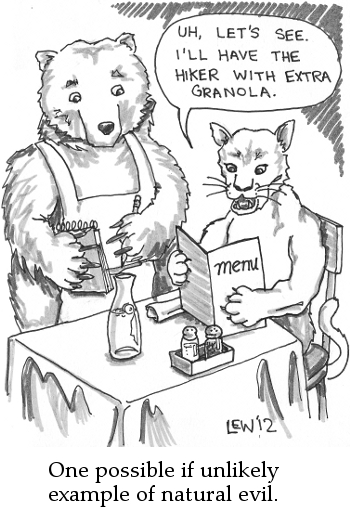
Back to the interview.  Once D’Souza establishes that God exists but people are just angry at him, he moves to science, suggesting that certain findings justify the necessity of natural evil, as distinguished from man-made evil.  That means chance calamities like earthquakes and disease, rather than suffering that results from human volition.  So as chilling as they are, mountain lion attacks must be racked up as natural evil.

With this focus on science, the author makes some nifty declarations: life on Earth couldn’t develop without plate tectonics.  If we couldn’t face the consequences of defying gravity, we wouldn’t have true free will.  But these kind of arguments don’t persuade materialistic determinists or skeptics inured to the anthropic principle.  Especially not after you’ve insulted them.

In an hour of radio, the author manages to insult atheists, avoids affirming the fallenness of man, indulges popular appeals to science and psychology, and fails to offer substance for the weighty question of evil.

Yes, he is a former fellow of the Hoover Institution, and the current president of The King’s College in New York City.  And the respectable Evangelical biographer Eric Metaxas gives glowing praise for God Forsaken, so the book may not be a wash.  But considering his previous sketch on Obama, his radio interview, and his second-place finish in last year’s Intelligence Squared debate, I have some doubts as to whether Mr. D’Souza is an effective apologist for Christians or the American Conservative movement.

Good public discourse is not built on sensational psychology or svelt scientific findings.  Whether it’s Dinesh D’Souza or Richard Dawkins answering life’s big questions, we deserve from them solid epistemology and a coherent metaphysics.  We shouldn’t expect less from our top-shelf minds.

Univocal language

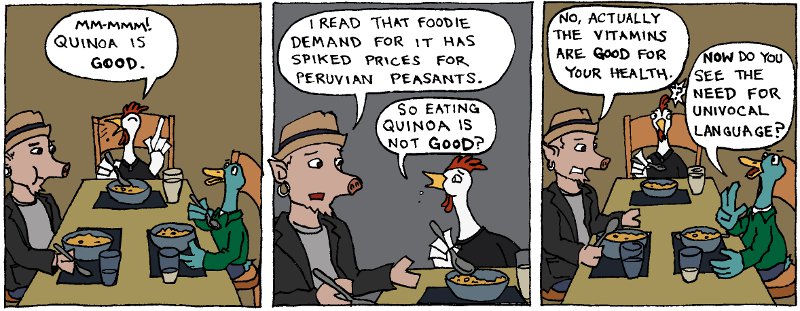
In recent episodes of his Reasonable Faith podcast, William Lane Craig hits hard at physicist Laurence Krauss’s assertions that the universe came from nothing.  It turns out Krauss’ “nothing” is basically vacuum space filled with a sea of crackling energy.  Among other things, it has properties regarding stability of decay and the potentiality of begetting matter. But anything with properties and states of potentiality, even if devoid of matter, is not nothing! This is not the first time a naturalist has deployed a definitional bait-and-switch in the hope of dispatching the annoyingly transcendent Deity.  Each time Dr. Craig refutes these kind of metaphysical transgressions, he reminds us of the necessity of univocal language; that is, the importance of using words whose meanings do not change from one sentence to the next.

One arena that could benefit from this clarity of meaning is the question of rights.  Last month, Greg Koukl highlighted on his radio show a string of stories illustrating the tragic trajectory of human rights.  First, he reported this BBC this headline: “Dolphins deserve same rights as humans, say scientists.”  And then followed the cetacean saga where PETA sued Sea World under the premise that the 13th amendment, protecting against slavery, applies to killer whales.  The thread linking these stories is the desire to assign legal personhood on the basis of what Koukl called functionalism.  When a living being achieves a certain functionality, say certain brain wave complexity, then it deserves rights and protection.  The flip side is that some beings, like human fetuses, may not attain to the criteria, depending on who assigns them.  Koukl illustrated the case powerfully with reference to the recent Journal of Medical Ethics article on “after-birth abortion.”

Without an objective grounding to our moral values, there is total confusion as to rights.  Are they really human rights, or are protections conferred only when certain experts declare personhood?  Can Flipper and Koko the gorilla come along for the ride?  It’s complicated enough just in the realm of Homo sapiens.  Justice Ginsberg, much to her discredit, isn’t on the same page as the rest of us when it comes to human rights.  It seems on her view that the year your constitution was written has considerable bearing on how good it is.  And then, there is the obfuscation that comes from sensational media train-wrecks, as we’ve seen with the privileged, 30-year-old Georgetown law student and rising victimhood star Sandra Fluke.  Fortunately, there are still those who can elucidate the absurdity of when rights go too far.

Whether we’re talking about the origin of the cosmos or the foundation of human rights, or just wondering if “quinoa is good,” our debates and discussions will be much smoother when we use our terms univocally.

Destiny without Deity

Like lots of folks last week, I invested a bit of time looking for a good Valentine’s Day Card to give my beloved.  Whether for a birthday or some other occasion, I’m always dismayed by the selection of cards in the store.  For the most part, they alternate between mildly profane and unbearably saccharine.

I did manage to find an agreeable V-Day card.  However, another card happened to catch my attention.  It was one of those sappy ones, but different; a card that wanted to retain a sense of romantic destiny without tipping a hat to deity. I don’t remember it verbatim, but in essence, it read something like this:

“I am in awe of a universe that put the two of us together, and even more so that it knew I needed someone who could put up with me.”

It was a striking example of two powerful but opposing forces at work in the human mind. On the one hand, the propensity toward awe, and on the other, the conspicuous denial of whom that awe is owed to. What does it mean to be in awe if not to acknowledge the masterful work, power, or fury of a willing agent?

And describing a universe that knows something about the couple beforehand not just implies intelligence, but borrows from a sense of divine providence. It shouldn’t have been a big deal for the card to just say “God” instead of “universe.”  Even a pantheist could be happy with “God” wording; on such a metaphysical view, God is the universe.  So maybe the card maker was trying to be inclusive of an acutely irreligious clientele.  Whatever the reasoning, the consumer is confronted with an inconsistent sentiment on the card shelf.  Our material universe cannot be owed awe or have foreknowledge.

The late pastor and apologist Francis Schaeffer gave us a potent tool for making sense of this inconsistency in his concept of the upper story and the lower story. Imagine human knowledge as being contained in a two-story house. On the lower story, we have truths about the material world: what we can learn through empirical inquiry and science. The facts formed from the observation of physical phenomena do not support any normative end in themselves.  Even with them, we find ourselves asking, “How now shall we live?” We somehow must find those answers in the upper story, where morality and meaning reside.

On a pre-modern worldview, which allows the possibility of the supernatural, we can ascend a staircase that connects the lower and upper stories.  But with the Western Enlightenment came modernity.  Strict naturalistic presuppositions disallowed any real connection between the two stories.  On this materialism, there was no effective way to indict evils like the Nazi holocaust or European colonialism.  So postmodernism launched in an attempt to recover some sense of meaning for humanity. Yet, its claims on meaning and morality are only a “leap” of faith from the first to the second story.  It doesn’t even want to affirm any real logical connection.  Only an objective supernatural reality can ground true morality and purpose.

Without the supernatural, all our sentiments are empty.  That we picked out a nice greeting card and some flowers becomes a matter of simply going through the motions. There are still philosophers, like Luc Ferry, who suggest that we ground our meaning in the frame of reference of our fellow human beings.  But if matter is all there is, to speak of meaning as if were something real becomes itself incoherent.  Anyone who harbors such a worldview must come to terms with the idea that nothing can inspire awe, and that there is no path of destiny you can embrace. Thank God this is not actually the case.

The problem with the problem of evil

The Problem with the Problem of Evil

While the pepper spray controversy was causing much consternation, there was a brighter side to last weekend: the 10th annual Evangelical Philosophical Society Apologetics Conference in Berkeley.  Imagine that I went to that shining city on a hill to escape the hotbed of political activism that was Davis!

This was the first apologetics conference I ever attended.  My wife and I were very excited to see Dr. William Lane Craig speak on Hawking and Mlodinow’s book The Grand Design.  But Dr. Craig was only one of many noteworthy speakers, most of whom I might have heard of but was not too familiar with.  Dallas Willard set the right tone for the weekend, reminding us of the spiritual context in which we pursue knowledge.  J.P. Moreland gave us a good historical sketch of the recent intellectual life of the Church, consistent with what I have read in Love Your God with All Your Mind.  Craig Hazen was very personable as the conference emcee and plenary speaker.  And to cap it off, Greg Koukl managed to speak pointedly yet uphold the value of civility in expounding on “The Intolerance of Tolerance.”  All the speakers were winsome, thoughtful, and inspiring.

The conference theme, “To everyone an answer,” hints at the fact that outside (and within) the Christian faith are people in different states of mind, each needing to hear a different reason for the hope that is in us (1 Peter 3:15).  Some people are genuinely seeking, and some people are just angry with God.  And it was one speaker’s amusing and thoughtful flourish to ponder indeed why some atheists are angry with God.  Unicorns may be imaginary, but no one is really upset with them in their nonexistence.  So why are atheists angry with God?  Repeatedly from each speaker’s experience, I could see that despite what you can show with clear thinking and clean routines of logic, the recalcitrance of skeptics sometimes just boils down to them being hurt, broken, and emotionally unwilling.

While there are earnest seekers and angry engagers, another group that apologists can seek to address are the apathetic, or maybe what we can call the unimaginative.  My wife managed to attend a session on literature as a mode of apologetic.  And while I opted instead to sit in on a tangy session on the doctrine of Hell, I was heartened to be reminded of the role that narratives play in engaging our imaginations to receive God’s kingdom.

All told, the conference was a very encouraging and positive experience.  I will be keeping an eye out for similar opportunities in the future.