Carter’s Turn

You may recall that a couple of years ago President Barack Obama reached out to claim a piece of the Reagan legacy.  TIME even declared that 44 had a “bromance” with the Gipper.  How sweet.

Just a couple of weeks ago, President Obama was buoyed by Bill Clinton’s fiery, crowd-winning speech at the DNC.  But now with several U.S. embassies besieged or breached in recent days, it’s the memory of Jimmy Carter’s presidency that’s sticking to our present commander-in-chief.

President Obama’s recent Egypt-is-neither-ally-nor-enemy gaffe is especially remarkable given that Egypt’s allegiance to the U.S. has been a cornerstone of Middle East peace since the Carter administration.

Yes, Carter’s tenure was pretty awful.  But we should not forget that he deregulated some American industries in his time.  If you’ve enjoyed an affordable airline flight or a tasty microbrewery beer lately, you can be thankful for the few pro-market decisions he made.

In Obama’s three and a half years, we’ve seen a stiff reluctance to help American enterprise.  And in the foreign policy realm, he really hasn’t made the world like America any better.  His Nobel Peace Prize is still waiting for its justification.

Instead of leaving our economy or our national security to chance, let’s opt for a surer hand in November.  Let’s elect Mitt Romney.

The Gipper on Obama’s Cold War mind warp

How about that Democratic National Convention?  While the Left heaped praise on Bill Clinton’s speech, media generally opined that President Obama’s was muted and relatively unimpressive.  No promise of a sweeping agenda, but a plea to hang on because things are moving in the right direction.  Never mind that, per the historical record, the recovery should be moving much more briskly.

One of the most memorable moments of the President’s speech came when he attacked Mitt Romney for being “stuck in a Cold War mind warp.”  As he tells it, Governor Romney wants to return to a time of “blustering and blundering.”  This is a rather unfortunate way for President Obama to describe the most significant–and a greatly triumphant–chapter in American history.

Think of the man who had the biggest role in leading America to victory in that nearly five decade showdown between freedom and tyranny: Ronald Reagan.  His greatest speech (transcript and YouTube) was called “A Time for Choosing.”  In it, he reminded Americans of their country’s exceptional worth and the tremendous stakes of a prolonged conflict with the Soviet Union.  In retrospect, Americans today can rightly claim a fulfillment of what Reagan called “our rendezvous with destiny.”

But for the media and Democrats, “blustering and blundering” suffice for a label.  The tendency on the Left has always been to trivialize national security concerns.  At the heart of the liberal worldview, communists, jihadis, and so on are ultimately well-meaning, misunderstood types.  But Reagan had it right.  There have been and will continue to be dire times when serious foes will work to end our way of life.  Appropriately, these moments are “a time for choosing.”

This past Spring, Mr. Obama made a choice of sorts when he announced his flexibility for Mr. Putin after the election.  Granted, Russia is not the committed ideological foe it once was, but it has hardly been a global Boy Scout either.

There is another way in which Obama erred by his “mind warp” comment.  The Cold War was not just an arms race, but the ultimate game of statist one-upmanship.  Recall Lyndon Johnson’s “Great Society.”  The world’s superpowers were out to win prestige in every arena, including who could build the biggest, shiniest welfare state.  In large part, the heavy expenditures and extensive central planning required for this contest buried the Soviet bloc.  Even social democracies like the once mighty Great Britain had to change their tack.

In America, the 1970s shocks of the OPEC crisis and stagflation disabused many of the welfare state utopia.  President Reagan proclaimed the following decade: “In this crisis, government is not the solution to our problem; government is the problem.”  And in the 1990s President Clinton conceded, “the era of big government is over.”  And in the time since, conservative governments from Scandinavia to Canada have improved their economic fortunes by shifting policy to the right.

Of course there are those who still haven’t gotten the memo.  It would seem that President Obama, who has yet to demonstrate meaningful concern for the debt, is one such person.  When it comes to engorging the superstructure of the welfare state, Mr. Obama has shown himself to be the one stuck in a Cold War mindset.

Muffin consumption pivotal issue in 2012. Really?

A writer who teaches at Columbia managed to file another subjective, liberal polemic with the New York Times the other day.  In the piece, the author invokes the memory of her deceased, Korean immigrant father to denounce . . . you guessed it, Mitt Romney.

And the decisive issue for Asian immigrants in 2012?  How one eats a muffin.

This time, the opinion writer drags us along an arc strewn with references to airline peanut packets and Burberry scarves, whatever those are.  She arbitrarily parks the words “Anglo-Saxon” in the vicinity of Ann Romney’s name, in a bald attempt to evoke from her readers whatever animus may have been deposited by past ethnic studies professors.

As for breakfast habits, the writer would have us believe that, for miserly immigrants like her father, they’re a game changer:

I can only imagine what he would have had to say about a presidential candidate so heedless he eats only the top off a muffin. No matter how loyal a Republican, my father would likely have declared Mr. Romney a very silly, profligate man — not the kind of man to be trusted with his precious tax money. Perhaps his vote would have gone to a Democrat for the first time ever. Politico has declared the Asian-American vote “key for both parties.”  Will muffin-top-gate cause other immigrant parents to join their Democratic-leaning children?

This passage, besides being an unrealistic fantasy, betrays the totalizing tendency of liberals.  That is chiefly, the conflation of private behavior with public obligations.  If a police officer tucks in his daughter at night with a tender kiss, does he become too gentle to chase and pin down a violent suspect the next day?  In the same way, how a businessman spends his own earnings has no connection with his performance at his day job.

Indeed, it was President Clinton who called Romney’s business record “sterling.”  Car elevators and the alleged discarding of muffin bottoms don’t erase the over 100,000 jobs and healthy profit Romney generated at Bain; neither do they negate his tremendous service to the Salt Lake Olympics.

And since we’re counting, let’s not forget all the penny-pinching, middle class markers of Mr. Romney: his “cheap” kitchen light bulb fix, the family vacations in a wood-paneled station wagon, and his regular trips flying economy class, even at the risk of air rage fisticuffs.

The appropriate scrutiny for this election is not on what a businessman does with privately-purchased muffins, but what a public steward like President Barack Obama has done with the people’s money.  An added $6,000,000,000,000 to the debt, the failed $800 billion stimulus (check the graph here), support of green flops like high speed rail and Solyndra, and an otherwise total lack of leadership on the federal budget make a better case for profligacy than any half-eaten baked breakfast good ever could.

If we’re going to talk muffin waste, Barack Obama has wantonly discarded untold dumpster loads of them, in the belief that he could always tax the muffin-rich or inflate his way out of the muffin debt.

So there we have it.  A mainstream publication continues to avail itself as a platform for utterly unconvincing liberal carping.  It would have been genuinely interesting to have an honest exposition of what ideas animated the writer’s allegiance to the Democratic party.  For now, the consuming public must be content with a couched, self-referential diatribe of cross-generational rebellion.  That, and whatever else the enlightened editors toss our way.

2016 and RNC: increasingly visible, minority conservatives buck liberalism

This past weekend, I saw Dinesh D’Souza’s 2016: Obama’s America.  It was playing on some 1,000 movie screens.  And this upcoming weekend, it will open up on a thousand more.  There’s been considerable coverage now that it’s broken into the weekly box office top ten.  Not only that, it’s at least the fifth highest grossing political documentary of all time.  Watch out, Michael Moore!

I have offered some critical words about D’Souza’s past work.  Just the cover of his 2011 tome, The Roots of Obama’s Rage, comes off as a psychoanalytical potshot.  But given the election year excitement and buzz, I thought I’d give 2016 a try.

Dinesh D’Souza travels the world to learn about Obama’s roots. 2016themovie.com

The film is well-produced, and acclaimed Hollywood veteran Gerald Molen can be thanked for that.  The music, not overbearing or manipulative as we might expect for a political documentary, lends an air of excitement and intrigue befitting the cosmopolitan journey.  After all, this is D’Souza’s “reading” (as my wife put it) of Obama’s globetrotting, cross-cultural upbringing.

D’Souza lays out a comprehensive case in the course of 90 minutes; undoubtedly, he has done his homework.  Polished graphics and dramatic cuts of D’Souza retracing Obama’s footsteps through Indonesia, Hawaii, and Kenya add grit and a kinetic potency to his “anticolonial” thesis.

A recent AP Fact Check–which Breitbart’s Big Journalism has answered–takes exception to some of D’Souza’s claims.  But the finer points of what Obama was exposed to at prep school or what his father’s old associates believe about Israel pale in comparison to the the core fact that the AP fact checker perhaps willfully overlooked.  This is the odd trajectory his white, American, maternal side of the family put him on.

Looking beyond the film for a moment, we can see the root of that strange trajectory.  President Obama’s maternal grandfather, Stanley Dunham, named his daughter after himself.  Of course, people mostly know her by her middle name Ann.

Back in the film, we see Ann’s radical values–adopted early in life–play out.  She rejects her Indonesian husband Lo Lo Soetoro because he cozies up to an American oil company and comes to oppose communists.  This telling is hardly the kind of “logical stretch” that AP’s fact check would have you believe the film is built on.

D’Souza’s most important revelation may be Obama’s “founding fathers.”  How he comes to know one of these guiding lights is particularly telling.  Young Barack’s grandfather Stanley Dunham  introduces a peculiar personal friend to be his mentor: card-carrying Communist (no. 47544) Frank Marshall Davis.

At one point in the film, D’Souza refers to Obama’s ideas as “alien.”  As cringe-inducing as this may sound, it is not a prelude to a radical right rant.  Neither is it a racist code or dog whistle.  After all, D’Souza is a mixed race immigrant from the global South.  That Barack Obama is black is merely an asterisk to the long-raging ideological struggle that lent his mother and grandfather strange ideas most Americans reject.

As important as D’Souza’s revelations are, we’ll find in 2016 a deeper significance.  It’s a film where a South Asian immigrant stars in a winsome, provocative telling of his own life as it contrasts with Obama’s.  During one prominent segment, D’Souza invokes the expert testimony of a fellow biracial academic, Shelby Steele.  Liberal Hollywood doesn’t hand us such a substantive, diversely-cast film everyday.  Sure, there’s Harold and Kumar, if Asian-Americans being depicted as stoners is somehow a good thing.

What 2016 accomplishes by featuring such thought-provoking minority conservatives is something neither the media, academia, nor the rest of our liberal cultural elites can stand.  This film is a very “brown” critique of the liberal worldview, and something I deeply appreciate as the son of a Southeast Asian immigrant myself.  Just as D’Souza relates his own college experience to spotlight the strange thinking of some Americans, I can recall absurd liberal expectations that I encountered as a college student of color.

Minority conservatives are to be found not just on screen, but on stage, at the Republican National Convention.  Speakers like Nikki Haley, Artur Davis, Condoleezza Rice and Susana Martinez have this year voiced their rejection of liberalism while affirming all that makes America powerful, decent, and good.

Nothing threatens the liberal worldview more than when its objects of sympathy and concern stand up, call it for what it is, and reject it.  As important as it will be in getting out the 2012 conservative vote, 2016 is,  perhaps more significantly, another nail in the coffin of liberal ideas whose time has passed.

Shared sacrifice

President Obama unfurled a new school yard taunt this week, calling his challenger “Romney Hood.”  The moniker piggy backs on a study crafted by definitively left-leaning groups that presume to know the details of Romney’s future budget proposals.  Supposedly, Mitt Romney will balance the budget on the backs of the middle class.

But if anyone is taxing the middle class, it’s surely President Obama.  After all, the Supreme Court ruled in June that the penalty component of his Affordable Care Act is for all intents and purposes a tax.  Many who will be paying the new tax will be younger, less-established workers, the up-and-coming who are in many ways at the heart of economic growth.  That is, unless a Republican President and Congress are able to intervene at the start of 2013.

Is the “Romney Hood” label even fitting?  Maybe if you interpret the hugely successful capitalist as Atlas Shrugged pirate Ragnar Danneskjöld, a man who steals from corrupt “people’s republics” and bequeaths gold bars to cloistered industrialists.  However, the “tax cuts” that President Obama perennially refers to are not stealing from anyone.  Continuing with the ten-year-old, boring, existing rate is merely allowing high income earners to keep more of what is rightfully theirs.

If we examine the President’s rhetoric about income and wealth, it’s clear he has little real regard for the deep American tradition of ownership, particularly that which comes from “earned success.”  Consider his 2008 retort to Joe the Plumber, that all he wants to do with the little extra taxed income is “spread the wealth around.”

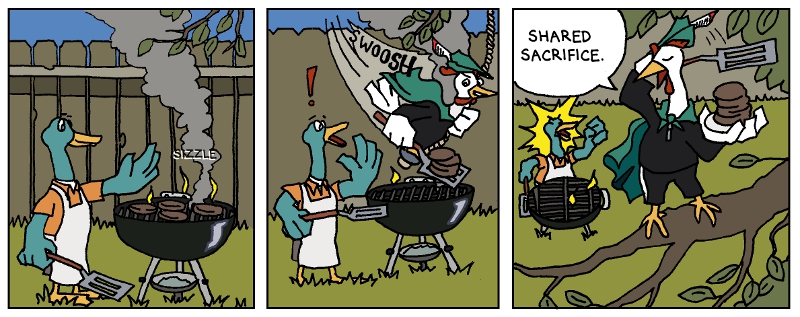
In 2010, and even into 2012, the President repeatedly sprinkled his speeches with references to “shared sacrifice.”  This is meant to conjure up thoughts of selflessness and nobility: folks who step up and offer voluntarily for a good cause.  But how are new taxes “sacrifice” when they are ultimately collected at the barrel of a gun?  This rhetoric ought to be seen as embarrassing and sloppy by all observers.  The rights to the fruits of one’s own sweat and toil, time and treasure are ultimately discarded by such a line of reasoning.  Utterly chilling.

If what we’re concerned with is a green-hooded robber running around in the woods and seizing wealth, we should be more wary of the man who has spent the last three and a half years in the Bully Pulpit than we should be of his challenger.

Obama’s “Our plan” pitch doesn’t work

With many buzzworthy stories washing over news audiences lately, President Obama’s attempt to claim Bill Clinton’s economic record has not garnered as much attention as it ought.  Nonetheless, ABC dutifully reported the incredible credit grab last Friday, dubbing it “Our Plan.”  As in when the President declared, ““We tried our plan–and it worked.””

Reading the story (linked above), you’ll find the writers were a less than thrilled at poking a hole in “Hope and Change.”  The following gem conveys their reluctance to call the President out on his silly move:

This pitch on occasion has meant that President Obama at times sounds as if he’s claiming some ownership of the Clinton economy – referring to “our plan” — which has allowed Republicans an opening to act as if the crowing he’s engaged in about the Clinton economy is out-of-touch braggadocio about the current economy.

Can you find the several qualifying phrases the writers deploy to effectively neuter their own critique?  They further blunt the impact of their work by twice calling the story’s developments merely “interesting.” The repeated use of this ho-hum descriptor either indicates grade school student authorship, or else is a euphemism for harsher terms the journalists can’t bring themselves to say.  Or maybe both.  You can decide what is more likely.

Whatever the case may be, the President’s team at Health and Human Services  haven’t helped the “Our Plan” claims.  Just a couple of weeks ago,  they watered down the Clinton-era welfare reform work requirements.  This signature achievement, only adopted at the prodding of a Republican Congress, has been generally acknowledged as a policy success.  But with the new HHS changes, we can expect entitlement culture to crowd out any productive behaviors the reform had brought.  Like the greatly expanded food stamp program,  this makes for a significant departure from the Clinton policy environment.

Now let’s look at “Our Plan” by the numbers.  On one level the numbers game is disingenuous.  Obama’s main claim to Clinton’s tax policy hinges solely on the top marginal rate, which he wants to boost from 35 to 39.6 percent.  Any revenue increase, even if dynamically scored, will only be a drop in the deficit bucket.  A host of other variables outside of the control of “Our Plan” will hold more sway over the economy.  But if the game is to be played, there’s a pretty good case to be made against the Democrats.

That 22 million jobs came into being under Clinton’s two terms has been echoed far and wide by Democrat acolytes.  Never mind that Obama’s net created jobs won’t be positive by election day.  But what about unemployment rates?  They’re readily available from the Bureau of Labor Statistics.  Combining Clinton’s eight full years and Obama’s first three, the average annual unemployment rate under “Our Plan” is 6.4 percent.  How much does this cream Bush’s average rate by? It’s the other way around.  At 5.3 percent, Dubya beats “Our Plan” by over a point.  Not that Mitt Romney is running as Bush anyway.

Taking things a step further, let’s attribute the unemployment numbers to Congress instead.  The average annual rate was an ultra low 5.0 percent from 1995-2006, the time Republicans had at least a tenuous hold on both houses.  By comparison, Nancy Pelosi and Harry Reid’s Congress pulled 7.3 percent from 2007-2010.  Whether looking at Congress or the White House, the employment rate tends to be healthy over the broad sweep of recent Republican tenures.  It’s those pesky times of transition to and from Democrat control that correlate to a high rate of joblessness.

When President Clinton speaks at the Democratic National Convention this September, will he be pitching the strained reasoning of “Our Plan?”  As with previously tried campaign themes, I doubt it will have the legs to carry Democrats forward.  Maybe Mr. Clinton will be singing a different song.

Water bottles and other campaign debris

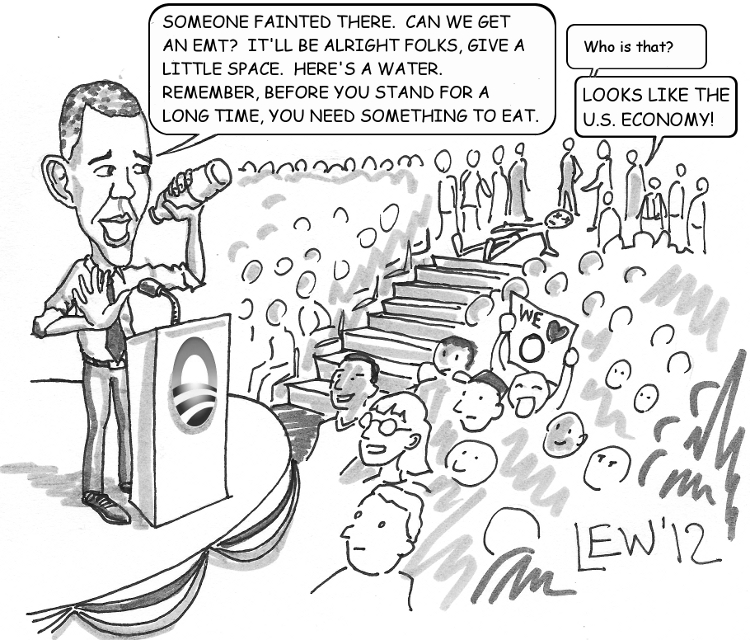
Ever since 2008, conspicuous fainting episodes have occurred with bizarre regularity at President Obama’s campaign rallies.  Some wider attention came earlier this week when Obama, who offers a consistent, canned response to these potentially serious collapses, inadvertently called for a “paralegal” instead of a paramedic. Michael Medved, who has documented this phenomenon since the beginning, has a good point regarding the displays: how does the Commander-in-Chief know it’s just a swoon and nothing more serious?

The fainting routine, with Mr. Obama’s predictable admonition to eat food, drink water, and remain calm,  is quite possibly meant to bolster his image as a confident, competent leader. He can have own mini Bush-with-a-bullhorn moment, giving gentle nanny state prescriptions that earn laughter from the adoring crowd. But one Medved caller this week had an alternate take: with the president habitually 20-60 minutes late to appointments, and belting out stump speeches nearing an hour, it would be no surprise if the fainting fans were genuine and not crowd plants.

Why do mainstream journalists, the “dinosaur media” if you will, turn a blind eye to Obama and his fellow Democrat’s campaign gimmicks?  Who knows what other minutia have gone undocumented while the media combs over Romney’s vacation photos, his financial arrangements, and his 1999-2002 status at Bain?

Of course it’s the substance and not the minutia that matters.  Yet, it was with some pain that I learned of new–if trivial –criticisms from two Hollywood geek icons.  Mark Hamill, the actor who played Luke Skywalker in Star Wars, recently knocked Mitt Romney as “not human.”  His critique hinged on how awkwardly the governor responded to a sip of lemonade.  Really?  Hamill’s observation rivals Matt Damon’s fearful, perhaps bigoted babble from 2008 that managed to mention Sarah Palin, dinosaurs, and nuclear codes in the same breath.

Giving good company to Hamill is Wil Wheaton, who played the star ship’s resident whiz kid on Star Trek: The Next Generation.  He took the occasion of a recent George Bush interview to lament the loss of life and treasure the 43rd president instigated with a “war of choice.”  It’s regrettable the actor doesn’t understand that jihadis have free will or that all wars are embarked upon as a deliberate exercise.

The men who once played space teens on film and television can now–fittingly enough–join Cher, who apparently left Earth so she could avoid breathing the same air as Mitt Romney.  Celebrities’ reflexive gags make nice conservative water cooler talk, but they also indicate just how impervious some sections of the country are to reality.

Let’s return from our Hollywood excursus to Washington, where we get a different taste of the same liberal worldview.  The media, after four days of burying its head in the sand, has reluctantly picked up on President Obama’s “You didn’t build that” gaffe.  And while ABC moved quickly to paint it as out of context, The Wall Street Journal’s James Taranto insists the gaffe was a genuine betrayal of a deeply liberal inner attitude.

If you read the wider quote from Obama, Taranto has solid reasoning: “that” refers to the singular and proximate “business.”  Obama would have said “those” if he were referring to the earlier bridges and roads.  Yet, I would entertain the possibility of a simple slip up, since “you didn’t build that” has more of a rhetorical impact than “you didn’t build those.”  It also reminds us of MC Hammer’s sweet refrain, “U can’t touch this.”

Is all this attention unfruitful nitpicking?  Not inasmuch as it draws focus to the real and gaping philosophical chasm that separates Democrats from Republicans.  Undeniably, economic policy is ultimately driven by a sense of who “owns” growth and success.

What does lack substance is the liberal canard that the rich need to “pay back” for all they’ve been given.  Not that Republicans deny a need for some government in the first place!  High income earners already pay much more than the rest of us under our already progressive tax regime.  And all the while, we can’t deny the abounding opportunity that many of those earners’ businesses provide.

There is no need for top income earners to pay “us” back or forward, for that matter.  But we could use comprehensive tax reform, a closing of loopholes and lowering of rates that Romney and a Republican Congress will deliver if elected.  If only our electorate can navigate the field of campaign season debris first.

The AP, Obama, the ‘S’-word and E.J. Dionne

I never get tired of calling out the mainstream media.  Its reporters give us steeply slanted stories and we’re supposed to believe they are fair and objective.  A recent AP piece–not marked by Yahoo! as commentary or analysis–defends President Obama against the “socialist” label while simultaneously slapping down conservatives.

The article’s language allows the writer to circuitously vent his disdain for Obama critics.  In his prose, they “pounce,” “slur,” and “denigrate.”  Other words color the tone for us: contention, epithet, shock value, nonsense, insult.

He weaves quotes from academic experts.  One proclaims he is “weary” of the socialist label.  Another points to a “hysterical outbreak of abuse” and “animosity” coming from a “certain segment of Americans.”  In other words, racist bigots are saying bad things about the President.

Besides saturating his article with inflammatory language, the writer gets smarmy by informing the reader that it was a socialist who wrote the Pledge of Allegiance.  He faults Obama critics for missing a strict definition of socialism, but goes on to quote and mention people who do not fit the bill he uses.

As written, this purported news story is just a string of unsubstantiated quotes and couched words meant to take conservatives down a notch.  But this patronizing corrective is not the first.  I remember NPR running a piece like this just prior to election day 2008.  For years now mainstream journalists have been meticulously removing criticism from the President as if they were remora eels attached to the belly of a giant, lumbering whale.  Hopefully a one-term whale.

These nominally non-ideological reporters work in tandem with analysts and commentators who are open about their Left/liberal leanings.  E.J. Dionne is among the more effective of this clean-up crew.  Whether in his weekly sparring with David Brooks or on the talk radio circuit promoting his new book, Dionne often comes across as sharp, earnest, and even magnanimous.  For many in the political middle that could be swayed, his style threatens to give credence to his thesis that conservatives have moved radically rightward, abandoning what he calls a traditional balance between private and public, individual and community.  Never mind that he conflates government with community or that families, churches, and civic associations don’t neatly fit into his talking points.  For some swing voters, tone and presentation will matter more than substance.

Anyone who wants to stave off the misfortune of another four years of Barack Obama and his liberal, Leftist, progressive, and Democratic friends should consider carefully how they’re talking about him.  “Socialist” may be a cogent term that energizes the base, but it will turn off at least a few independents who are paying attention.

What I’m suggesting is not the abandonment of principle but getting fancy with footwork.  In conversations that count, identify the common ground and frame the choice in those terms: personal responsibility, the dangers of centralization, or whatever it may be.  Make it clear that even if Obama and Democrats don’t satisfy some strict definition of “socialist,” it is a distinction without a difference.

We don’t need to renounce our partisanship like mainstream journalists do; it’s better to confess rather than suppress your bias.  But beyond the statistics, labels, and gotchas that get thrown about, we must connect the dots, clearly articulating why it is we believe what we believe.

Resurrecting birtherism, questioning leadership

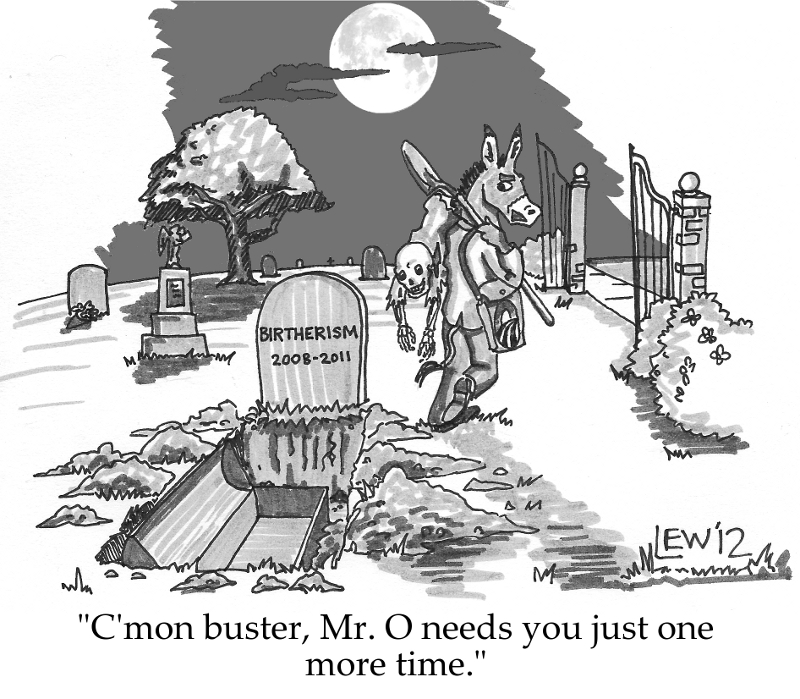
The Obama campaign resurrected the birther bogeyman this week with the release of a video questioning Romney’s ability to lead in light of his ties to Donald Trump.  This is an odd accusation coming from a president who forfeited leadership in shaping Obamacare, his crowning achievement, to his Democratic allies in Congress.  Meanwhile, his best claim as a bipartisan leader is the glorified photo-op of playing golf with John Boehner.  Much good that did.

Ed Klein’s new book, The Amateur: Barack Obama in the White House, reveals just how incapable a commander the president has been. In a recent Michael Medved interview, Klein contrasted Obama’s lack of day-to-day communication with President Reagan’s warm and regular phone calls to Democrat House Speaker Tip O’Neill. Today, Obama’s allies, to say nothing of his opponents, complain they never hear from him.  Maybe he’s been out on the links too much?

The biggest danger President Obama presents is not his race, his place of birth (Hawaii, USA) or his alien religion (secular liberalism). It’s his incompetence. This, combined with his unpopular, stubbornly-held big government liberalism, is why his campaign must constantly churn out red herrings like the birther issue.

Make no mistake.  Romney may not be the warmest character or give you leg-tingles, but his substantial experience heading up real, successful, and reputable enterprises give him a serious advantage over the incumbent, whose rock star status sheltered him and left him clueless as to how an executive should actually operate.

Prairie fire and cowpies make campfire politics

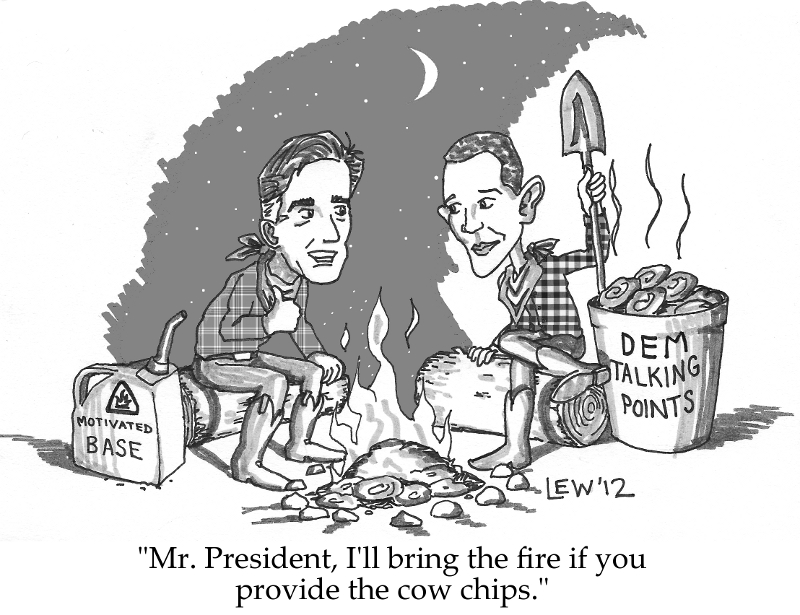
What happens when an unstoppable force hits an immovable object?  Who knows.  The more pertinent question for this past week: What happens when a prairie fire hits a pile of cowpies?

Both Mitt Romney and Barack Obama have been tweaking their rhetoric for Iowan ears.  Responding to Romney’s accusation that he’s tended over a “prairie fire of debt,” Obama has described his opponent’s criticism as a “cowpie of distortions.”  Our President continues to debase the discussion with a vulgar allusion to a steaming pile.

Meanwhile, the White House and the Left have tried to play off of the ill logic of Rex Nutting, who contended earlier this week that Obama has grown Federal deficits at the lowest rate since the Eisenhower administration.  Many observers have debunked this idea.  James Taranto put it well when he noted that Obama has treated Bush’s one year, necessary TARP swell as a baseline for subsequent years’ Federal budgets.

It’s as if you, the head of a household, assented to spending $10,000 to repair a sudden, gaping hole in the roof one year, but decided to keep spending that same extra amount for each of the three following years.  And this spending is not on other emergencies, but pet projects.  All the while, you claim to be a fiscal hawk because your spending hasn’t grown significantly since the initial boost that you approved when you first came in.

So Romney’s prairie fire claim isn’t so . . . smelly after all.  What we’re left with is a challenger with a base itching–on fire, in fact–to vote out an incumbent whose campaign and allies never seem to be in short supply of well, cowpies.  At least you can dry them out and use them for fuel.