Why should government endorse same sex marriage?

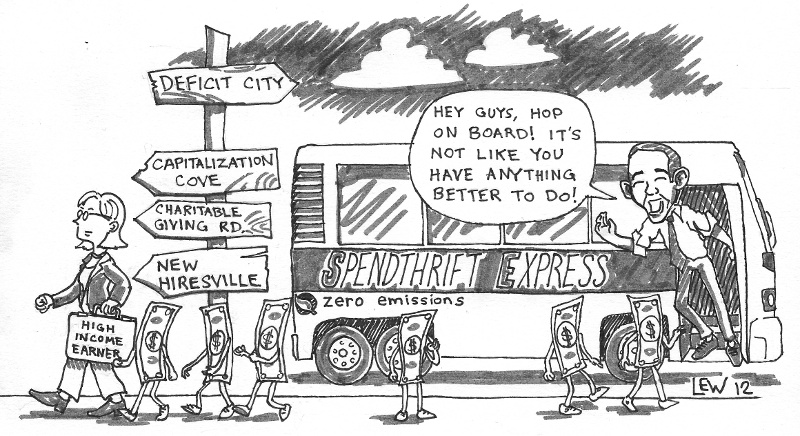
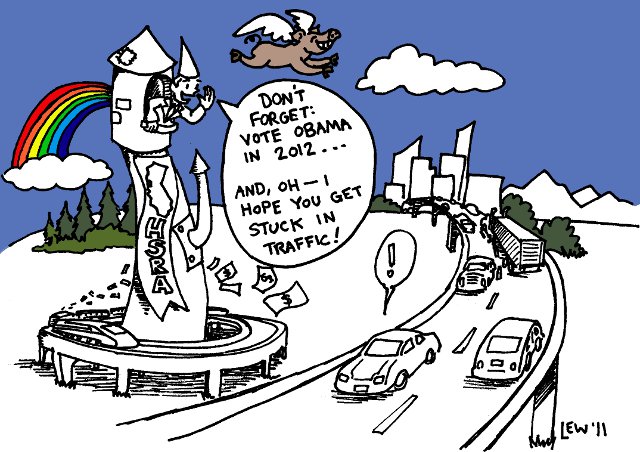
The above fictional account touches on the gimmicky raffles the Obama campaign has been using to raise money.  Small-time donors first had a chance to meet George Clooney, and now  Sarah Jessica Parker.  For Mother’s Day, there was the opportunity to win mom a tweet from the President himself.

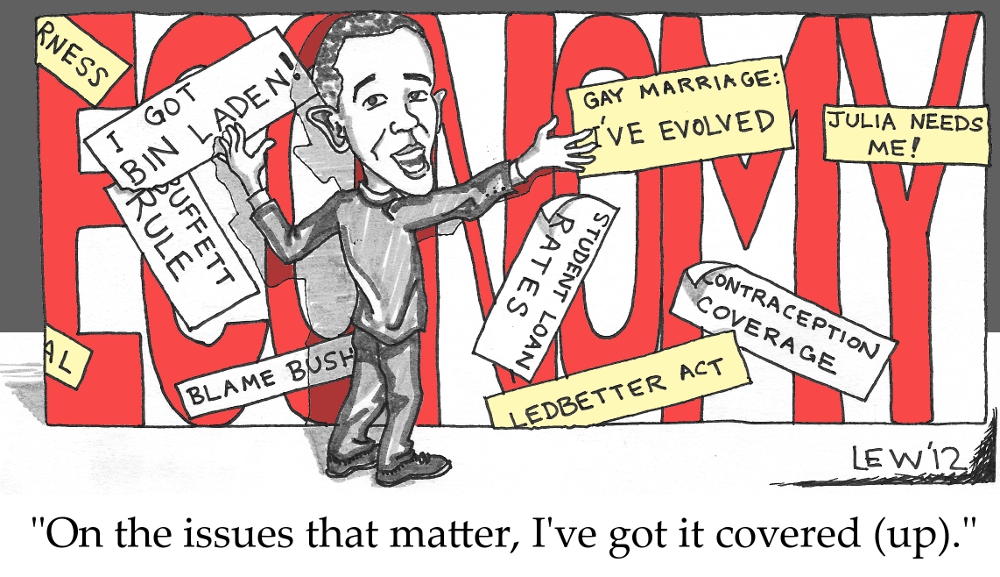
The other issue I’ve depicted and invite you examine for the remainder of this post is gay marriage.  The tendency in the public square is to conflate cultural practice with government endorsement.  We saw this two weeks ago when some folks were upset with North Carolina’s poll but pleased with President Obama’s evolution.  If we want a lucid discourse on marriage, we need to parse the cultural practice from government endorsement.  The critical question to ask: why is this new task of endorsement—with its associated costs—necessary?

Supporters of gay marriage often say it’s a civil  rights issue, inviting a comparison to the historic plight of racial minorities.  But the gay community’s experience today is nothing like the suffering under Jim Crow.  The collective socioeconomic status of homosexuals doesn’t reflect some sort of pervasive systemic bias.  And Federal laws already protect against sexual orientation discrimination.  The relative lack of exigency is a strike against the necessity of endorsement.

Yet, through personal experience, many feel gay marriage to have the moral force of a civil rights issue.  “Equality!” is the cry.  What is government supposed to equalize: individuals or relationships?  The state certainly treats individuals differently.  Men must sign up for selective service; women don’t.  Divorcing mothers tend to win custody over fathers.  And government  justifiably treats relationships differently too:  marriages are proscribed on the basis on age, blood relation, ability to consent, or number of  partners in the relationship.  Having strong feelings about equality doesn’t make government endorsement necessary.

The question remains, why endorse?  One with an expansive view of government may say that endorsement validates or affirms the humanity of gay individuals.  But personal affirmation is not the state’s  business.  We all have God-breathed dignity in spite of what government says about us.  Dissidents living under oppressive regimes around the world know this.  It’s our patrimony as Americans to know and live this truth without such pointed help from Uncle Sam.

In opening up two weeks ago, Vice President Biden gushed about commitment and love.  But governmental recognition of marriage, which boils down to enforcing a contract, is an unsexy thing.  It’s not about feeling love or commitment.  It’s a man and woman assenting to being bound by the law, with the end of raising children well in mind.  With the contract, the couple faces an increased cost of separation, and so does the court system for that matter.  This is another reason why government shouldn’t recognize relationships it doesn’t have to.  And it doesn’t have to because same sex couples never produce children naturally, while opposite sex couples do all the time.  Simultaneously, they face pressures that would separate them from each other.  It’s a bit ignoble, but that is the human condition.

All this to say government needn’t recognize gay marriage.  In fact, the  push for recognition sends the dangerous signal that government’s role is to correct every perceived societal slight, or worse, validate our personal feelings.  Each of us should feel free to pursue any relationship or endeavor we find fulfilling.  Just keep government out of it if you’re able.
President Obama’s off-base

The White House’s campaign messaging has been all over the place in recent weeks.  And contrary to his 2008 promise, the President has come off as more of a divider than a uniter.  Not to be confused with President Bush, who was mocked for proclaiming himself the “Decider.”

The Obama team’s trail of message wreckage started with February’s awkwardly handled contraception mandate work around, which, for all the trouble, still leaves some religious organizations paying indirectly for services they find unconscionable.

Then, erupting inconveniently last week was President Obama’s personal “evolution” on gay marriage. Many observers saw the President’s hand forced by discretion-challenged Vice President Joe Biden.  What’s most vexing about this iteration of the marriage debate is not the particular stance taken, but the justification as to how one arrives there.  Biden baffled us all with the idea that the 1998-2006 sitcom Will and Grace was for him some pivotal, moral tour de force.

As one poll shows, Obama and company seem to have alienated swing voters on the social issues.  But  they have tried mightily to boost their standing with female voters, trumpeting the 2009 Lilly Ledbetter Fair Pay Act as a great and early first term accomplishment.  All the act does is give women more time to sue their bosses for the phantom menace of wage discrimination–a boon for Democrat’s loyal base of litigious attorneys.  Touted as historic and consequential, the act is only known because the Obama team has dusted it off as a showpiece for the 2012 campaign.

Indeed, the Ledbetter Act featured prominently as part of the Life of Julia, a fictional every-woman whose slideshow biography was quickly and widely ridiculed for its earnest portrayal of a hopelessly lonely, overly dependent, Obama-centered life.  Rather than making the conventional, family-oriented “Harry and Louise” kitchen table-type pitch, The Life of Julia deliberately caters to the fervent, perennially disaffected fringe that is Obama’s base.

To see just how hard the Campaigner-in-Chief has tacked toward those who self-identify as embattled and aggrieved, we need only look to the recent “dueling” commencement speeches delivered this past week.  Conservative commentator Michael Medved noted that of all the colleges in the country he could have spoken at, President Obama chose the elite, astronomically expensive Barnard College.  His audience at the women’s liberal arts college was a particularly concentrated sample of privilege: women now far surpass men in educational achievement by the numbers, from undergraduate enrollment to attainment of advanced degrees.  Yet, the faculty and students were ebullient when the President was introduced as one who appointed so many women and minorities to the highest offices.  Meanwhile, Mitt Romney’s receptive audience at Liberty University, with its larger student body and more affordable tuition, was a far more representative cross-section of America, on the socioeconomic level not to mention anything of gender representation.

The White House has garnered a few days’ media attention on other issues: “spiking the football” at the anniversary of Osama bin Laden’s death, and the economic distractions of the Buffett Rule and the student loan rate relief.  The former was no help to the incumbent, with liberal Arianna Huffington calling one Democratic campaign spot “despicable.”  The paltry Buffett Rule captures more class resentment votes than it would actual marginal revenue from the wealthy.  Likewise, the playing up of the student loan rate extension nakedly caters to the college age vote, while dangerously distorting market decisions about the relative value of earning a degree.

All told, the President seems pretty set on stoking his base with the visceral fuel of social, class, and identity politics.  Meanwhile, substantive solutions for the economy, as well as the sensibility of swing voters, remain neglected.  Sending Biden around with the fib that he’s working class will only go so far.  We’ll see in the months ahead if the Obama team can refocus, or if Romney, sticking to the economy and clearly rising, can build and maintain a respectable distance.  Let’s hope so for our country’s sake.


How Buffett bluster boomerangs; or, Taxosaurus Rex

The unvarnished rhetoric coming out of the White House over the past two weeks has been just too delectable for conservative commentators.  In a recent WSJ piece, Daniel Henninger suggests that Democrats’ furious assault on Paul Ryan’s budget plan is desperate “thermonuclear” overkill.  Indeed, all the accusations of Social Darwinism and “trickle-down” economics cannot make up for Democrats’ utter lack of seriousness when it comes to the national debt.

As the White House rolled out the practically inconsequential yet politically expedient Buffett Rule this week, I was amazed at the justification given by allied economist Alan Krueger.  The Christian Science Monitor quotes:

“In addition to fairness, in fact it’s a step in the direction of economic efficiency,” said Alan Krueger, chairman of the Council of Economic Advisors. The Buffett rule allows people to “devote more effort what their focus should be, which is to their jobs and job creation … rather than restructuring their income to minimize their taxes.”

He’s alleging that the tax increases economic efficiency.  But how does government spend anyone’s money better than they themselves would?  During the global high tide of state central planning in the 1940s, F.A. Hayek explained cogently in his The Road to Serfdom who spends money best: the one who earns it.

When given other people’s money, legislators face the temptation of buying constituents’ votes with pork rather than allocating it wisely.  Then the money goes to bureaucrats, who are not careful enough with it.  Their lack of accountability flows from the political difficulty of de-funding them.  It is the original income earner who best appreciates the sweat and effort it took to get the money.  She appreciates the reality that her income might dry up tomorrow, and so will handle it more carefully than the central planners.

According to his critics, the car elevator in Mitt Romney’s mansion is a bad thing.  But he used his own money, which he only earned in the first place by benefiting others in voluntary transactions.  And the construction provided gainful employment to all sorts of craftsmen.

President Obama, meanwhile, either had to grow our debt or tax money out the economy to give us public project flops like Solyndra and the constipated stimulus weatherization projection.  Money that otherwise would have been carefully spent in private hands was squandered by legislators and bureaucrats.

Of course, not all government spending is bad; some spending is necessary.  But Krueger’s claim that a tax increases efficiency overlooks government’s great tendency towards inefficiency.

The case against the Buffetteers may be clearer when we look at that favorite magic word of progressives and liberals, “investment.”  Any public project from education to high-speed rail becomes an unmitigated good if it can be spoken in terms of investment.  But our current, low tax rates vindicate private investments as an even greater good.  This is why Buffett and Obama pay less in taxes than their secretaries.  The Monitor quotes Marco Rubio:

“What [Americans] need to understand is the reason why he may pay less than his secretary, in terms of the rate, is that she makes her money on a paycheck and he makes his money on investments,” Senator Rubio said. “We have always wanted Warren Buffett to, instead of putting that money in a coffee can, to take his money and invest it, because that created jobs.”

As much as the Buffett-minded would increase taxes on private investment earnings, they would demolish the incentive to invest and crash the stock market.  In this way the Buffett Rule boomerangs back on itself.

Class envy can’t lift up the poor, but it can bring us all down.  Let’s all move past the Buffett distraction.

A workable green energy solution

We all know the things we’re supposed to spurn the Republican contenders for: vomiting on hearing JFK talk about church and state, offering statehood to a yet-unfounded lunar colony.  The litany against front-runner Mitt Romney is long, if insubstantial: having buddies who are NASCAR team owners, driving two Cadillacs (not Porches or even Mercedes, mind you), being an Etch-a-Sketch candidate.  Since there is no major scandal or outrageous hair-flaming position the man takes, mainstream media must squeeze every ounce it can get out of the latest Romney gaff.  It’s getting old for anyone with half a brain, and fortunately those are the people who tend to show up at the polls.

Republicans have been scrutinized intensely, but what has been coming out of mouths in the Democratic corner?  You wouldn’t know watching NBC or reading Yahoo! News.  Sure, Maxine Waters called Eric Cantor and John Boehner demons.  Nonetheless, it’s the recent speeches of household-name White House officials that are worth looking at.

President Obama kicked things off earlier this month, comparing himself to Ghandi and Nelson Mandela.  He claimed that, as with those men in their noble struggles, the fight is hard and it takes time.  But how is the Democratic agenda in 2012 comparable to the effort for Indian independence or the campaign to end Apartheid?  Does this mean the GOP is as brutal as the British Raj or as unjust as the old South African regime?  This sloppy pandering is reminiscent of the racially-tinged “dollar bill” accusation Obama hurled at McCain and Republicans in his 2008 campaign.  But these remarks get scant media scrutiny when they come from this president.

Next, Secretary of State Hillary Clinton spiced things up at the 2012 Women in the World Summit.  She equated more ardent American conservatives with the more egregious human rights abusers in the Muslim world, slapping them both with the common label of “extremists.”  Opposing compulsory contraception coverage is nothing akin to what women deal with every day in Afghanistan, or Egypt for that matter.  Secretary Clinton scores bonus points for lugging domestic politics into foreign affairs.

Finally, Joe Biden rounds out the good times with a speech given to the UAW in Toledo last week.  The Vice President branded his ticket as one offering a “fair shot and a fair shake.”  With this language we might as well have entered a time warp and come out in FDR’s bad old New Deal.  This is the kind of sloganeering given to those who think capitalism is wrong, broken, or dead.  In its place comes Uncle Sam who “takes care of things” for you.  Just like when you need Vito Corleone to get your landlord off your back.  More like fair shakedowns than fair shake.  This rhetoric values shameless deal-making over the rule of law.

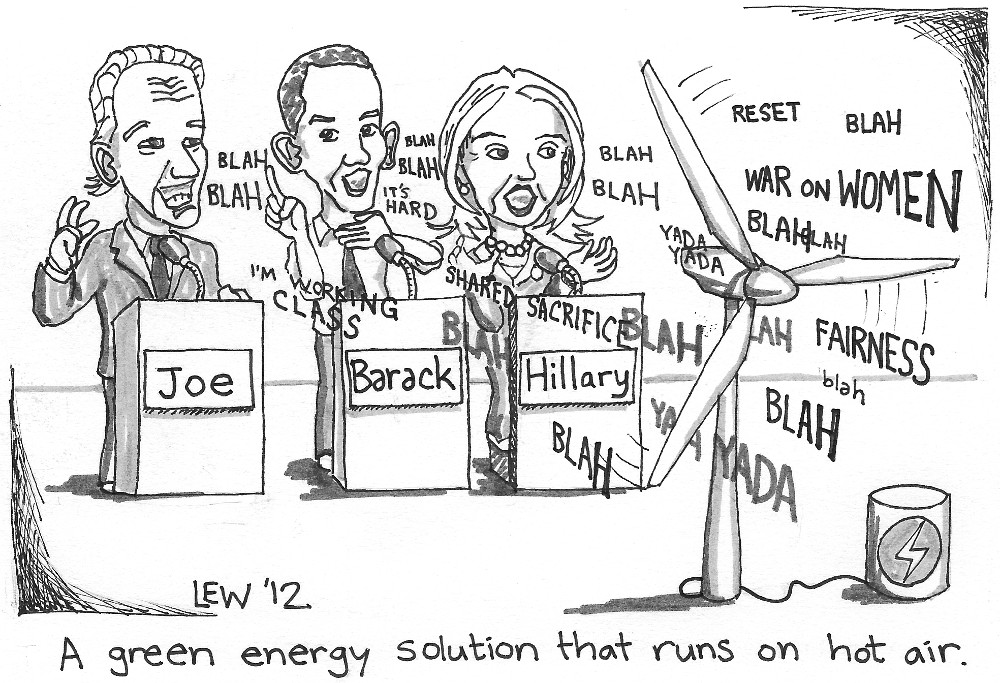
It’s no surprise the highest officials in the land get the soft treatment; they’re liberal and progressive after all.  Their rhetoric should have generated some push back from the mainstream media.  If only we could harness all their hot air, we could generate electricity instead.  Then they could deliver on their green energy solutions promises.

Kony 2012 and Afghanistan

I found last week’s hoopla surrounding the Kony 2012 video annoying and disturbing.  Designed to stir souls to a noble cause, the video is worrisome because it is classic agitprop.  It has ignited among its viewers a strong emotional firestorm that bypasses reason.  (On a sadder note, it seems the global explosion of attention and backlash were too much for the maker of the video.)

Everyone agrees that Kony is a bad man, but I doubt everyone agrees on a real solution.  Neither Facebook posts nor monetary contributions stop an evil man like this.  UN blue helmets don’t do much good either; just ask the residents of Srebenica.  It would take a concerted effort by a competent, modern military force to uproot that kind of evil.  Funny though, when that sort of operation becomes reality, as with the Iraq War, people complain about it.  If only text donations were more widespread back then, maybe Saddam Hussein could have been effaced by the collective wireless bills of the Free World.  And what about the fresher atrocities of Kim Jong Il?  By the time of his death last December, there was no 80 million+ hits YouTube video for his crimes.

For all the talk of “capturing” Kony, I would not be surprised if his capture attempt looked and ended up like last year’s righteous and successfully culminated mission against Osama Bin Laden.

Just a day or two after the Kony 2012 media explosion came the sensational storm of the Afghanistan massacre.  But instead of passion to spark a new war, this story reinforced among the public a desire to end an old one.  I instinctively resist the popular sentiment to pull out that comes from seeing casualties and bloodshed.  When I studied “peace and security” as an international relations major, I discovered the great extent of thought that informs decision-making on questions of peace and war.  Such deadly serious business must not be decided by the fickle whims of the public, but ought to rest in the hands of sober-minded policymakers.  Whether we actually have such trustworthy policymakers in power is another story altogether.

The power to make war is a necessary and classic function of government that is not going away anytime soon.  Indeed, Robert Kagan’s latest book argues specifically for America’s need to maintain a prominent profile in the world’s affairs.  What is ultimately entailed in Afghanistan is hard for me to say, but mere public opinion shouldn’t determine whether we send SEALs to get Kony or send our troops in Afghanistan packing.  Our national security and our troops’ sacrifice are too important for that.

Of sheeple and super PACs

Just the other week, the charmingly hateful Bill Maher announced he was giving $1 million to a super PAC working to re-elect President Obama.  Despite his past harangues against the Roberts Supreme Court, Mr. Obama has resigned himself to the reality of unlimited campaign spending for now.

The Citizens United decision that ushered in that reality is deeply unpopular with the public. But what is the alternative?  Restrictions on political advertising are inextricably at odds with America’s free speech tradition.  Contrary to popular belief, the first amendment does not aim to protect lap dances, the pitching of tents on university quads, or school children’s ability to endorse “bong hits for Jesus.”  If nothing else, free speech exists so we may amply criticize our incumbent political leaders.  Anyone who remembers Tienanmen square ought to have a natural appreciation for this necessity.

Yet, Americans fear the pernicious effects of too much political speech.  Some are concerned for the quality of the speech, but most trepidation is reserved for the idea that rich people and wealthy corporations will have too much power.  In reality, there is a healthy split between rich Democrats who want to raise their own taxes and rich Republicans who understand the importance of keeping taxes low.  Even from the class war perspective, there is no need to worry that big donors will team up and categorically dominate everyone else.  President Obama’s ample 2012 war chest attests to that.

What of the quality of political speech?  This election cycle, news media consumers cannot help but be acutely aware of the Republican tit-for-tat.  Recall the sensational, anti-capitalist dross that Gingrich supporter Sheldon Adelson financed earlier this year.  But in what past golden era were political campaigns not ugly?  More to the point, the desire to suppress distasteful or distorted speech through legislated, bureaucratic discernment is chillingly Orwellian.

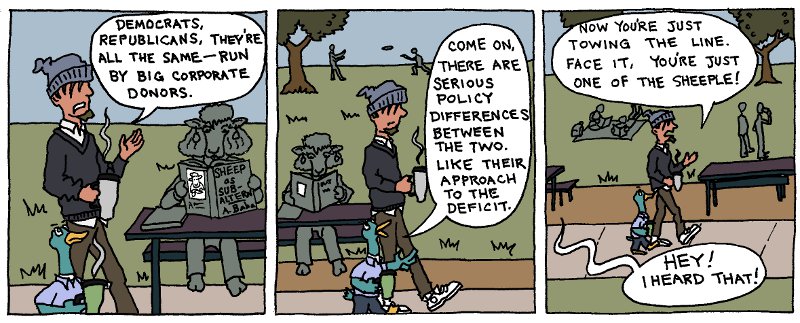
As the unattributable maxim goes, fight bad speech with good speech.  True democrats (lowercase “d”) have nothing to fear, as long we believe our fellow citizens aren’t dumb.  But for some reason this pervasive mentality prevails: that millions of dollars of campaign money automatically translate into bought votes, as if people were uncritical voting robots.  This is classic “sheeple” thinking, a presumptuous judgement that your fellow countrymen are mere followers who are too blind to apprehend the truth you happen to perceive.

We must appreciate our democracy as a marketplace of ideas, where we test confidently a faith that our fellow citizens are endowed with true decision-making ability and are not bought-and-sold sheeple.  To do otherwise would be to shrink into the clutches of tyranny.

Theocracy from the Left; or, Other people’s money

At the National Prayer Breakfast earlier this month, President Obama played up his Christian faith, declaring “for unto whom much is given, much shall be required.” Attempting to marshal scripture in support of his idea of fairness, he ended up inserting a theological foot into his political mouth by conflating God and government.  In this, Mr. Obama managed to betray an aloofness from mainstream churches as well as raise a troubling portent for civil libertarians.

With the words “much shall be required,” what else did the Central-Planner-in-Chief mean but to put the tax man’s moral authority on par with God’s?  Christians understand that God doesn’t compel anyone to obedience, but leaves each of us to our free will and our conscience.  By contrast, human government must compel its citizens.  Taxes are collected ultimately at the barrel of a gun.  That’s why the founders saw it as essential to limit what is “required” by the government.

During the Bush years, a handful of agitated liberals spawned a new book industry, warning of theocracy arising from the Religious Right.  If history’s any predictor, President Obama’s statement should launch a new wave of dire tomes warning against a theocracy of the Religious Left.  The social justice crowd that rallies behind Obama’s fairness push is out of touch with America’s exceptional ethos and experience: that a people, under the guidance of God and conscience, and free from a central meddler, have built for the world a Shining City on a Hill.

Besides conflating God and government, the President and his tax-the-rich allies have committed another type of unforced error in their moral reasoning.  Mr. Obama, investment wiz Warren Buffett, and retired Google exec Eric Schmidt have each, in recent times, implored that their own taxes be raised.  Their advocacy sweeps up all the fellow earners in their tax bracket, both the willing and unwilling.  How is this kind of appeal sensible?  It’s a perverse, inverted golden rule.  Like saying you personally don’t mind being bludgeoned, so it’s okay to bludgeon your peers.  It seems as if these folks are hoping your brain isn’t turned on.  Or maybe that you won’t notice theirs aren’t.  There’s a certain kind of arrogance in volunteering other people’s money.

So in a couple of ways Obama and company’s moral arguments are really lacking.  But don’t forget the facts about our nation’s recent Great Society redux.  Stephen Moore’s op-ed challenge to the White House fairness narrative provides us with a rich inventory of ways our big government has failed us to date .  Among the more salient is the mounting concentration of national wealth in the suburbs of Washington DC; the top three median income counties in the nation are clustered in the DC metro area.  Such a backslide of civilization would give any shameless, caviar-chomping commissar of Soviet-era Moscow a run for his money.  And we know that whatever part of our nation’s economic lifeblood that does not end up feeding a Falls Church jumbo mortgage tends to get lost in legislative backscratching or bureaucratic head-scratching.

Anyway you dice the tax dollar, Washington isn’t justified in its spending increases.  Given President Obama’s deficit deafness, and Democrats’ contorted fairness distractions, voters need to just say “No!” and oust the tax-grubbing big spenders this November.

SOTU 2012: The Tax Loophole Jump

SOTU 2012:The Business Tax Loophole Jump


There were some nice things about Tuesday’s State of the Union Address:  Representative Gifford’s recovery, the accomplishments of our awesome Navy SEALs, and Mitch Daniels’ well-spoken and clever GOP response.  And there were some not so nice things.

Looking at the fiscal picture, President Obama’s speech boiled down to two proposals: shuffling business tax credits and asking for more money on things we already spend a lot on.  Among the various behaviors the President aspires to manipulate through a fresh scrambling of our already deeply convoluted tax code: who businesses hire, how much they pay those employees, what  manufacturers make, and where they make those things.  Has the White House not gotten one of those memos on tax simplification?  What ever happened to the recommendations from the Simpson-Bowles report they commissioned?  All of the new tax credits (read: loopholes) will only distort market behavior.  And market distortions are “what got us into this mess.”

Then there are the new outlays he requested.  First, to create a new bureaucracy, the Trade Enforcement Unit.  I think he is going for the Jack Bauer vote by calling it a unit, as in “Counterterrorism Unit (CTU).”  Its a worthy cause, but can’t it be done by retasking existing agencies?  Next on the list is money to transform community colleges into “community career centers.”  I don’t know what they were before if not that!  Just a place to find a date for Friday night?  Finally, he asked us to fork more money over for teachers.  But it seems like school voucher programs don’t count.  Democrats only accept more money for education when it doesn’t threaten unions.

I don’t think our President has managed to outdo himself in 2012.  Last year’s “Winning the Future” (WTF) theme with $53 billion for high speed rail projects is just too tough to beat.  And that outlandish record will hopefully stand if this State of the Union address is President Obama’s last.

The Economic Red Button

The economic red button

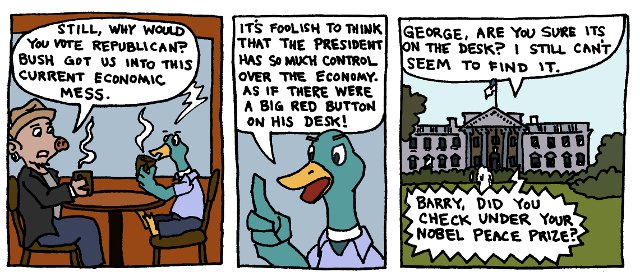
Today’s strip continues the cafe conversation.  Probably you’ve heard people try to judge presidents by the shape of their economies.  This kind of logic is mistaken, but it is the bread and butter of progressives and Democrats.  They survive pretty much on promises of government activism.  But because of the harm that most often comes from government meddlings in the market, the best kind of president would lead with a hands off style.  Better a good steward than an all-out commander.

HSRA: Get stuck in traffic?

California HSRA hopes you get stuck in traffic?


The Sacramento Bee has offered us a strange, new angle on California’s budget-busting high-speed rail project.  Having interviewed the HSRA’s chair this week, they inform us that the Authority’s latest business plan hinges on a friendly Washington budget environment in the years ahead.  Basically, HSRA is betting its chips on President Obama’s re-election.  With forecasters putting his odds somewhere in the neighborhood of 50-50, isn’t this plan a little reckless?

As it is, Jerry Brown’s gimmicky budget for the current fiscal year is  well on track to trigger further cuts.  And we all know the long line of agencies begging for fiscal mercy: education, prisons, parks, sundry social services, and so on.  Given these dire straits, where will the money come from?

The global track record for high speed rail is abysmal.  These extremely capital- and labor-intensive projects don’t recoup their start-up costs, and there is no reason to believe the latest projected ridership numbers, given the stubbornness of the American Love Affair and the high level of competition airlines will bring to bear.  Train passengers might not need to stand in security lines, but the door-to-door times will be comparable, and at the end of it all they will still need to get picked up or rent a car anyway.

The funny thing about the article though is the last bit about getting stuck in traffic.  It’s not clear whether the Bee is trying to be cute, or imply something more sinister about the Rail Authority.  Even then, local traffic patterns only have partial bearing on the need for a high speed train.  When was the last time you were caught in traffic outside of Harris Ranch?