The AP, Obama, the ‘S’-word and E.J. Dionne

I never get tired of calling out the mainstream media.  Its reporters give us steeply slanted stories and we’re supposed to believe they are fair and objective.  A recent AP piece–not marked by Yahoo! as commentary or analysis–defends President Obama against the “socialist” label while simultaneously slapping down conservatives.

The article’s language allows the writer to circuitously vent his disdain for Obama critics.  In his prose, they “pounce,” “slur,” and “denigrate.”  Other words color the tone for us: contention, epithet, shock value, nonsense, insult.

He weaves quotes from academic experts.  One proclaims he is “weary” of the socialist label.  Another points to a “hysterical outbreak of abuse” and “animosity” coming from a “certain segment of Americans.”  In other words, racist bigots are saying bad things about the President.

Besides saturating his article with inflammatory language, the writer gets smarmy by informing the reader that it was a socialist who wrote the Pledge of Allegiance.  He faults Obama critics for missing a strict definition of socialism, but goes on to quote and mention people who do not fit the bill he uses.

As written, this purported news story is just a string of unsubstantiated quotes and couched words meant to take conservatives down a notch.  But this patronizing corrective is not the first.  I remember NPR running a piece like this just prior to election day 2008.  For years now mainstream journalists have been meticulously removing criticism from the President as if they were remora eels attached to the belly of a giant, lumbering whale.  Hopefully a one-term whale.

These nominally non-ideological reporters work in tandem with analysts and commentators who are open about their Left/liberal leanings.  E.J. Dionne is among the more effective of this clean-up crew.  Whether in his weekly sparring with David Brooks or on the talk radio circuit promoting his new book, Dionne often comes across as sharp, earnest, and even magnanimous.  For many in the political middle that could be swayed, his style threatens to give credence to his thesis that conservatives have moved radically rightward, abandoning what he calls a traditional balance between private and public, individual and community.  Never mind that he conflates government with community or that families, churches, and civic associations don’t neatly fit into his talking points.  For some swing voters, tone and presentation will matter more than substance.

Anyone who wants to stave off the misfortune of another four years of Barack Obama and his liberal, Leftist, progressive, and Democratic friends should consider carefully how they’re talking about him.  “Socialist” may be a cogent term that energizes the base, but it will turn off at least a few independents who are paying attention.

What I’m suggesting is not the abandonment of principle but getting fancy with footwork.  In conversations that count, identify the common ground and frame the choice in those terms: personal responsibility, the dangers of centralization, or whatever it may be.  Make it clear that even if Obama and Democrats don’t satisfy some strict definition of “socialist,” it is a distinction without a difference.

We don’t need to renounce our partisanship like mainstream journalists do; it’s better to confess rather than suppress your bias.  But beyond the statistics, labels, and gotchas that get thrown about, we must connect the dots, clearly articulating why it is we believe what we believe.

Spirit guide

Humor is a subjective thing, so I’ll fill you in on the gaps.  Our pig of course shares a lack of certain scruples with Elizabeth Warren.  The totem gig comes from two sources.

First, I heard interviewed last year on The Michael Medved Show a remarkable performance artist.  She was commissioned via Kickstarter to circumprostrate herself around Mount Rainer.  It’s not as dirty as it sounds.  From all the bowing down, I guess there’s a spiritual dimension to it, but I can only scratch my head in wonder as to who paid for this and why.  Nonetheless, as a free marketeer I say more power to this woman if she can get people to pay her for her art.  It’s something I’m working on myself.

The second part of the totem reference also originates in the Pacific Northwest, which is a sort of epicenter of ecological writing.  There’s a whole lifestyle and philosophy that’s captured by folks like now-retired English professor and poet Gary Snyder.  Early in life, he saw the world as a merchant mariner, caught Zen Buddhism, and subsequently married it to Native American spirituality among other things.

From time to time in my day job, I encounter some works in this tradition.  I find the children’s literature to be especially striking.  One story book features a privileged white kid who is empowered by the spirit of Raven to oppose some mean guys in hard hats who cut down trees for a living.  Another encourages children to connect to “place” and maybe discover for themselves a special inspiring animal, or totem.  As the child of one Asian immigrant (and a native-born American) I can’t help but be tickled by how my fellow, privileged Americans turn from their rich heritage in search of more resonant truths.  By accident or providence, I’m on the opposite end of the divide from those Beatniks and baby boomers disaffected with Western modernity.  Once I came upon the scene, I was taken with the strange idea that America is a singular land of opportunity, that democracy and free market enterprise were vindicated by the end of history, and that we all have God to thank for it.  I still hold to this, by the way.

There’s one more piece to the punchline, if like me you don’t recall much of ancient literature.  It’s that Gilgamesh is 2/3 god, and 1/3 mortal.  But how does one get such a proportion of pedigree?

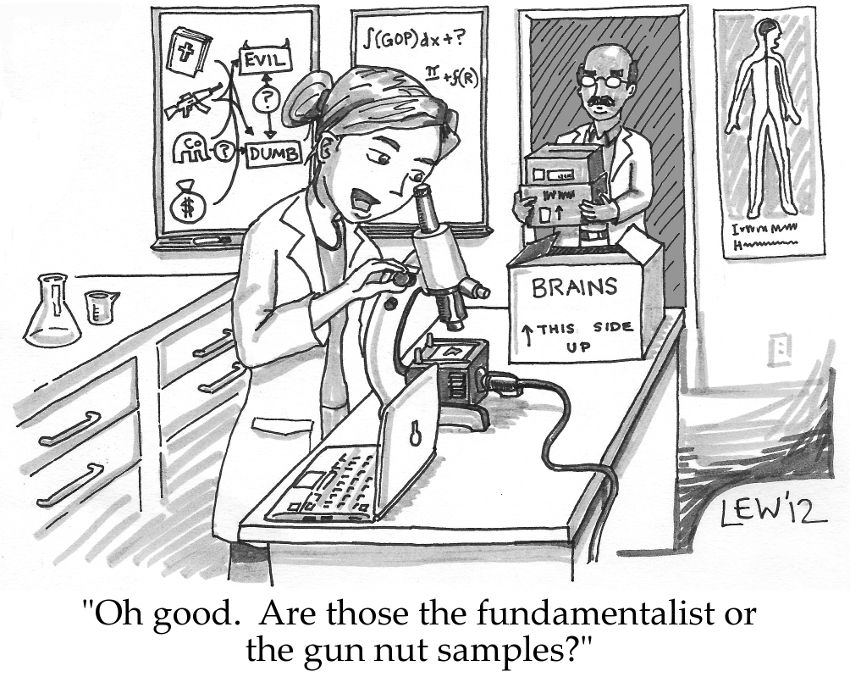
Scientists campaign against Republican, conservative brains

Back in April, I was dismayed to learn that my alma mater was hosting a speaker promoting a new book titled The Republican Brain: The Science of Why They Deny Science and Reality.  (Read Jonah Goldberg’s take on the book here)  It’s become a refrain of mine that no one should be shocked at liberal bias in media or academe. But that a campus would sanction an event branded with such a patent insult is a new low for discourse.  Doubtless, the glorified ad hominem that Republicans are wired to deny reality would go unnoticed by the campus’s “Civility Project,” which rather than treat civility seriously, reinforces notions of victimhood and grievance.

Andrew Ferguson at The Weekly Standard has managed to capture the zeitgeist of liberal academics who try to analyze conservatives. The New Phrenology, as he calls it, has roots as far back as the “F Scale” psychological test of the 1940s. It was meant to gauge one’s conservative tendencies. The “F” stands for Fascism.

Looking at more recent studies of the same vein, Ferguson finds some recurring faults. In a couple of cases the sample groups consisted entirely of college students. Hormonally-driven and still maturing, these folks are hardly suitable representatives for the population at large.  Furthermore, the subjects were also disproportionately Asian-American and female. One study assessed subjects’ conservatism by asking whether they felt “powerful” that day. The methodology leaves much to be desired.

Remember when Farleigh-Dickinson University’s Public Mind Institute reported that watching FOX News makes you dumber? They recently touted the study’s results were “confirmed” with a follow-up. But by asking the same questions as the first time, they repeated the same mistakes. A self-reporting NPR or evening news consumer is going to get a solid block of news, but a watcher of a 24-hour cable news network quite possibly could miss out on substantive programming. And the questionnaire’s focus on Syria favors a misguided, cosmopolitan set that believes the UN might actually be effective. It’s not FOX News but The Public Mind Institute that has made the world dumber with its junk studies.

Meanwhile, one Marcus Arvan has attempted to pin conservatives on the pages of a journal called Neuroethics. The determinism implied in the journal’s title is striking; as if morality were some lightning to be captured in a materialistic bottle. Arvan alleges conservatives share in a “Dark Triad” of personality traits, among them a Machiavellian bent. It’s nothing to worry about. That’s just what people label realists when they don’t like what they have to say.

But on the contrary, anthropologist T.M. Luhrmann finds evangelicals to inhabit a fantasy land.  She sees her native tribe of secular liberals as results-focused, but evangelicals as strangely obsessed with self-improvement and how people could be. Last time I checked, it was liberals who were pie-in-the-sky, swaying to John Lennon’s “Imagine.”  Serious Christians remain firmly rooted in reality, thanks to a cognizance of sin. Among other things, this is the idea that no one, not even ourselves, is perfect or perfectible on this Earth. The Incarnation excluded. Far from enabling delusion, real knowledge of sin and fallenness equips Christians with an ideal, double-edged skepticism. Like the kind that informed America’s great system of governance.

If anyone, it’s secular liberals who ought to be concerned for their own views of reality. Progressives can’t question the very thing they’re progressing toward. There’s no room for genuine critique if there’s a real war on with capitalism, patriarchy, scientific illiteracy, or some other ill of preference. And, as with war, secular liberals demand that problems be dealt with centrally and in totality. This embarrassing prescriptivism should have died with eugenics and all the other awkward progressive-era vestiges long ago.

Still, we are burdened with the unquestioned assumptions of the liberal-scientific consensus. We’re not allowed to question computer models of climate change. But the layman recognizes the hubris in forecasting a city’s weather one month in advance let alone global conditions one hundred years hence. On policy, the consensus demands economy-crushing carbon taxes, lest famines and war break out. But these conditions prevail already.

It’s maddening that the liberal-scientific consensus recuses itself from the possibility of error. Meanwhile, it treats people and the environment as fragile and unable to adapt–in fact, in need of a strong, capable hand–a scientific and liberal hand.  On this view, everything is material, knowable, and solvable. Their knowledge is so certain that even their critics’ reasons for criticism can be deconstructed with empirical precision.

No one likes to deal with this kind of impenetrable certitude. All the more that liberal scientists and academics should abandon their shameful quest to dismiss conservatives with the cudgel of science. Then we can get around to solving real problems.