Destiny without Deity

Like lots of folks last week, I invested a bit of time looking for a good Valentine’s Day Card to give my beloved.  Whether for a birthday or some other occasion, I’m always dismayed by the selection of cards in the store.  For the most part, they alternate between mildly profane and unbearably saccharine.

I did manage to find an agreeable V-Day card.  However, another card happened to catch my attention.  It was one of those sappy ones, but different; a card that wanted to retain a sense of romantic destiny without tipping a hat to deity. I don’t remember it verbatim, but in essence, it read something like this:

“I am in awe of a universe that put the two of us together, and even more so that it knew I needed someone who could put up with me.”

It was a striking example of two powerful but opposing forces at work in the human mind. On the one hand, the propensity toward awe, and on the other, the conspicuous denial of whom that awe is owed to. What does it mean to be in awe if not to acknowledge the masterful work, power, or fury of a willing agent?

And describing a universe that knows something about the couple beforehand not just implies intelligence, but borrows from a sense of divine providence. It shouldn’t have been a big deal for the card to just say “God” instead of “universe.”  Even a pantheist could be happy with “God” wording; on such a metaphysical view, God is the universe.  So maybe the card maker was trying to be inclusive of an acutely irreligious clientele.  Whatever the reasoning, the consumer is confronted with an inconsistent sentiment on the card shelf.  Our material universe cannot be owed awe or have foreknowledge.

The late pastor and apologist Francis Schaeffer gave us a potent tool for making sense of this inconsistency in his concept of the upper story and the lower story. Imagine human knowledge as being contained in a two-story house. On the lower story, we have truths about the material world: what we can learn through empirical inquiry and science. The facts formed from the observation of physical phenomena do not support any normative end in themselves.  Even with them, we find ourselves asking, “How now shall we live?” We somehow must find those answers in the upper story, where morality and meaning reside.

On a pre-modern worldview, which allows the possibility of the supernatural, we can ascend a staircase that connects the lower and upper stories.  But with the Western Enlightenment came modernity.  Strict naturalistic presuppositions disallowed any real connection between the two stories.  On this materialism, there was no effective way to indict evils like the Nazi holocaust or European colonialism.  So postmodernism launched in an attempt to recover some sense of meaning for humanity. Yet, its claims on meaning and morality are only a “leap” of faith from the first to the second story.  It doesn’t even want to affirm any real logical connection.  Only an objective supernatural reality can ground true morality and purpose.

Without the supernatural, all our sentiments are empty.  That we picked out a nice greeting card and some flowers becomes a matter of simply going through the motions. There are still philosophers, like Luc Ferry, who suggest that we ground our meaning in the frame of reference of our fellow human beings.  But if matter is all there is, to speak of meaning as if were something real becomes itself incoherent.  Anyone who harbors such a worldview must come to terms with the idea that nothing can inspire awe, and that there is no path of destiny you can embrace. Thank God this is not actually the case.
Theocracy from the Left; or, Other people’s money

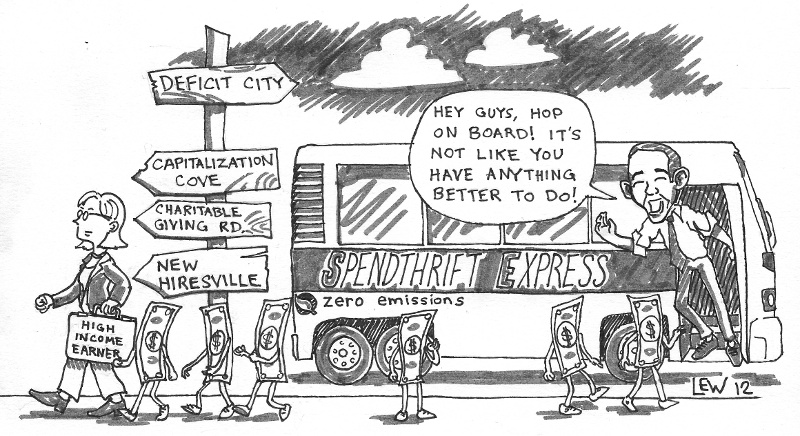
At the National Prayer Breakfast earlier this month, President Obama played up his Christian faith, declaring “for unto whom much is given, much shall be required.” Attempting to marshal scripture in support of his idea of fairness, he ended up inserting a theological foot into his political mouth by conflating God and government.  In this, Mr. Obama managed to betray an aloofness from mainstream churches as well as raise a troubling portent for civil libertarians.

With the words “much shall be required,” what else did the Central-Planner-in-Chief mean but to put the tax man’s moral authority on par with God’s?  Christians understand that God doesn’t compel anyone to obedience, but leaves each of us to our free will and our conscience.  By contrast, human government must compel its citizens.  Taxes are collected ultimately at the barrel of a gun.  That’s why the founders saw it as essential to limit what is “required” by the government.

During the Bush years, a handful of agitated liberals spawned a new book industry, warning of theocracy arising from the Religious Right.  If history’s any predictor, President Obama’s statement should launch a new wave of dire tomes warning against a theocracy of the Religious Left.  The social justice crowd that rallies behind Obama’s fairness push is out of touch with America’s exceptional ethos and experience: that a people, under the guidance of God and conscience, and free from a central meddler, have built for the world a Shining City on a Hill.

Besides conflating God and government, the President and his tax-the-rich allies have committed another type of unforced error in their moral reasoning.  Mr. Obama, investment wiz Warren Buffett, and retired Google exec Eric Schmidt have each, in recent times, implored that their own taxes be raised.  Their advocacy sweeps up all the fellow earners in their tax bracket, both the willing and unwilling.  How is this kind of appeal sensible?  It’s a perverse, inverted golden rule.  Like saying you personally don’t mind being bludgeoned, so it’s okay to bludgeon your peers.  It seems as if these folks are hoping your brain isn’t turned on.  Or maybe that you won’t notice theirs aren’t.  There’s a certain kind of arrogance in volunteering other people’s money.

So in a couple of ways Obama and company’s moral arguments are really lacking.  But don’t forget the facts about our nation’s recent Great Society redux.  Stephen Moore’s op-ed challenge to the White House fairness narrative provides us with a rich inventory of ways our big government has failed us to date .  Among the more salient is the mounting concentration of national wealth in the suburbs of Washington DC; the top three median income counties in the nation are clustered in the DC metro area.  Such a backslide of civilization would give any shameless, caviar-chomping commissar of Soviet-era Moscow a run for his money.  And we know that whatever part of our nation’s economic lifeblood that does not end up feeding a Falls Church jumbo mortgage tends to get lost in legislative backscratching or bureaucratic head-scratching.

Anyway you dice the tax dollar, Washington isn’t justified in its spending increases.  Given President Obama’s deficit deafness, and Democrats’ contorted fairness distractions, voters need to just say “No!” and oust the tax-grubbing big spenders this November.

World better without religion?

At some point, you’ve likely heard the lament that the world would be better off without religion.  You may have even unwittingly imbibed it this past New Year’s Eve, when Cee Lo Green covered John Lennon’s classic hit “Imagine.” The song starts famously:

Imagine there’s no heaven
It’s easy if you try
No hell below us
Above us only sky
Imagine all the people living for today

And in due course the listener is asked to imagine a world with “no religion too.”  What better way to kick off 2012?  I’m sure Times Square’s officiants Lady Gaga and Michael Bloomberg approve wholeheartedly.

Beyond the pop culture realm, but still in the confines of Manhattan, the Oxford-style debate forum Intelligence Squared US picked up on the same theme this October past.  For some time I’ve heard bits of their debates on NPR, but only recently did I bother to get the podcast.  Naturally floating to the top of my queue was the episode featuring the resolution, “The World Would Be Better Off Without Religion.”

The debate, held before an audience at New York University, was remarkable in that the pro- and con- teams were prohibited from discussing the existence of God.  At first this might seem absurd; whether  God exists or not is patently germane to the question of religion.  But the imposed restriction has the benefit of allowing the debaters to focus neatly on the social ramifications of religion.

Consider what religion is in the restricted sense of the debate: moral beliefs with social consequences, that happen to be theistic. Then listen to the debate participants in action, and the chief complaint becomes clear: people kill and oppress others on the basis of differing moral beliefs.  So, would any hypothetical, religion-free world be better? No.  We would only be exchanging a world filled with a diverse array of theistic moral belief for a world filled with a diverse array of atheistic moral belief.  That people hold moral beliefs, and differ from each other on those beliefs are immutable elements of humanity.  So is the fact that we are social creatures.  We cannot escape each other.  I suppose we can imagine a world of people in secluded pods, or one solely populated by clones, or else a world that is entirely monocultural.  But most people would rightly see such worlds as deeply impoverished and no improvement over our own.  An inescapable part of being human is living in a world with others who hold to different “oughts” and “ought nots.”

Let’s move from possible worlds to the historical record. For thousands of years, religion has presided over mankind, such that any given killer, oppressor, or victim for that matter, could in some sense be tagged by us as “religious.” Only after the Enlightenment do we start to see significant cases of self-identified irreligious individuals.  All we need is one instance where an atheist kills another atheist on the basis of differing morality to obliterate the idea that religion is uniquely harmful.  Consider who swung the ice pick that killed Leon Trotsky.  It seems someone thought he “ought” not have disobeyed Stalin.  Purging religion only allows new types of contentious belief to crop up and take its place. Religion doesn’t kill or oppress people, human wickedness does. Christians rightly recognize this as sin nature.

So, how did the Intelligence Squared debate turn out?  The pro-side, making the case things would be better without religion, persuaded more audience members at the end and thereby won.  Unfortunately, the con- debaters Dinesh D’Souza and Rabbi David Wolpe failed to decisively isolate the social idea of “religion” from man’s underlying wickedness.  But even if they effectively made that case, what other outcome could we expect from public broadcast patrons congregated in a New York university performing arts center?

That the finger of blame could be pointed toward oneself has been thoroughly expunged from our culture today.  It’s easier for some just to chalk our problems up to some conception of a social condition called “religion.”

Journalists, academics try to understand God and government

Here’s an interesting and recent headline from the Christian Science Monitor: “Does government do too much? That could depend on your view of God.”

Some folks at Baylor did a study on the intersection of small government conservatism and Christian faith.  When both the journalist and the academic undertake an investigation like this, I think there tends to be an outsider’s bias.  They are kind of scratching their heads, asking “Why on Earth would anyone think this way?”

At least the journalist MacDonald does a fair job by getting a counterpoint from Woodard, an academic with rightward sympathies.  Yet the article, sadly typical of mainstream media work, smuggles in the notion that conservatives are by nature angry.  Researcher Froese conjectures that since small government Christians tend to be poorer and less educated, they are probably anxious and depressed.  According to this line of thought, they are then given to believing in a wrathful and angry God.  But reading on about the study, one really wonders why the secular/liberal types who believe they cannot find the meaning of their lives wouldn’t be even more anxious and depressed.

To me it follows that any Christian who takes his faith seriously will have peace and hope.  I know somewhere there is a statistic that Christians actually achieve higher levels of education than the general population.  But ultimately, the article’s discourse is muddied by juggling so many overlapping identities.

Between the two opposing interpretations that Froese and Woodard offer on small government Christians, I have to commend Woodard’s view.  After all, it would take a fearful or angry liberal to have such an uncharitable view of his Christian neighbors.

Moral equivalence, tolerance, reciprocity

When specifics are at stake, when values are weighed, and when judgments must be passed, it seems American liberals cannot help but default to moral equivalence.

Take for example the post-9/11 semantic struggle for the word “terrorism.”  In an earlier era, terrorism clearly meant something like a plane hijacking or an embassy bombing; it was bad because it forced a government into an odious moral dilemma of either sacrificing innocents or legitimating violence as a means for change.  But with the War on Terror, many opponents were either too angry or wearied by the daily use of the “T” word to maintain the important distinctions of who, how, and why that makes terrorism so bad.  In their new parlance, “terrorist” became an epithet befitting the unrealistic black-and-white view that any exercise of force or the mere holding of power was bad.  Common was the claim that Americans were terrorists because they dropped bombs from planes or their ancestors once sniped British officers from treetops.  This dumbing down of the “T” word culminated in a bumper sticker featuring a quaint photo of four Native Americans with rifles at the ready.  Its caption: “Homeland Security–fighting terrorism since 1492.”  And so in a thumbnail sketch, the whole of our glorious and equitable American civilization was dismissed as no different from a band of murderous Islamo-supremacist thugs.

Not only can moral equivalence single-handedly dismiss a civilization’s rich heritage, its also a cover for those who don’t want to think too hard in comparing religions or considering their respective relation to truth.  In the midst of August’s “Ground Zero mosque” media madness, a telling exchange between Charlie Rose and Newsweek’s Fareed Zakaria demonstrated a shameful intellectual weakness that pervades mainstream journalism.  To them, the shared evil between Christendom and Islam was not violence or the threat of coercive force, but the idea of proselytization itself;  that is, the desire to share, spread, or submit for discussion that one idea or belief is possibly better than another.  It is anathema to their profession, which upholds objectivity and neutrality.  But in an existential twist, their reports in turn must be colored by a tolerance that is itself intolerant of exclusive truth claims.  All this is surely an overreaction to a past age when fears of patriarchy, conformity, and stigmatization of minorities were major concerns.  But if we can’t get beyond the hang up of stigmatization and the impulse of tolerance that begets moral equivalence, then we have no hope of solving our problems.

Oddly enough, the inability of journalists to admit their true feelings or core motivations gives them something in common with orthodox Islam.  They both are deficient in reciprocity.  While the vested partisans of Christendom have demonstrated a sustained capacity for self-criticism, reflection, dialog, and reform, no one under the sun of political correctness can bear to admit that orthodox Islam today is in want of those things.  When a religion’s unmistakable prescription for apostasy is death, and when a civilization propagates its ideas but cannot reciprocate openness to allow the honest consideration of others, there is a problem.  Any institution or social phenomena, whether it be a religion, a government, or the culture of professional journalism, cannot long survive without shedding illiberal bulwarks against the unfettered exchange of ideas.  Totalitarian states make no qualms about shutting up debate, but when American liberals run up against the hard facts of life, they all too often dull distinctions by means of moral equivalence.

To be sure, all individuals must be respected and judged on their own merits, not on their cultural background.  And while religions and cultural norms should be given due diligence, it does not hold that in the end they are all the same.