Does floating unfounded allegations of racism help Obama?

The other day I came across a commentary in the Christian Science Monitor that absolutely floored me.  Offered by two academics, McIlwain and Caliendo, its headline questions: “Is a pro-Romney ad racist? Five questions to ask yourself.

Apparently, the coauthors don’t think Democrats can ever make a racist appeal, so they only focus on the Romney campaign.  To them, it’s not a question of if but which of his ads will be racist.  As we’ve seen with Joe Biden’s  “unchained” appeal,” this myopic model leaves voters unable to account for racism when it actually happens.

You can’t find racism from the left if you’re only looking right.  But with advanced degrees in the humanities and social sciences, the coauthors command a toolkit that enables them to pick out the finest notes of that pesky racism “dog whistle.”  Funny though, only a self-selecting pool of liberal academics have the authority or ability to discern them.  Good thing they’ve taken the time to help the rest of us out!

The examples the coauthors provide in their commentary are tenuous at best.  They advance their arguments on mere possibilities.  Does this sound familiar?  Elements of Romney’s ads “could be interpreted” or might “imply” some kind of racism.  A string of possible but weakly supported claims puts the piece just a notch above Harry Reid’s completely groundless claim that Romney didn’t pay ten years’ worth of taxes.

In one section of their commentary, the authors warn against the deployment of stereotypes.  Their metric for determining a potential stereotype is wide, vague, and subjective.  They bar Romney from any avenue of attack, while allowing Obama to proceed. Consider this passage on criminality:

For instance, while the Obama campaign might charge that Romney is a felon – a strong attack to be sure – there is no historical association between whites – as a group – and criminality. That association is present with respect to blacks, however. Thus, the message functions as a stereotype, not merely a criticism of one individual.

Have you ever watched a Hollywood action movie?  The villain is always some rich white guy in a suit!

Or, think of the TV series 24.  Each season, there are two levels of bad guys.  The first wave of villains might be terrorists from a fictitious Middle Eastern country, a Mexican drug cartel, or maybe opportunistic African warlords.  But then, somewhere around hour 10 or 12, the ultimate culprit emerges: always a cold, well-heeled white guy who is an unscrupulous industrialist, a crackpot defense hawk, or otherwise a liberal’s gross impression of Dick Cheney.  And this from a show with supposedly conservative leanings!

Although not matching McIlwain and Caliendo’s cherry picked “historical” or “group” criteria, Team Obama’s felon accusation against Romney exploits a real Hollywood stereotype embedded in the American consciousness.

Indeed, racism was a serious problem fifty years ago, but some folks haven’t gotten the memo that things might have improved just a bit.  This fact is easily missed by those who can’t put down their Critical Race Theory books.

It is sad that unsubstantial claims of racism get undying attention in the media.  The effect, whether intended or not, is to silence genuine criticism and steer the conversation into divisive, unproductive territory.  Just by running McIlwain and Caliendo’s commentary, the Christian Science Monitor sanctions a free tarring of conservatives, a gift to Democrats and their allies.

From Palestine to Anaheim: culture matters

When Mitt Romney dropped by Israel a couple of week ago, he made an observation that the American media all-too-eagerly interpreted as a gaffe.  Drawing from a scholar’s work, the former governor contended that Israel’s relative economic success was a matter of “culture.”

In public conversation, this term has sadly become a stop word for latent prejudice.  And like a good student of the Western Academy, Palestinian spokesman Saeb Erekat demonstrated his fluency in the language of victimhood by calling Romney “racist.”

Back in America, progressives have been busy applying racial spin to a local governance conflict.  In Anaheim, California, activists–with help from the Southern California ACLU–are trying to budge the city council from it’s longstanding at-large representation system to a geographic, district-based one.  They reason that minorities, such as Latinos, have been been effectively disenfranchised by the current regime.  A spate of controversial police actions, including the recent killing of an unarmed man, have helped to propel the campaign.

Two years ago, a small New York village made headlines for a similar move.  After its existing system of staggered elections was ruled illegal, a federal judge bequeathed cumulative voting to Port Chester.  The village council went from being all white to having its first Hispanic, all thanks to elections that allow each voter six votes per office.  Yes, six votes!

The idea behind Port Chester’s civic miracle is degrading to the voter and the candidate.  An individual who identifies with an underrepresented group is supposed to gain representation by voting for the same person six times.  Meanwhile, the majority-status voters would presumably split their vote among several contenders.  Like affirmative action, cumulative voting robs the winning candidate of the confidence that he won on his own merit.  Rather, he can be sure the system was crafted specifically to boost him into office.

The proposal for Anaheim is scarcely better.  Activists have the implicit goal of changing the racial/ethnic makeup of the council.  It may be well intentioned, but it is unprincipled and works against the meritocratic ideal.  And like affirmative action, it is by definition racist.

Sometimes plans that play with racial demographics backfire.  This past primary election season, Redlands Democrat Pete Aguilar was expected to come into a newly crafted U.S. House seat, but was squeezed out by two Republicans thanks California’s new top-two runoff system.

Who is to say if Anaheim switched to district representation, that a Latino would accede to the city council?  Maybe the downtrodden denizens would opt for a Ted Cruz-like Hispanic conservative.  Given the root of the problem, gangs and crime, it would not be surprising if a law-and-order type won.  Not exactly the result progressive activists were aiming for.

Rather than spend sums on lawsuits and campaigns that are ultimately uncertain, progressives should just come out and move a well-connected, rising star Latino Democrat into the city before the next election.  It’s not like they are serious about the underlying issue: culture.

Plenty of smart, reasonable voices tell us culture matters.  Charles Murray has put decades of research into his latest tome, calling on America’s privileged to spark anew in their working-class neighbors the values that drive success.  And Richard Landes backs up Governor Romney’s recent observations on Israel.  But these folks just don’t get play in the liberal world.  Mainstream journalists thrives off of the sensational, but talk of culture upsets their own sensibilities.

As human beings, we are not merely members of our own little tribes, but individuals who reason.  We all are agents that react to incentive, and culture is the framework that shapes our agency.  It’s upsetting to some, but well-meaning government aid programs can breed dependency.  Obscuring your face with a hoodie as a fashion statement can inculcate mistrust.  A Hollywood actress who elects to become a single mom can sanction for some poor, distant child a difficult upbringing.

The values we choose make a difference.  Culture matters.

Shared sacrifice

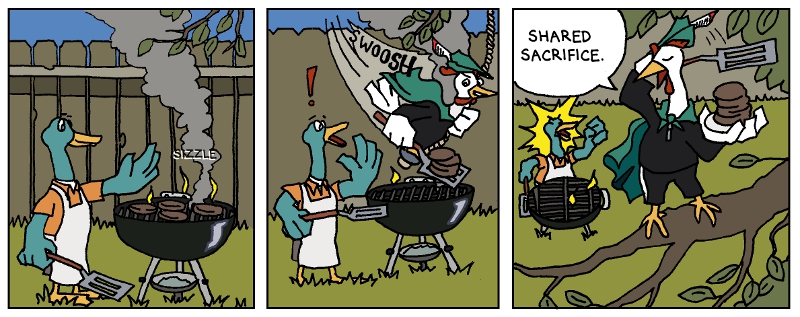
President Obama unfurled a new school yard taunt this week, calling his challenger “Romney Hood.”  The moniker piggy backs on a study crafted by definitively left-leaning groups that presume to know the details of Romney’s future budget proposals.  Supposedly, Mitt Romney will balance the budget on the backs of the middle class.

But if anyone is taxing the middle class, it’s surely President Obama.  After all, the Supreme Court ruled in June that the penalty component of his Affordable Care Act is for all intents and purposes a tax.  Many who will be paying the new tax will be younger, less-established workers, the up-and-coming who are in many ways at the heart of economic growth.  That is, unless a Republican President and Congress are able to intervene at the start of 2013.

Is the “Romney Hood” label even fitting?  Maybe if you interpret the hugely successful capitalist as Atlas Shrugged pirate Ragnar Danneskjöld, a man who steals from corrupt “people’s republics” and bequeaths gold bars to cloistered industrialists.  However, the “tax cuts” that President Obama perennially refers to are not stealing from anyone.  Continuing with the ten-year-old, boring, existing rate is merely allowing high income earners to keep more of what is rightfully theirs.

If we examine the President’s rhetoric about income and wealth, it’s clear he has little real regard for the deep American tradition of ownership, particularly that which comes from “earned success.”  Consider his 2008 retort to Joe the Plumber, that all he wants to do with the little extra taxed income is “spread the wealth around.”

In 2010, and even into 2012, the President repeatedly sprinkled his speeches with references to “shared sacrifice.”  This is meant to conjure up thoughts of selflessness and nobility: folks who step up and offer voluntarily for a good cause.  But how are new taxes “sacrifice” when they are ultimately collected at the barrel of a gun?  This rhetoric ought to be seen as embarrassing and sloppy by all observers.  The rights to the fruits of one’s own sweat and toil, time and treasure are ultimately discarded by such a line of reasoning.  Utterly chilling.

If what we’re concerned with is a green-hooded robber running around in the woods and seizing wealth, we should be more wary of the man who has spent the last three and a half years in the Bully Pulpit than we should be of his challenger.

Water bottles and other campaign debris

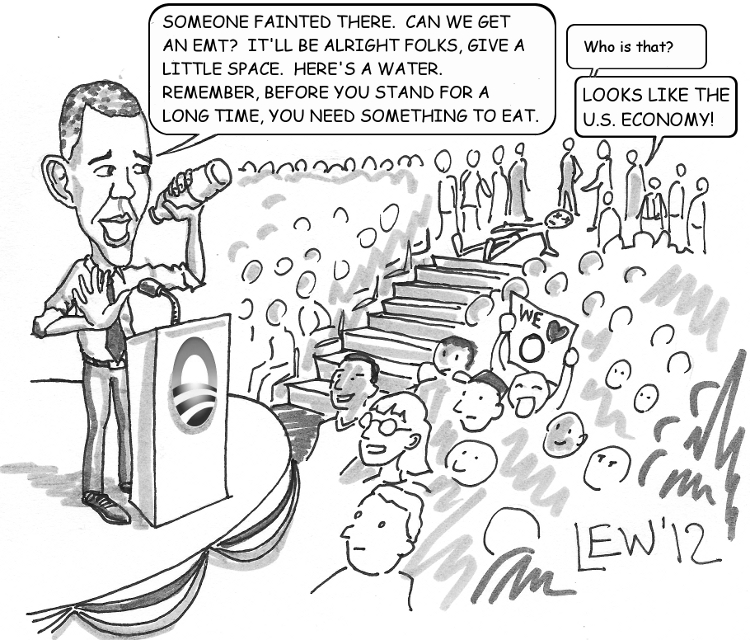
Ever since 2008, conspicuous fainting episodes have occurred with bizarre regularity at President Obama’s campaign rallies.  Some wider attention came earlier this week when Obama, who offers a consistent, canned response to these potentially serious collapses, inadvertently called for a “paralegal” instead of a paramedic. Michael Medved, who has documented this phenomenon since the beginning, has a good point regarding the displays: how does the Commander-in-Chief know it’s just a swoon and nothing more serious?

The fainting routine, with Mr. Obama’s predictable admonition to eat food, drink water, and remain calm,  is quite possibly meant to bolster his image as a confident, competent leader. He can have own mini Bush-with-a-bullhorn moment, giving gentle nanny state prescriptions that earn laughter from the adoring crowd. But one Medved caller this week had an alternate take: with the president habitually 20-60 minutes late to appointments, and belting out stump speeches nearing an hour, it would be no surprise if the fainting fans were genuine and not crowd plants.

Why do mainstream journalists, the “dinosaur media” if you will, turn a blind eye to Obama and his fellow Democrat’s campaign gimmicks?  Who knows what other minutia have gone undocumented while the media combs over Romney’s vacation photos, his financial arrangements, and his 1999-2002 status at Bain?

Of course it’s the substance and not the minutia that matters.  Yet, it was with some pain that I learned of new–if trivial –criticisms from two Hollywood geek icons.  Mark Hamill, the actor who played Luke Skywalker in Star Wars, recently knocked Mitt Romney as “not human.”  His critique hinged on how awkwardly the governor responded to a sip of lemonade.  Really?  Hamill’s observation rivals Matt Damon’s fearful, perhaps bigoted babble from 2008 that managed to mention Sarah Palin, dinosaurs, and nuclear codes in the same breath.

Giving good company to Hamill is Wil Wheaton, who played the star ship’s resident whiz kid on Star Trek: The Next Generation.  He took the occasion of a recent George Bush interview to lament the loss of life and treasure the 43rd president instigated with a “war of choice.”  It’s regrettable the actor doesn’t understand that jihadis have free will or that all wars are embarked upon as a deliberate exercise.

The men who once played space teens on film and television can now–fittingly enough–join Cher, who apparently left Earth so she could avoid breathing the same air as Mitt Romney.  Celebrities’ reflexive gags make nice conservative water cooler talk, but they also indicate just how impervious some sections of the country are to reality.

Let’s return from our Hollywood excursus to Washington, where we get a different taste of the same liberal worldview.  The media, after four days of burying its head in the sand, has reluctantly picked up on President Obama’s “You didn’t build that” gaffe.  And while ABC moved quickly to paint it as out of context, The Wall Street Journal’s James Taranto insists the gaffe was a genuine betrayal of a deeply liberal inner attitude.

If you read the wider quote from Obama, Taranto has solid reasoning: “that” refers to the singular and proximate “business.”  Obama would have said “those” if he were referring to the earlier bridges and roads.  Yet, I would entertain the possibility of a simple slip up, since “you didn’t build that” has more of a rhetorical impact than “you didn’t build those.”  It also reminds us of MC Hammer’s sweet refrain, “U can’t touch this.”

Is all this attention unfruitful nitpicking?  Not inasmuch as it draws focus to the real and gaping philosophical chasm that separates Democrats from Republicans.  Undeniably, economic policy is ultimately driven by a sense of who “owns” growth and success.

What does lack substance is the liberal canard that the rich need to “pay back” for all they’ve been given.  Not that Republicans deny a need for some government in the first place!  High income earners already pay much more than the rest of us under our already progressive tax regime.  And all the while, we can’t deny the abounding opportunity that many of those earners’ businesses provide.

There is no need for top income earners to pay “us” back or forward, for that matter.  But we could use comprehensive tax reform, a closing of loopholes and lowering of rates that Romney and a Republican Congress will deliver if elected.  If only our electorate can navigate the field of campaign season debris first.

ABC News: Romney might be a felon

ABC News is running hard with an unsubstantiated accusation that Mitt Romney might be a felon.  At the time of this post, it’s square and center on their homepage.

Earlier in the day, a less virulent form of the story parlayed–seemingly from out of nowhere–factcheck.org’s smackdown of Team Obama’s outsourcing charge into a suggestion of Romney’s culpability:

But, as fact checkers note, Team Obama does not provide any specific evidence to back up claims that Romney was actively managing Bain between 1999 and 2002.

If they had, Romney could be liable for felony charges in court for lying in sworn statements.

The follow-up story by Matt Negrin makes clear reference to a Boston Globe report and White House campaign fodder suggesting a possible crime.  Yet, Devin Dwyer’s earlier report, deficient in these references, ends up looking like a random mulling of counterfactuals.  If more mainstream journalists followed Dwyer’s pattern, we might see some other hypotheses regularly floated as objective reporting:

If the unemployment rate were two percent lower today, President Obama’s campaign would not be in such rough shape.”

If President Obama attended church regularly, fewer people would be confused about his religion.”

If President Obama had chosen a Fat Tire instead of a Bud Light for the Beer Summit, he might have locked up the LGBT vote.”

Dwyer’s report can be consigned to a bin of recent, poorly written pieces, among which we can include Virginia Heffernan’s universally indecipherable response to Ann Marie Slaughter’s work-life balance essay.  If nothing else, it shows just how eager mainstream reporters are to associate Republicans with criminality.

Resurrecting birtherism, questioning leadership

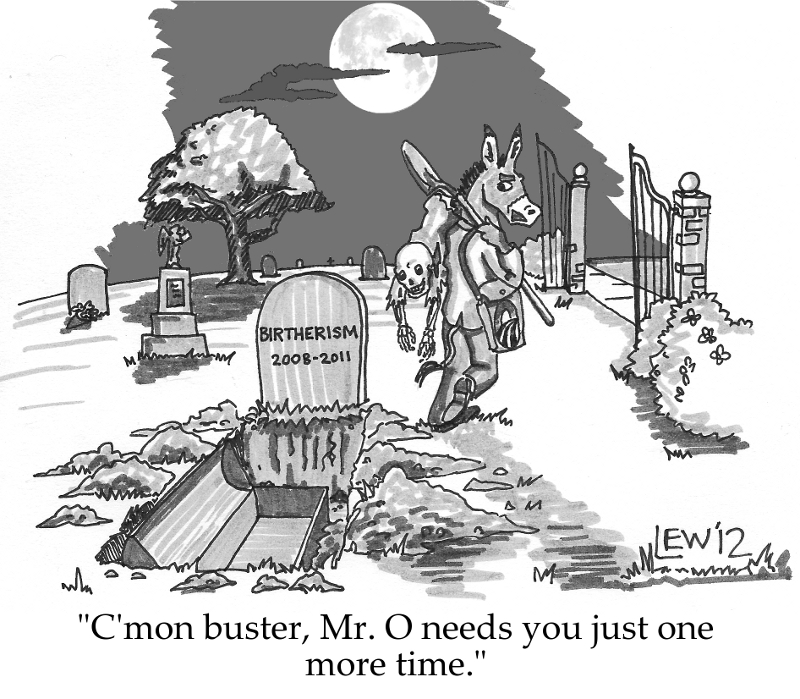
The Obama campaign resurrected the birther bogeyman this week with the release of a video questioning Romney’s ability to lead in light of his ties to Donald Trump.  This is an odd accusation coming from a president who forfeited leadership in shaping Obamacare, his crowning achievement, to his Democratic allies in Congress.  Meanwhile, his best claim as a bipartisan leader is the glorified photo-op of playing golf with John Boehner.  Much good that did.

Ed Klein’s new book, The Amateur: Barack Obama in the White House, reveals just how incapable a commander the president has been. In a recent Michael Medved interview, Klein contrasted Obama’s lack of day-to-day communication with President Reagan’s warm and regular phone calls to Democrat House Speaker Tip O’Neill. Today, Obama’s allies, to say nothing of his opponents, complain they never hear from him.  Maybe he’s been out on the links too much?

The biggest danger President Obama presents is not his race, his place of birth (Hawaii, USA) or his alien religion (secular liberalism). It’s his incompetence. This, combined with his unpopular, stubbornly-held big government liberalism, is why his campaign must constantly churn out red herrings like the birther issue.

Make no mistake.  Romney may not be the warmest character or give you leg-tingles, but his substantial experience heading up real, successful, and reputable enterprises give him a serious advantage over the incumbent, whose rock star status sheltered him and left him clueless as to how an executive should actually operate.

Prairie fire and cowpies make campfire politics

What happens when an unstoppable force hits an immovable object?  Who knows.  The more pertinent question for this past week: What happens when a prairie fire hits a pile of cowpies?

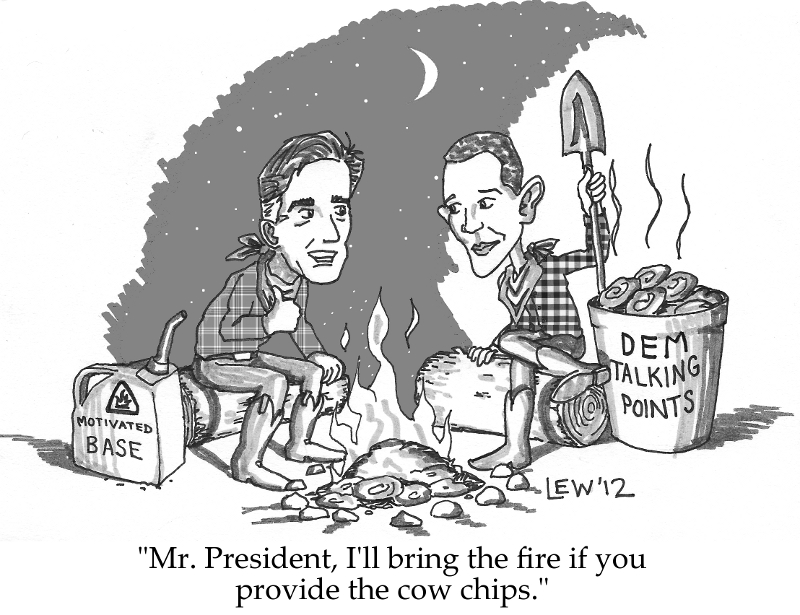
Both Mitt Romney and Barack Obama have been tweaking their rhetoric for Iowan ears.  Responding to Romney’s accusation that he’s tended over a “prairie fire of debt,” Obama has described his opponent’s criticism as a “cowpie of distortions.”  Our President continues to debase the discussion with a vulgar allusion to a steaming pile.

Meanwhile, the White House and the Left have tried to play off of the ill logic of Rex Nutting, who contended earlier this week that Obama has grown Federal deficits at the lowest rate since the Eisenhower administration.  Many observers have debunked this idea.  James Taranto put it well when he noted that Obama has treated Bush’s one year, necessary TARP swell as a baseline for subsequent years’ Federal budgets.

It’s as if you, the head of a household, assented to spending $10,000 to repair a sudden, gaping hole in the roof one year, but decided to keep spending that same extra amount for each of the three following years.  And this spending is not on other emergencies, but pet projects.  All the while, you claim to be a fiscal hawk because your spending hasn’t grown significantly since the initial boost that you approved when you first came in.

So Romney’s prairie fire claim isn’t so . . . smelly after all.  What we’re left with is a challenger with a base itching–on fire, in fact–to vote out an incumbent whose campaign and allies never seem to be in short supply of well, cowpies.  At least you can dry them out and use them for fuel.

Duel of the embattled visages

You know how news websites usually have a most-read stories box.  Sometimes, the Christian Science Monitor inexplicably has an old report at the number one spot.  Earlier this week, a January story critically probing Mitt Romney’s record at Bain Capital was on top.  The lead photo struck me as over the top in conveying the anti-business tone of the article.

Christian Science Monitor

From the side, a harsh light defines the subject’s face.  Squinty-eyed, she stares off into the distance, as if in the midst of a hardscrabble existence.  We know she’s not happy.  Maybe you can imagine the photographer coaching her, “No, not quite.  Try to look a little more . . . off-put.  Turn your head just a little more to the left.  That’s it.”

The photo surely recalls an iconic image from one of the more trying times of last century.

Migrant Mother, Dorothea Lange, 1936. Wikimedia.

I wouldn’t try to question the artistic merit of Lange’s photography.  But given today’s sensibilities, to stumble upon such a spitting facsimile of her work’s form and style ought to puzzle if not disturb us.  In Lange’s time, America was reaching, in ways more benign than in other parts of the world, its own totalitarian zenith.  Government drafted artists en masse to produce, well, propaganda.  And surely, that’s what Lange’s work is: biased, and with a story to tell.  This is not bad in itself, but in our jaded, post-Vietnam, post-Iraq culture, there’s a double standard at work.

It’s routine and accepted for journalists to play up poverty as grinding.  But they can’t allow themselves to show private sector success as uplifting.  Not alarmist enough, or in tow with liberal media execs’ worldview.  When we hear or read “Bain Capital,” we expect to see grizzled profiles rather than glowing families.  Such a sustained slant is pernicious to our way of thinking, and in turn to the way we live.  At least there are those who would straighten the record.

President Obama’s off-base

The White House’s campaign messaging has been all over the place in recent weeks.  And contrary to his 2008 promise, the President has come off as more of a divider than a uniter.  Not to be confused with President Bush, who was mocked for proclaiming himself the “Decider.”

The Obama team’s trail of message wreckage started with February’s awkwardly handled contraception mandate work around, which, for all the trouble, still leaves some religious organizations paying indirectly for services they find unconscionable.

Then, erupting inconveniently last week was President Obama’s personal “evolution” on gay marriage. Many observers saw the President’s hand forced by discretion-challenged Vice President Joe Biden.  What’s most vexing about this iteration of the marriage debate is not the particular stance taken, but the justification as to how one arrives there.  Biden baffled us all with the idea that the 1998-2006 sitcom Will and Grace was for him some pivotal, moral tour de force.

As one poll shows, Obama and company seem to have alienated swing voters on the social issues.  But  they have tried mightily to boost their standing with female voters, trumpeting the 2009 Lilly Ledbetter Fair Pay Act as a great and early first term accomplishment.  All the act does is give women more time to sue their bosses for the phantom menace of wage discrimination–a boon for Democrat’s loyal base of litigious attorneys.  Touted as historic and consequential, the act is only known because the Obama team has dusted it off as a showpiece for the 2012 campaign.

Indeed, the Ledbetter Act featured prominently as part of the Life of Julia, a fictional every-woman whose slideshow biography was quickly and widely ridiculed for its earnest portrayal of a hopelessly lonely, overly dependent, Obama-centered life.  Rather than making the conventional, family-oriented “Harry and Louise” kitchen table-type pitch, The Life of Julia deliberately caters to the fervent, perennially disaffected fringe that is Obama’s base.

To see just how hard the Campaigner-in-Chief has tacked toward those who self-identify as embattled and aggrieved, we need only look to the recent “dueling” commencement speeches delivered this past week.  Conservative commentator Michael Medved noted that of all the colleges in the country he could have spoken at, President Obama chose the elite, astronomically expensive Barnard College.  His audience at the women’s liberal arts college was a particularly concentrated sample of privilege: women now far surpass men in educational achievement by the numbers, from undergraduate enrollment to attainment of advanced degrees.  Yet, the faculty and students were ebullient when the President was introduced as one who appointed so many women and minorities to the highest offices.  Meanwhile, Mitt Romney’s receptive audience at Liberty University, with its larger student body and more affordable tuition, was a far more representative cross-section of America, on the socioeconomic level not to mention anything of gender representation.

The White House has garnered a few days’ media attention on other issues: “spiking the football” at the anniversary of Osama bin Laden’s death, and the economic distractions of the Buffett Rule and the student loan rate relief.  The former was no help to the incumbent, with liberal Arianna Huffington calling one Democratic campaign spot “despicable.”  The paltry Buffett Rule captures more class resentment votes than it would actual marginal revenue from the wealthy.  Likewise, the playing up of the student loan rate extension nakedly caters to the college age vote, while dangerously distorting market decisions about the relative value of earning a degree.

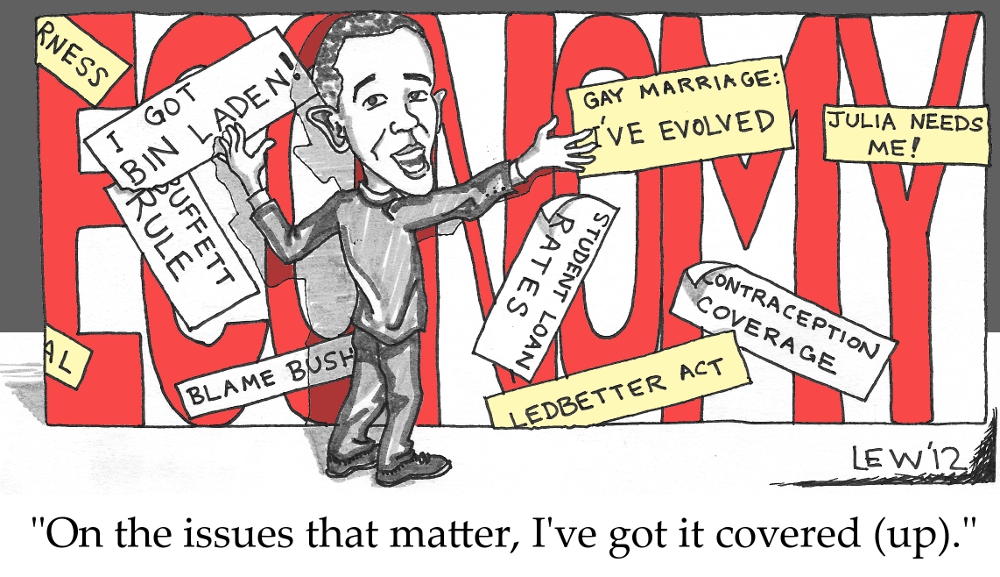
All told, the President seems pretty set on stoking his base with the visceral fuel of social, class, and identity politics.  Meanwhile, substantive solutions for the economy, as well as the sensibility of swing voters, remain neglected.  Sending Biden around with the fib that he’s working class will only go so far.  We’ll see in the months ahead if the Obama team can refocus, or if Romney, sticking to the economy and clearly rising, can build and maintain a respectable distance.  Let’s hope so for our country’s sake.


How Buffett bluster boomerangs; or, Taxosaurus Rex

The unvarnished rhetoric coming out of the White House over the past two weeks has been just too delectable for conservative commentators.  In a recent WSJ piece, Daniel Henninger suggests that Democrats’ furious assault on Paul Ryan’s budget plan is desperate “thermonuclear” overkill.  Indeed, all the accusations of Social Darwinism and “trickle-down” economics cannot make up for Democrats’ utter lack of seriousness when it comes to the national debt.

As the White House rolled out the practically inconsequential yet politically expedient Buffett Rule this week, I was amazed at the justification given by allied economist Alan Krueger.  The Christian Science Monitor quotes:

“In addition to fairness, in fact it’s a step in the direction of economic efficiency,” said Alan Krueger, chairman of the Council of Economic Advisors. The Buffett rule allows people to “devote more effort what their focus should be, which is to their jobs and job creation … rather than restructuring their income to minimize their taxes.”

He’s alleging that the tax increases economic efficiency.  But how does government spend anyone’s money better than they themselves would?  During the global high tide of state central planning in the 1940s, F.A. Hayek explained cogently in his The Road to Serfdom who spends money best: the one who earns it.

When given other people’s money, legislators face the temptation of buying constituents’ votes with pork rather than allocating it wisely.  Then the money goes to bureaucrats, who are not careful enough with it.  Their lack of accountability flows from the political difficulty of de-funding them.  It is the original income earner who best appreciates the sweat and effort it took to get the money.  She appreciates the reality that her income might dry up tomorrow, and so will handle it more carefully than the central planners.

According to his critics, the car elevator in Mitt Romney’s mansion is a bad thing.  But he used his own money, which he only earned in the first place by benefiting others in voluntary transactions.  And the construction provided gainful employment to all sorts of craftsmen.

President Obama, meanwhile, either had to grow our debt or tax money out the economy to give us public project flops like Solyndra and the constipated stimulus weatherization projection.  Money that otherwise would have been carefully spent in private hands was squandered by legislators and bureaucrats.

Of course, not all government spending is bad; some spending is necessary.  But Krueger’s claim that a tax increases efficiency overlooks government’s great tendency towards inefficiency.

The case against the Buffetteers may be clearer when we look at that favorite magic word of progressives and liberals, “investment.”  Any public project from education to high-speed rail becomes an unmitigated good if it can be spoken in terms of investment.  But our current, low tax rates vindicate private investments as an even greater good.  This is why Buffett and Obama pay less in taxes than their secretaries.  The Monitor quotes Marco Rubio:

“What [Americans] need to understand is the reason why he may pay less than his secretary, in terms of the rate, is that she makes her money on a paycheck and he makes his money on investments,” Senator Rubio said. “We have always wanted Warren Buffett to, instead of putting that money in a coffee can, to take his money and invest it, because that created jobs.”

As much as the Buffett-minded would increase taxes on private investment earnings, they would demolish the incentive to invest and crash the stock market.  In this way the Buffett Rule boomerangs back on itself.

Class envy can’t lift up the poor, but it can bring us all down.  Let’s all move past the Buffett distraction.