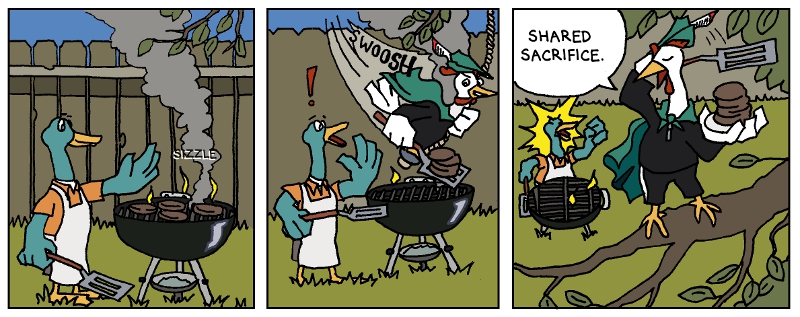
Shared sacrifice

President Obama unfurled a new school yard taunt this week, calling his challenger “Romney Hood.”  The moniker piggy backs on a study crafted by definitively left-leaning groups that presume to know the details of Romney’s future budget proposals.  Supposedly, Mitt Romney will balance the budget on the backs of the middle class.

But if anyone is taxing the middle class, it’s surely President Obama.  After all, the Supreme Court ruled in June that the penalty component of his Affordable Care Act is for all intents and purposes a tax.  Many who will be paying the new tax will be younger, less-established workers, the up-and-coming who are in many ways at the heart of economic growth.  That is, unless a Republican President and Congress are able to intervene at the start of 2013.

Is the “Romney Hood” label even fitting?  Maybe if you interpret the hugely successful capitalist as Atlas Shrugged pirate Ragnar Danneskjöld, a man who steals from corrupt “people’s republics” and bequeaths gold bars to cloistered industrialists.  However, the “tax cuts” that President Obama perennially refers to are not stealing from anyone.  Continuing with the ten-year-old, boring, existing rate is merely allowing high income earners to keep more of what is rightfully theirs.

If we examine the President’s rhetoric about income and wealth, it’s clear he has little real regard for the deep American tradition of ownership, particularly that which comes from “earned success.”  Consider his 2008 retort to Joe the Plumber, that all he wants to do with the little extra taxed income is “spread the wealth around.”

In 2010, and even into 2012, the President repeatedly sprinkled his speeches with references to “shared sacrifice.”  This is meant to conjure up thoughts of selflessness and nobility: folks who step up and offer voluntarily for a good cause.  But how are new taxes “sacrifice” when they are ultimately collected at the barrel of a gun?  This rhetoric ought to be seen as embarrassing and sloppy by all observers.  The rights to the fruits of one’s own sweat and toil, time and treasure are ultimately discarded by such a line of reasoning.  Utterly chilling.

If what we’re concerned with is a green-hooded robber running around in the woods and seizing wealth, we should be more wary of the man who has spent the last three and a half years in the Bully Pulpit than we should be of his challenger.

Chick-Fil-A and the language of (in)tolerance

A few days ago, Boston mayor Thomas Menino told burgeoning restaurant chain Chick-Fil-A it was not welcome in his city.  Responding to chain president Dan Cathy’s personal opinions–on city letterhead, no less–he decried the restauranteur as “prejudiced,” insisting there’s no room in Boston for “discrimination.”  He concluded that to allow Chick-Fil-A in his city would be an “insult” to gay couples whose marriage ceremonies he proudly presided over.  Fellow mayor Rahm Emanuel soon tried to one up Menino by appealing to “Chicago values,” an incredible claim for a place which, politically speaking, is a values wasteland.

Menino’s letter in particular is unwarranted in its use of charged language.  He and his allies have read base motives into Dan Cathy’s recent comments, which were issued earnestly in a radio interview.  If you listen, it’s clear he’s not hopped up on hate, or motivated by bigotry; his words flow from a reasoned, sincere conviction.  Neither has his company been yet charged of legally-actionable discrimination.  The mayors and their fellow critics are free to dislike Cathy and his firm, but while their claims of prejudice and discrimination go unsubstantiated, they cannot be taken seriously.

Some have justified their indignation by pointing to Chick-Fil-A’s past charitable contributions.  Media reports (here, here, and here) have alternately labeled Cathy, the company, and the donation recipients as “anti-gay” for ultimately opposing same-sex marriage initiatives.  But within these reports, the label goes unexplained and unchallenged.  The reader must naturally take it to be descriptive of one who is against gay people themselves, an utter slander that people of good will ought to reject.

In a similar fashion, the broad, vague charge of “homophobia” came with coverage of Google’s recent “Legalize love” campaign.  To call one homophobic is just as destructive to discourse, as it imparts a motive of irrational fear to the one being described.  In popular usage it is synonymous with hate.

These words ought not to be bandied about by press claiming fairness and objectivity.  Yet, media have a long, bad habit of describing conservatives as phobic and painting them in “anti” terms, as in anti-abortion or anti-spending.  Pro-choice advocates are never referred to as anti-unborn or anti-child.  Deficit spenders are never called anti-frugal.  This is a function of the Orwellian intersection of the tolerance paradigm and positive rights.  Tolerance as presently understood never allows us to question the ever-expanding field of rights, even though reason assures that absurdity must ensue at some point.

Those who want real tolerance have to abandon these loaded terms that implicitly judge the hearts and inner motivations of other individuals.  The hypocrisy of using such labels hurts one’s own cause as much as the conversational climate at large.

Fortunately, the mayors have backed off a bit from their testy declarations.  As the controversy continues to roil, may more people become cognizant of the language used, and realize that same-sex marriage opponents should not be automatically equated with bigots.  We all carry our own personal experiences, shadowboxing with traumas of the past.  Let’s not allow these to cloud an important and necessary conversation.

Spirit guide

Humor is a subjective thing, so I’ll fill you in on the gaps.  Our pig of course shares a lack of certain scruples with Elizabeth Warren.  The totem gig comes from two sources.

First, I heard interviewed last year on The Michael Medved Show a remarkable performance artist.  She was commissioned via Kickstarter to circumprostrate herself around Mount Rainer.  It’s not as dirty as it sounds.  From all the bowing down, I guess there’s a spiritual dimension to it, but I can only scratch my head in wonder as to who paid for this and why.  Nonetheless, as a free marketeer I say more power to this woman if she can get people to pay her for her art.  It’s something I’m working on myself.

The second part of the totem reference also originates in the Pacific Northwest, which is a sort of epicenter of ecological writing.  There’s a whole lifestyle and philosophy that’s captured by folks like now-retired English professor and poet Gary Snyder.  Early in life, he saw the world as a merchant mariner, caught Zen Buddhism, and subsequently married it to Native American spirituality among other things.

From time to time in my day job, I encounter some works in this tradition.  I find the children’s literature to be especially striking.  One story book features a privileged white kid who is empowered by the spirit of Raven to oppose some mean guys in hard hats who cut down trees for a living.  Another encourages children to connect to “place” and maybe discover for themselves a special inspiring animal, or totem.  As the child of one Asian immigrant (and a native-born American) I can’t help but be tickled by how my fellow, privileged Americans turn from their rich heritage in search of more resonant truths.  By accident or providence, I’m on the opposite end of the divide from those Beatniks and baby boomers disaffected with Western modernity.  Once I came upon the scene, I was taken with the strange idea that America is a singular land of opportunity, that democracy and free market enterprise were vindicated by the end of history, and that we all have God to thank for it.  I still hold to this, by the way.

There’s one more piece to the punchline, if like me you don’t recall much of ancient literature.  It’s that Gilgamesh is 2/3 god, and 1/3 mortal.  But how does one get such a proportion of pedigree?