Stigmatize gun ownership like smoking?

The Christian Science Monitor continues to astound with its idiocy.  One recent Monitor headline described the belligerence of Hamas as mere “military action.”  This when their signature mode of armed conflict–rocket attacks–consists in the indiscriminate targeting of Israeli civilians.  So much for the idea of terrorism.

Now, the Monitor‘s editorial board suggests gun violence can be curbed by a public perception campaign akin to that which stigmatized smoking.  What would this look like? We can imagine the Ad Council cartoon propaganda now: a bratty, freckled blonde boy, sporting a sideways baseball cap, growls, “Hey bro, owning guns is not cool.”  Will subjecting upstanding, law abiding gun owners–who are generally paragons of civic responsibility–to such a silly and divisive psychological campaign really help?

There are better stigmas to promote instead. When Hollywood celebrities earnestly “demand a plan” of politicians while remaining unapologetic for their own glorification of gun violence, we ought to stigmatize their hypocrisy (and chuckle given their unintended fulfillment of this prophetic Portlandia parody). When our society allows severe mental illness to remain untreated out of fear of institutionalization and the corresponding desire for maximal autonomy, we should stigmatize indifference towards such danger.

Michael Medved is right when he declares that gun violence is a spiritual rather than a material problem. Prisoners of progressive thought are always trying to stigmatize material things.  They say SUVs kill the earth, or guns kill people.  At least the market tinkering of “cash for clunkers” had the probable effect of increasing the nation’s overall fuel efficiency.  But gun buybacks only decrease the ratio of gun ownership between law-abiding citizens and criminals.  Why is it ever good for criminals and murderers to have relatively more guns than the population at large?

The Monitor editorial also suggests an expansion of non-gun-owner rights along the lines of “non-smoker rights.”  Please, everyone, we have to think more carefully about rights!  We can’t just keep making up new ones.  Especially ones backed by stigma.  Have the editors at the Monitor forgotten that stigma–based on the materialistic concern of skin color–once supported the Jim Crow “right” for whites to not share public accommodations with blacks?

Rather than invoke stigmas based on material things, let’s stigmatize undesirable attitudes and behaviors instead.  We can start with the unfounded hysteria over gun violence.

Is higher education really in crisis?

20130123.capandgown

I received a friendly invitation from Consider Again to comment on his latest post about the higher education bubble.  In making my comment, I found I had a full blown post.

Indeed, the bubble exists.  There is an “irrational exuberance” on the part of consumers with respect to higher education.  For deeply ingrained cultural reasons, demand for the product is highly inelastic.  It would be cathartic for the bubble to burst.  Better yet, for it to gently deflate.

The idea of crisis or a problem with higher education itself is largely illusory.  The real problem is that so many people expect the four year college experience to supplant a maturation process that should have happened while the child was still at home.  The problem will resolve only when our culture accepts that college should not be a necessity for each individual’s success.

It seems consumers value higher education for two distinct purposes.  First is the classic humanist ideal that education helps you become a better person.  Second is the economic utility that comes from enhancing the future marketability of the student’s labor.  Our society suffers needlessly for expecting higher education to deliver these two values together.  We’d do better to ensure that formation of a good citizen comes first, and is effectively carried out by the K-12 system.  Then, if parents and students choose, they may pursue higher education to enhance job prospects or to gain admittance into specialized careers.

The ongoing failure of the K-12 system to consistently produce well-informed citizens is a major drag on higher education.  There’s misguided pressure on universities to make up for that failure.  The University of California campuses implement some form of a “general education” requirement that is supposed to ensure a well-rounded experience.  But why duplicate what should have been done at the K-12 level?  At least the system could excuse students who grew up in state and should have already met the state’s basic standards.

Consumers aren’t the only ones to overestimate the value of an education.  The producers are just as off-base.  State universities are keen to stay competitive with top private universities that thrive off of massive endowments.  Neither state nor Federal taxpayer dollars can make up the gap for administrator salaries or luxury dorms in the higher ed arms race, let alone keep up with the steadily rising cost of worker health and retirement benefits.

This reality of course irks those who read a progressive sense of fairness and equality into the land grant mission.  But look how land grant universities started.  Only a small fraction of the work force utilized the system.  In the postwar period, that fraction grew remarkably.  Stuck between ever increasing enrollment, a highly competitive environment, and an all around disdain for tuition hikes, land grant schools have become just another victim of rising expectations.  It would take a very brave university president or chancellor to level with his or her community and declare the truth that too much is being offered to too many for too little.  Something has to give.

Then again, remember the higher ed crisis is illusory.  Like the White House’s current gun control drive, this is a propped up anxiety meant as news fodder.  The reality is that any prospective student worth her salt has the ability to take stock of a vast array of potential educational options, earn, borrow, or be awarded money for that end, and set goals accordingly.  A pricey four-year university education may be what she needs.  Then again, some of the happiest and most well off people in our society are those who never went to college.

The Low Info Express

20130101.lowinfoexpress

Happy New Year!  We’ve gone over the fiscal cliff, thanks to the capable leadership of President Barack Obama.  It was just a tiny pipe dream when Democratic senator Patty Murray urged it a couple of months ago.  Now, it’s a reality.

Republicans have been pretty miserable in the midst of this journey.  Fingers have been pointed at Mitch McConnell and John Boehner.  But who could blame them when the real problem is the weight of public opinion?  Polls showing the public blaming Republicans more than the White House tell us all we need to know.

Among conservatives, the calls for more backbone and a greater articulation of ideas continue.  But Democrats will maintain leverage as long as “low information voters” are in their corner.  They’ve got the bully pulpit and the media.  Meanwhile, the majority of  Americans continue to be concerned with less . . . pressing things.  How can conservatives rally to get America out of its bind?

I was inspired by the simplicity of a book I received as a gift over Christmas: Tactics: A Game Plan for Discussing your Christian Convictions by Gregory Koukl.  If you’ve followed this blog you know that I freely mix politics and apologetics.  I’m not a fan of preaching to the choir, or of drawing out the secret army of people who think like me.  Rather, I take the long view in hoping to persuade others as to their basic beliefs.

As you can surmise from the title, Tactics is primarily about having discussions with others.  What’s striking about Greg Koukl’s approach is that the goal is modest.  When he engages someone in conversation, he’s not out to completely change their views in a half hour.  Rather, he wants to jump start their thought process, or put a stone in their shoe, as he so often says.  After all, most people have not sat down and thought through their most basic beliefs.

Whether it’s politics or religion, the majority of folks are not staunchly rooted in one camp of belief, but are just content to go along for the ride.  Epitomizing these are the low information voters who ushered in President Obama’s second term with all its fallout.

The long slog that conservatives should embrace is the everyday task of gently questioning their neighbors’ assumptions.  This is something that comes on all fronts, from the messages of movies watched and songs listened to, to expectations of government and understandings of human nature.  It helps to be studied up on history and statistics, but even someone with incomplete knowledge, when armed with the right outlook and simple tools of logic, can make a real difference.

On this New Year’s Day, I’d like to propose a toast for a more carefully thought-through 2013.

Reverse schadenfreude over Tim Scott

I have to admit, I was energized when I learned that South Carolina governor Nikki Haley selected Tim Scott to succeed Jim DeMint in the U.S. Senate.  Here we have a female Republican of South Indian descent drafting a solid conservative who happens to be African-American.  Compared to their counterparts in California–the dusty, Democratic dinosaurs Jerry Brown, Barbara Boxer, and Diane Feinstein–these two young and dynamic leaders come off quite favorably.

It is unfortunate that we have to talk about race so much.  Commentators from the Left have been less than charitable in characterizing the GOP’s celebration of the appointment.  One blogger at The Washington Post front-loaded her criticism this way: “Yes, the giddiness is almost embarrassing as Republicans congratulate themselves . . .”

No commentary where a form of the word “giddy” appears within the first three words can really be worth reading.  Regrettably, that was once the fourth word used in one of my older posts!  I think being on the receiving end of it, I will retire the adjective. It only betrays a reverse schadenfreude, where one is either frustrated at, dismissive of, or indignant at the joy of another.  Not a helpful attitude.

Neither is it constructive to refer to Senator-designate Scott as a “cynical token,” as happened in a recent New York Times editorial.

Whatever critics say, the Republican trumpeting is necessary, if only to counter the incessant squawking about a race problem coming from MSNBC types.  Take note of Scott’s ascension to the Senate, as it is just one more indicator that reality runs counter to noxious media narratives.


Reverse psychology

2012.12.13.cogitduck023

Michigan’s accession to the right-to-work club made shockwaves for a day or two.  It’s mostly conservative news consumers who learned anything about union thug brutality like that enacted against Steven Crowder, Americans For Prosperity, and their hot dog vendor.  As an aside, the careful reader of this blog will remember Mr. Crowder as the guy who experimented with Halloween candy redistribution.

A couple of days ago Michael Medved highlighted something remarkable about the coverage of Michigan’s right-to-work controversy.  Consider how The New York Times tortures the English language in this story (emphasis mine):

Republicans said they intended to cast final votes as early as Tuesday on legislation abruptly announced last week that would bar workers from being required to pay union fees as a condition of employment, even as thousands of union members planned to protest at the state Capitol and as President Obama, visiting a truck factory outside Detroit, denounced the notion.

The liberal bias couldn’t be any more naked.  We should agree that forcing a worker to pay dues is something less than desirable.  To be “barred” from this coercion is comparable to being denied a root canal.  Not exactly something to complain about, or tape your mouth over in protest, for that matter.

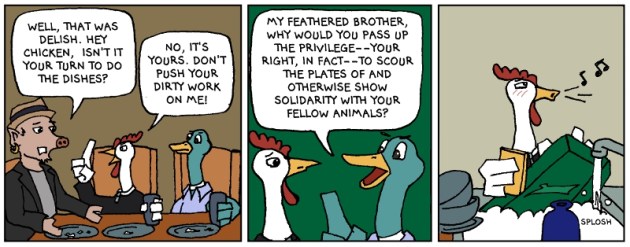
These grammatical gymnastics are hardly distinguished from the cartoon routines of reverse psychology, something I’ve tried to represent with today’s comic.

Return of Taxosaurus Rex

2012.12.02.neckbite

I was compelled to illustrate some sort of combed-over neck-biting dinosaur after I heard my local morning commute talk host share this bit of candor from Chris Matthews.

To break it down: after a Republican House member tells the difficulties of the fiscal cliff negotiations and of his own hope for comprehensive tax reform, Chris Matthews rebuffs with what amounts to a lurid confession of his own gut feeling.  He motions with clawed finger at his own neck and speaks of his fellow liberals, “they want to see the bite mark on your neck” and “they want to know that you guys defending the rich have paid a price.”

This post-election bloodlust is entirely consistent with what we saw in the 2012 campaign.  From the White House on down, the Left has little regard for the fiscal or cultural health of the country.  Rather, the fires of antipathy must be continually stoked, against the Tea Party, against outmoded geezers pointing to the original meaning of the Constitution, against anyone who would stop the feel good parade that happily coincides with Democratic politicians’ hunger for influence and power.

Please remember this the next time some distasteful news come out of Washington: Conservatives, through the Republican party, want to put an end to this gross manipulation.  Honestly, rolling government spending back to manageable levels does not stem from a desire to bite the neck of food stamp recipients.

Liberals like Matthews would rather keep afloat the long-failed fantasy of big government activism.  Enough elites are sympathetic to this vision to keep it from dying its natural death.  And as long as that is the case, we will all continue to be hurt by the avenging claws of Taxosaurus Rex.

The Wizard of Bogeyman Narratives

Yahoo News has thrown up (in the fullest sense of the term) a piece by Chris Moody on Grover Norquist.  It’s accompanied by a gaudy, melodramatic illustration that’s more at home disgracing the cover of the now defunct liberal siren Newsweek.  But if by invoking The Wizard of Oz imagery Yahoo wants to claim squatter rights to that niche, that’s fine by me.

Here’s a painful point of Moody’s text:

But Norquist is like a bearded Lernaean Hydra, which grows only more powerful the more you attack it. The evidence? A majority of Republicans have not publicly joined the rogue moderates, reinforcing the narrative that they remain under Norquist’s binding spell.

Where is this “narrative” coming from?  Perhaps Mr. Moody is describing an out-of-body experience, because it is media that drive narratives, and he is very much a part of that enterprise.

That Republicans don’t budge on their no tax pledge is a point even Chuck Todd can understand.  There is an electoral base that must be answered to.  And no, these constituents to whom congressmen are accountable are not drooling, rabid, or themselves cult followers of a giant, green, bearded head.  Some segment of the population even finds their demands sensible.

Of course, it hurts the noggins of liberal journalists too much to try to draft anything other than “GOP beholden to extremist” pieces.  They could try an expose on Michael Moore, who recently touted–under delusion–a strong re-election mandate as a justification for President Obama to lead a righteous charge off of the fiscal cliff.  But then again, journalists are supposed to target powerful and relevant voices.

Our media corps’ oblivious lopsidedness is the price of the free market, where people with big soft hearts–and reasoning most often just as soft– funnel into a self-selecting army that’s out to change the world.  Thankfully there are today many means of recourse to soft pieces like Yahoo’s Norquist essay.

The shell game of postmodernity

This week I’m drawing disparate threads together from recently digested media.  Hopefully these will inspire some critical thoughts on worldview, whether it be your own or of those around you.

In anticipation of the first Hobbit movie, my wife and I re-watched The Two Towers and The Return of the King.  This insightful quote by Gandalf struck me:

The old wisdom that was borne out of the West was forsaken. Kings made tombs more splendid than the houses of the living and counted the names of their descent dearer than the names of their sons. Childless lords sat in aged halls musing on heraldry or in high, cold towers asking questions of the stars. And so the people of Gondor fell into ruin. The line of Kings failed, the White Tree withered, and the rule of Gondor was given over to lesser men.

Can you think of a place like this?  Perhaps the ivory tower of the academy.  Or better yet, Europe.  This image captures the predicament of the post-industrial world.  There is a concerted effort among elites of the “West” to unlearn its culture and traditions.  The great project of social democrats in Europe, Canada, Japan, and beyond has built an edifice that’s more a civilizational masoleum than a regime to edify humanity.  This is the modern welfare state.

Rather than be bothered with commitments of marriage, the raising of children, and the fruits of free enterprise, people are more concerned with securing their siestas and thirty-five hour work weeks, to the exclusion of the dwindling numbers of youth annually pouring onto the unaccommodating labor markets.

And even those jobless youth lap up the same tired ideas.  I recently caught a few episodes of Portlandia, the sketch comedy that pokes fun at a city where the young move “to retire.”  The program, often crude and in keeping with the laughing-at zeitgeist of The Daily Show, illuminates nonetheless.  In gentrified cores of our cosmopolitan metropolises an army of grown kids paste pictures of birds on objects to self-soothe and are more concerned for the welfare of animals than of children.

This inversion of priorities gets to some of the news of the day.  We have a citizenry that is more concerned about feeling good than getting it right.  And so the silly story that Obama’s pardoned turkey ended up being euthanized anyway.  It speaks to the lesson that liberal intentions don’t guarantee results.  Take heed the next time a politician proposes to spend some trillions to end poverty, restore jobs, or save the environment.  That which was to be prevented will probably pass, and we’ll only have more debt to show for it.

All the while, the ethic uniting the masses of the well-intentioned is tolerance, or as is often seen on California bumper stickers, the relativistic imperative to “Coexist.”  But everyone’s got a dogma in the fight.  Just look at the controversy of Republican Senator Marco Rubio’s GQ interview.  Being asked what he thought the age of the earth was, he ducked with “I’m not a scientist, man.”  In this day, scientism–a narrow view where science is the only deliverance of truth–is a cudgel secular liberals deploy against any threat to getting absolutely everything they want.

Yes, the 24-7, self-reinforcing materialist culture is ascendant.  To quote another sage of Middle Earth, “What can men do against such reckless hate?”

There are baby steps.  In the hopes of starting an apologetics study group in my church community, I’ve been scouting William Lane Craig’s On Guard: Defending Your Faith with Reason and Precision.  The second chapter launches a reductio ad absurdum, a negative apologetic that comes from asking, what would be the implication of God’s nonexistence?  Dr. Craig notes Jean-Paul Sartre’s concession that life without God has no meaning.  Yet, he took up for himself Marxism.  The choice was subjective and merely arbitrary.   Without an objective point of reference, no life lived can be both happy and consistent in its worldview.

The great work of reshaping society to foster lives both happy and consistent remains before us.  Humanism will only find its logical end in a re-commitment to the sanctity of marriage and a valuing of children.  The partnerless Julia will discover her Obama-daddy culture to be utterly unsustainable.

There is a parallel reformation in showing that fulfilling livelihoods come not from the cold top-down transactions of the welfare state, but from an embracing of free markets under the rule of law.

There are those who will try hard to thwart this course correction.  A culture of relativism enables ultimate shell game.  If we point out the shell that holds objective truth, whether it be policy or morality, the Phrygian-capped ideologue can deny it or question whether there is even a game going on.  The task for the civic-minded will be to figure how to effectively expose and counter such silly moves.

Political prudence for the GOP

It’s been almost two weeks now since the Great Disappointment of 2012.  In 1844, the Millerites were let down in their expectation of divine deliverance.  With the wailing and self-flagellation of some after Romney’s 2012 defeat, one could be forgiven for thinking an event of similar cosmic significance had transpired.

To be sure, there is much to talk about.  And I myself have had some hearty discussions or else tracked the ongoing conversation.  This time of ferment offers a fresh opportunity to applaud realistic thinking as well as call out and smack down the sillier and more destructive ideas.

Two or three days after election, I came across one of the self-flagellation pieces on American Thinker.  The article looks back to the GOP’s post-Gingrich Revolution profligacy.  It seems the author is laying some significant portion of the election blame there.  But these transgressions happened an eternity ago on the political timescale.  It’s a little hard to imagine any number of voters bemoaning Trent Lott’s appropriation decisions from 17 years ago.

Yet the idea persists that Republicans are still suffering from the veto of off-put fiscal purists.  Michael Medved counters this notion with a rhetorical image: where is this mythical army of conservative voters who are withholding for the right candidate?  Only 40% of the country identifies as conservative, and we pretty well turned them out this last time.  The decisive work ahead lies not in squeezing an elusive reservoir of more conservatives but winning more moderates in the middle.  The numbers bear this out.

Meanwhile, a piece from Forbes offers a different message: this latest defeat is a chance to shake free of Karl Rove and the Bush II cadre.  Per the commentary, its high time for true Reaganites, in the Jack Kemp mold, to climb back to power.  I’m not really knowledgeable on the comparative schools of GOP politicos, but I took the editorial with a grain of salt.  Just think of Reagan’s 11th commandment: “Thou shalt not speak ill of any fellow Republican.”  Certainly, there’s room to criticize of our fellow partisans, but we ought to be wary of taking away such a simplistic narrative.  And we need to watch out for the damage that comes from publicly airing our internecine struggles.

Reading articles is nice, but one doesn’t even have to look that far to examine a slice of the conservative movement.  There’s Twitter for that.  And a lot of what has been floating in the past few days is junk.  There is the talk of secession.  Just dumb.  Neither is a dire outlook of the Republican brand appropriate.  And please, let’s suffer no more talk of RINOs.  This kind of sourness doesn’t help grow the party.  But to Twitter conservatives’ credit, folks seem to be on the ball in registering their disdain for unelectable candidates like Todd Akin.  If anyone needs to be kicked out, it’s brand-destroyers of that vein.

A bright spot in the post-election conservation is Daniel Henninger’s deconstruction of the Obama victory.  He has exposed the repulsive shape of future campaigns that Democrats have pioneered.  It will be in your face, all the time, and begging for every last penny.  Democrats, drawing on the progressive obsession with number-crunching technocratic solutions, have perfected the division and manipulation of the voting populace.

The rank and file of the GOP is too idealistic by comparison.  We’re always waxing about “articulating ideas.”  But I know we have some unsavory electorate-dicing operatives among us; or at least, we ought to.  We need them to act with the resources and range of their Democratic counterparts.

One more take away from post-election discussion comes from Michael Medved.  Per his recent piece, the key to Obama’s reelection victory was voter suppression.  You read that right.  Not Black Panther intimidation or tampering with ballots, though that surely happened too.  The winning strategy was deeply cynical: turn off swing voters, and push your base to the polls at all costs.  There’s nothing magical we can’t replicate there.

I think the GOP definitely has the ability to turn things around in the next few elections.  But even if you disagree, I would implore you to hold the myopic moping, conspiracy theories and intra-partisan vitriol.  Don’t spoil the hunt for the rest of us; too much is at stake.

A school–and a state–that’s too cool

Sierra Magazine, a product of the environmental advocacy group The Sierra Club, recently crowned U.C. Davis the “#1 Cool School” for its efforts to conserve energy, resources, and otherwise be sustainable and fight climate change.

A couple of years ago, the student-run ASUCD Coffee House underwent a major renovation.  I’m not sure what the budget was, but hundreds of thousands if not millions of dollars went into the project.  The result?  Sliding doors became manual, and a versatile space with moveable chairs and tables gave way to massive dining booths, each typically empty but for one student entranced by her laptop.

In the end, does making a sliding door manual really benefit the campus community?  I’m confident that the electricity saved is more than offset by the germs and viruses spread via frequent grasping of handles by so many young adults.  Also, I can imagine at least one inattentive, returning alumnus slamming into the door, betrayed by the changing ways of an old friend.

And then there are the disposable cornware utensils.  With traditional plasticware, you could cut whatever was on your plate.  Now, your corn fork is likely to get bent out of shape.  And there’s no convenient place to grab your utensil in case you forgot it–it’s usually rationed out with your dish.  How many acres of corn are destined to become crappy utensils, rather than say, by some more natural demand of the market (hint: not ethanol fuel) go to feed a starving mouth in the Global South?

Now, I must confess there is no “Recycle Nazi” at the Coffee House.  This idea is borrowed from the Davis Farmers Market, where, after chomping down on your tandoori treat, you’re likely to confront a cheery dreadlocked twenty-year-old-of-unknowing-privilege, who will gently but firmly ensure you’ve cast your biodegradable cornware cup into the appropriate receptacle.  Only then can you go back to enjoy watching toddlers prance around to a Bob Dylan cover band.  The small tote dogs of even-greater-pampering-and-privilege are fun to watch too.

But back to campus.  The exorbitant charge for paper cups is reflective of the the long-standing reuse movement.  Yes, it’s nice to reuse your mug.  And not all of these eco-friendly changes are derisible. Yet, the guiding hand of the Nanny State is all too palpable on campus.

COMPACT parking

Every space in one recently repainted UC Davis lot was marked “COMPACT.” Cogitatingduck.

Take cars for example.  There have been new garages built on campus, but they are more to the periphery than the core.  And existing parking lots get eroded by the liberal legacy of litigation.  The clearest instance of this comes when spots disappear to make room for more ADA-compliant spaces.

As a part of recent maintenance, one parking area got a new coat of sealant.  The spaces were repaved, and I suspect they’re just a little smaller than they were before.  As if that weren’t enough of a hint against cars, one stretch of the lot was painted with “COMPACT” in every space.  But they’re plenty wide to accommodate those oversize SUVs with multiple Obama stickers on them.  So the commuter is left to scratch his own head: was this a simple painting error or a subliminal hint from Nanny to buy a smaller car?

Well, with tax-hiking Prop 30 passed, there is a little more assurance those lots will continue to fill with cars for the near future.  And all the while, Our Great Bullet Train will move forward.  This despite the Legislative Analyst’s Office finding there are more effective ways to reduce emissions with the carbon tax credits diverted to “backstop any shortfall” in funding for a project unlikely to finish before humans colonize Mars.  An inevitable byproduct of this is, you’ve guessed it: more lawsuits!

Greetings from California.