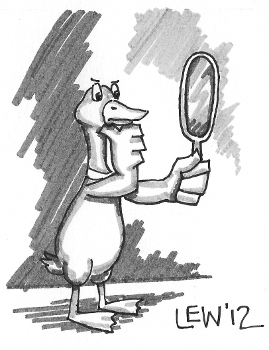
Paul Ryan: naive, inexperienced?

Good philosophy must exist, if for no other reason, because bad philosophy needs to be answered.

C.S. Lewis

As far as I know, neither I nor Virginia Heffernan is a philosopher in the professional sense, but I would submit that Lewis’s dictum is just as valid for bloggers.  And so it is that I must report on the Yahoo writer’s latest hit piece, because it is bad blogging.

Like her other columns, Heffernan’s latest meanders through obscure pop culture references, though fewer than usual.  This time, the most outlandish example is of some dusty blue book that every American must have owned circa 1970.

The author’s alternately snarky and earnest jaunt down memory lane serves an end of course.  In this case, it is to tie herself to her subject, the estimable Paul Ryan.  He is one year her junior, and as such is the first of Generation X to contend for the vice presidency.

The face of inexperience?

Heffernan proceeds to portray her college years as a perigee where she flirted with but ultimately moved away from a Jack Kempian conservatism.  Looking for bonus points with those harboring an unflattering memory of the Reagan years, she offers television character and teenage Republican Alex Keaton as a possible analog for Mr. Ryan.

By the end of the piece, it is clear than in so many words Heffernan has endeavored to say that compared to herself, Paul Ryan is naive and inexperienced in the ways of the world.  But for all of her musings on Generation X, she’s only managed to grasp the one elementary tool of commendation that the relativistic, existentially-driven Baby Boomers left behind: anecdotal evidence, the mere telling of personal experience.

Heffernan supposes that Mr. Ryan never faced a hard day in his life.  Meanwhile, she had some undescribed encounters that delivered her from a simplistic, uncaring worldview.  Maybe she saw a sad, hungry puppy shivering by the side of the road.  That is why, unlike the experientially impoverished Mr. Ryan,   she was able to grow out of an infatuation with that extreme ideology called fiscal restraint.

What a condescending take.  Did Heffernan fail to research that Paul Ryan discovered his father dead in bed when he was 16?  Or that his Alzheimer’s-stricken grandmother moved in for care shortly thereafter?  Indeed, the teenage Paul Ryan worked at McDonalds.  Those earnings, along with Social Security survivor’s benefits, allowed him to go to college.  And when he got there, he supported himself further with a side job selling hot dogs for Oscar Meyer.  Does this sound like some sort of silver spoon background, or the picture of naivete conjured by fictional teenage Republicans of TV yesteryear?  Contrary to her boast, it is Ryan, not she, who is the old soul.

Rather than offer commentary of value, Heffernan merely pollutes the national conversation with solipsistic bubble gum blogging.  She permits her readers to dismiss the latest Republican candidate as heartless, aloof, and extreme.  And in the same moment, they are left with fond recollections of leg warmers and ’80s prom hair.  Given the state of the entertainment establishment, this is hardly a novel achievement.

As I’ve warned before, Yahoo! News is more an entertainment outpost than an outlet for truth.

From Palestine to Anaheim: culture matters

When Mitt Romney dropped by Israel a couple of week ago, he made an observation that the American media all-too-eagerly interpreted as a gaffe.  Drawing from a scholar’s work, the former governor contended that Israel’s relative economic success was a matter of “culture.”

In public conversation, this term has sadly become a stop word for latent prejudice.  And like a good student of the Western Academy, Palestinian spokesman Saeb Erekat demonstrated his fluency in the language of victimhood by calling Romney “racist.”

Back in America, progressives have been busy applying racial spin to a local governance conflict.  In Anaheim, California, activists–with help from the Southern California ACLU–are trying to budge the city council from it’s longstanding at-large representation system to a geographic, district-based one.  They reason that minorities, such as Latinos, have been been effectively disenfranchised by the current regime.  A spate of controversial police actions, including the recent killing of an unarmed man, have helped to propel the campaign.

Two years ago, a small New York village made headlines for a similar move.  After its existing system of staggered elections was ruled illegal, a federal judge bequeathed cumulative voting to Port Chester.  The village council went from being all white to having its first Hispanic, all thanks to elections that allow each voter six votes per office.  Yes, six votes!

The idea behind Port Chester’s civic miracle is degrading to the voter and the candidate.  An individual who identifies with an underrepresented group is supposed to gain representation by voting for the same person six times.  Meanwhile, the majority-status voters would presumably split their vote among several contenders.  Like affirmative action, cumulative voting robs the winning candidate of the confidence that he won on his own merit.  Rather, he can be sure the system was crafted specifically to boost him into office.

The proposal for Anaheim is scarcely better.  Activists have the implicit goal of changing the racial/ethnic makeup of the council.  It may be well intentioned, but it is unprincipled and works against the meritocratic ideal.  And like affirmative action, it is by definition racist.

Sometimes plans that play with racial demographics backfire.  This past primary election season, Redlands Democrat Pete Aguilar was expected to come into a newly crafted U.S. House seat, but was squeezed out by two Republicans thanks California’s new top-two runoff system.

Who is to say if Anaheim switched to district representation, that a Latino would accede to the city council?  Maybe the downtrodden denizens would opt for a Ted Cruz-like Hispanic conservative.  Given the root of the problem, gangs and crime, it would not be surprising if a law-and-order type won.  Not exactly the result progressive activists were aiming for.

Rather than spend sums on lawsuits and campaigns that are ultimately uncertain, progressives should just come out and move a well-connected, rising star Latino Democrat into the city before the next election.  It’s not like they are serious about the underlying issue: culture.

Plenty of smart, reasonable voices tell us culture matters.  Charles Murray has put decades of research into his latest tome, calling on America’s privileged to spark anew in their working-class neighbors the values that drive success.  And Richard Landes backs up Governor Romney’s recent observations on Israel.  But these folks just don’t get play in the liberal world.  Mainstream journalists thrives off of the sensational, but talk of culture upsets their own sensibilities.

As human beings, we are not merely members of our own little tribes, but individuals who reason.  We all are agents that react to incentive, and culture is the framework that shapes our agency.  It’s upsetting to some, but well-meaning government aid programs can breed dependency.  Obscuring your face with a hoodie as a fashion statement can inculcate mistrust.  A Hollywood actress who elects to become a single mom can sanction for some poor, distant child a difficult upbringing.

The values we choose make a difference.  Culture matters.

Shared sacrifice

President Obama unfurled a new school yard taunt this week, calling his challenger “Romney Hood.”  The moniker piggy backs on a study crafted by definitively left-leaning groups that presume to know the details of Romney’s future budget proposals.  Supposedly, Mitt Romney will balance the budget on the backs of the middle class.

But if anyone is taxing the middle class, it’s surely President Obama.  After all, the Supreme Court ruled in June that the penalty component of his Affordable Care Act is for all intents and purposes a tax.  Many who will be paying the new tax will be younger, less-established workers, the up-and-coming who are in many ways at the heart of economic growth.  That is, unless a Republican President and Congress are able to intervene at the start of 2013.

Is the “Romney Hood” label even fitting?  Maybe if you interpret the hugely successful capitalist as Atlas Shrugged pirate Ragnar Danneskjöld, a man who steals from corrupt “people’s republics” and bequeaths gold bars to cloistered industrialists.  However, the “tax cuts” that President Obama perennially refers to are not stealing from anyone.  Continuing with the ten-year-old, boring, existing rate is merely allowing high income earners to keep more of what is rightfully theirs.

If we examine the President’s rhetoric about income and wealth, it’s clear he has little real regard for the deep American tradition of ownership, particularly that which comes from “earned success.”  Consider his 2008 retort to Joe the Plumber, that all he wants to do with the little extra taxed income is “spread the wealth around.”

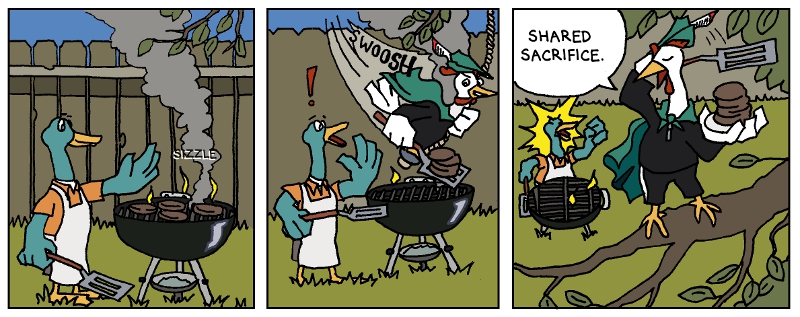
In 2010, and even into 2012, the President repeatedly sprinkled his speeches with references to “shared sacrifice.”  This is meant to conjure up thoughts of selflessness and nobility: folks who step up and offer voluntarily for a good cause.  But how are new taxes “sacrifice” when they are ultimately collected at the barrel of a gun?  This rhetoric ought to be seen as embarrassing and sloppy by all observers.  The rights to the fruits of one’s own sweat and toil, time and treasure are ultimately discarded by such a line of reasoning.  Utterly chilling.

If what we’re concerned with is a green-hooded robber running around in the woods and seizing wealth, we should be more wary of the man who has spent the last three and a half years in the Bully Pulpit than we should be of his challenger.

Liberal outrage boosts carbon emissions

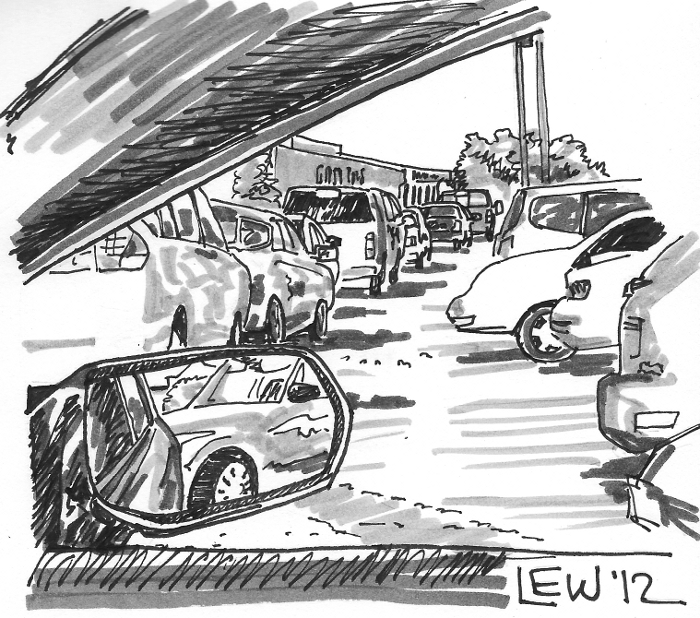
At the end of my workday today, I proceeded to Alta Arden Chick-Fil-A.  As with other locations throughout the country, there was a considerable line at the drive thru.  Many have posted their pictures and made reports.  Instead of a picture, I’m offering here a sketch I took toward the beginning of my hour long wait.

What was the atmosphere like?  Quite congenial from what I could tell.  All sorts of people and cute little kids running around under their parents’ watchful eye.  If there were any bigots there, you wouldn’t know.  Hate levels were negligible, reading at a low 0.029 pico-Sharptons.

For all their outrage, liberals have only managed to launch a thousand drive thru queues.  With all the exhaust spewing from the attendant trucks and SUVs, Leftist indignation correlates to a rise in carbon emissions.  Coincidentally, National Review’s lead essay today deals in part with progressives’ disdain for cars.

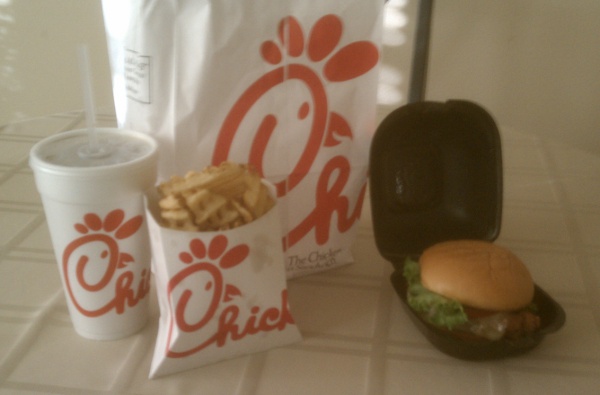
Once I got my order, I sped back home.  I had the spicy chicken sandwich with the waffle fries, and they didn’t disappoint.  The first time I had Chick-Fil-A was when I was staying with family in the South–as in southern California.  Contrary to how the media reports it, the Chick-Fil-A empire reaches far past the Mason-Dixon line.  It’s firmly established in my blue state, as San Francisco mayor Ed Lee certainly knows.  Forty miles is close enough for him.  Fortunately for my taste buds, I am beyond that radius.  The City by the Bay still makes for a nice day trip though.

Surely some nonpartisans are scratching their heads today at the latest culture war battle.  What’s the big deal with this Chick-Fil-A appreciation day?  Some say it’s about affirming Biblical truth, and some say it’s about freedom of speech.  These are both right and good, but the question of tolerance is the most pivotal one.

To remain a free, fair, and open society, we need to recover the original meaning of tolerance.  That means respecting the person who disagrees with your views.  This does not happen when traditional marriage defenders are dismissed out of hand as bigots and haters.  As with many things that touch on God, judgment, personal choice, and equality, too much of the conversation is controlled by the gut and not by a clear and open mind.

Today’s massive Chick-Fil-A turnout is not a mere spectacle, but a stand firmly taken.  A stand not in the name of blind faith or bitter clinging, but in the hope of a more charitable discourse.  Just maybe, we’re turning a cultural corner.

Obama’s “Our plan” pitch doesn’t work

With many buzzworthy stories washing over news audiences lately, President Obama’s attempt to claim Bill Clinton’s economic record has not garnered as much attention as it ought.  Nonetheless, ABC dutifully reported the incredible credit grab last Friday, dubbing it “Our Plan.”  As in when the President declared, ““We tried our plan–and it worked.””

Reading the story (linked above), you’ll find the writers were a less than thrilled at poking a hole in “Hope and Change.”  The following gem conveys their reluctance to call the President out on his silly move:

This pitch on occasion has meant that President Obama at times sounds as if he’s claiming some ownership of the Clinton economy – referring to “our plan” — which has allowed Republicans an opening to act as if the crowing he’s engaged in about the Clinton economy is out-of-touch braggadocio about the current economy.

Can you find the several qualifying phrases the writers deploy to effectively neuter their own critique?  They further blunt the impact of their work by twice calling the story’s developments merely “interesting.” The repeated use of this ho-hum descriptor either indicates grade school student authorship, or else is a euphemism for harsher terms the journalists can’t bring themselves to say.  Or maybe both.  You can decide what is more likely.

Whatever the case may be, the President’s team at Health and Human Services  haven’t helped the “Our Plan” claims.  Just a couple of weeks ago,  they watered down the Clinton-era welfare reform work requirements.  This signature achievement, only adopted at the prodding of a Republican Congress, has been generally acknowledged as a policy success.  But with the new HHS changes, we can expect entitlement culture to crowd out any productive behaviors the reform had brought.  Like the greatly expanded food stamp program,  this makes for a significant departure from the Clinton policy environment.

Now let’s look at “Our Plan” by the numbers.  On one level the numbers game is disingenuous.  Obama’s main claim to Clinton’s tax policy hinges solely on the top marginal rate, which he wants to boost from 35 to 39.6 percent.  Any revenue increase, even if dynamically scored, will only be a drop in the deficit bucket.  A host of other variables outside of the control of “Our Plan” will hold more sway over the economy.  But if the game is to be played, there’s a pretty good case to be made against the Democrats.

That 22 million jobs came into being under Clinton’s two terms has been echoed far and wide by Democrat acolytes.  Never mind that Obama’s net created jobs won’t be positive by election day.  But what about unemployment rates?  They’re readily available from the Bureau of Labor Statistics.  Combining Clinton’s eight full years and Obama’s first three, the average annual unemployment rate under “Our Plan” is 6.4 percent.  How much does this cream Bush’s average rate by? It’s the other way around.  At 5.3 percent, Dubya beats “Our Plan” by over a point.  Not that Mitt Romney is running as Bush anyway.

Taking things a step further, let’s attribute the unemployment numbers to Congress instead.  The average annual rate was an ultra low 5.0 percent from 1995-2006, the time Republicans had at least a tenuous hold on both houses.  By comparison, Nancy Pelosi and Harry Reid’s Congress pulled 7.3 percent from 2007-2010.  Whether looking at Congress or the White House, the employment rate tends to be healthy over the broad sweep of recent Republican tenures.  It’s those pesky times of transition to and from Democrat control that correlate to a high rate of joblessness.

When President Clinton speaks at the Democratic National Convention this September, will he be pitching the strained reasoning of “Our Plan?”  As with previously tried campaign themes, I doubt it will have the legs to carry Democrats forward.  Maybe Mr. Clinton will be singing a different song.

Chick-Fil-A and the language of (in)tolerance

A few days ago, Boston mayor Thomas Menino told burgeoning restaurant chain Chick-Fil-A it was not welcome in his city.  Responding to chain president Dan Cathy’s personal opinions–on city letterhead, no less–he decried the restauranteur as “prejudiced,” insisting there’s no room in Boston for “discrimination.”  He concluded that to allow Chick-Fil-A in his city would be an “insult” to gay couples whose marriage ceremonies he proudly presided over.  Fellow mayor Rahm Emanuel soon tried to one up Menino by appealing to “Chicago values,” an incredible claim for a place which, politically speaking, is a values wasteland.

Menino’s letter in particular is unwarranted in its use of charged language.  He and his allies have read base motives into Dan Cathy’s recent comments, which were issued earnestly in a radio interview.  If you listen, it’s clear he’s not hopped up on hate, or motivated by bigotry; his words flow from a reasoned, sincere conviction.  Neither has his company been yet charged of legally-actionable discrimination.  The mayors and their fellow critics are free to dislike Cathy and his firm, but while their claims of prejudice and discrimination go unsubstantiated, they cannot be taken seriously.

Some have justified their indignation by pointing to Chick-Fil-A’s past charitable contributions.  Media reports (here, here, and here) have alternately labeled Cathy, the company, and the donation recipients as “anti-gay” for ultimately opposing same-sex marriage initiatives.  But within these reports, the label goes unexplained and unchallenged.  The reader must naturally take it to be descriptive of one who is against gay people themselves, an utter slander that people of good will ought to reject.

In a similar fashion, the broad, vague charge of “homophobia” came with coverage of Google’s recent “Legalize love” campaign.  To call one homophobic is just as destructive to discourse, as it imparts a motive of irrational fear to the one being described.  In popular usage it is synonymous with hate.

These words ought not to be bandied about by press claiming fairness and objectivity.  Yet, media have a long, bad habit of describing conservatives as phobic and painting them in “anti” terms, as in anti-abortion or anti-spending.  Pro-choice advocates are never referred to as anti-unborn or anti-child.  Deficit spenders are never called anti-frugal.  This is a function of the Orwellian intersection of the tolerance paradigm and positive rights.  Tolerance as presently understood never allows us to question the ever-expanding field of rights, even though reason assures that absurdity must ensue at some point.

Those who want real tolerance have to abandon these loaded terms that implicitly judge the hearts and inner motivations of other individuals.  The hypocrisy of using such labels hurts one’s own cause as much as the conversational climate at large.

Fortunately, the mayors have backed off a bit from their testy declarations.  As the controversy continues to roil, may more people become cognizant of the language used, and realize that same-sex marriage opponents should not be automatically equated with bigots.  We all carry our own personal experiences, shadowboxing with traumas of the past.  Let’s not allow these to cloud an important and necessary conversation.

Water bottles and other campaign debris

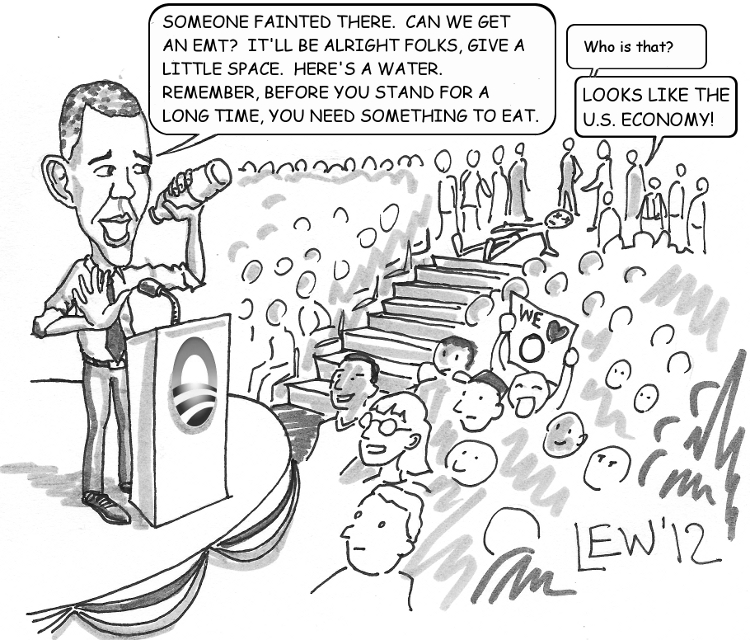
Ever since 2008, conspicuous fainting episodes have occurred with bizarre regularity at President Obama’s campaign rallies.  Some wider attention came earlier this week when Obama, who offers a consistent, canned response to these potentially serious collapses, inadvertently called for a “paralegal” instead of a paramedic. Michael Medved, who has documented this phenomenon since the beginning, has a good point regarding the displays: how does the Commander-in-Chief know it’s just a swoon and nothing more serious?

The fainting routine, with Mr. Obama’s predictable admonition to eat food, drink water, and remain calm,  is quite possibly meant to bolster his image as a confident, competent leader. He can have own mini Bush-with-a-bullhorn moment, giving gentle nanny state prescriptions that earn laughter from the adoring crowd. But one Medved caller this week had an alternate take: with the president habitually 20-60 minutes late to appointments, and belting out stump speeches nearing an hour, it would be no surprise if the fainting fans were genuine and not crowd plants.

Why do mainstream journalists, the “dinosaur media” if you will, turn a blind eye to Obama and his fellow Democrat’s campaign gimmicks?  Who knows what other minutia have gone undocumented while the media combs over Romney’s vacation photos, his financial arrangements, and his 1999-2002 status at Bain?

Of course it’s the substance and not the minutia that matters.  Yet, it was with some pain that I learned of new–if trivial –criticisms from two Hollywood geek icons.  Mark Hamill, the actor who played Luke Skywalker in Star Wars, recently knocked Mitt Romney as “not human.”  His critique hinged on how awkwardly the governor responded to a sip of lemonade.  Really?  Hamill’s observation rivals Matt Damon’s fearful, perhaps bigoted babble from 2008 that managed to mention Sarah Palin, dinosaurs, and nuclear codes in the same breath.

Giving good company to Hamill is Wil Wheaton, who played the star ship’s resident whiz kid on Star Trek: The Next Generation.  He took the occasion of a recent George Bush interview to lament the loss of life and treasure the 43rd president instigated with a “war of choice.”  It’s regrettable the actor doesn’t understand that jihadis have free will or that all wars are embarked upon as a deliberate exercise.

The men who once played space teens on film and television can now–fittingly enough–join Cher, who apparently left Earth so she could avoid breathing the same air as Mitt Romney.  Celebrities’ reflexive gags make nice conservative water cooler talk, but they also indicate just how impervious some sections of the country are to reality.

Let’s return from our Hollywood excursus to Washington, where we get a different taste of the same liberal worldview.  The media, after four days of burying its head in the sand, has reluctantly picked up on President Obama’s “You didn’t build that” gaffe.  And while ABC moved quickly to paint it as out of context, The Wall Street Journal’s James Taranto insists the gaffe was a genuine betrayal of a deeply liberal inner attitude.

If you read the wider quote from Obama, Taranto has solid reasoning: “that” refers to the singular and proximate “business.”  Obama would have said “those” if he were referring to the earlier bridges and roads.  Yet, I would entertain the possibility of a simple slip up, since “you didn’t build that” has more of a rhetorical impact than “you didn’t build those.”  It also reminds us of MC Hammer’s sweet refrain, “U can’t touch this.”

Is all this attention unfruitful nitpicking?  Not inasmuch as it draws focus to the real and gaping philosophical chasm that separates Democrats from Republicans.  Undeniably, economic policy is ultimately driven by a sense of who “owns” growth and success.

What does lack substance is the liberal canard that the rich need to “pay back” for all they’ve been given.  Not that Republicans deny a need for some government in the first place!  High income earners already pay much more than the rest of us under our already progressive tax regime.  And all the while, we can’t deny the abounding opportunity that many of those earners’ businesses provide.

There is no need for top income earners to pay “us” back or forward, for that matter.  But we could use comprehensive tax reform, a closing of loopholes and lowering of rates that Romney and a Republican Congress will deliver if elected.  If only our electorate can navigate the field of campaign season debris first.

Two Trons, Four Freedoms

After Governor Scott Walker’s June recall victory, blogging compatriot Cosmoscon shared some choice tweets from the Left.  One that really grabbed me was this spurious Abraham Lincoln quote:

“If any man tells you he loves America, yet hates labor, he is a liar.”

The line is simultaneously funny and sad.  The adversarial unions we know today were scarcely extant, let alone popularly identified by the “labor” moniker, in President Lincoln’s lifetime.  It’s ironic that a movement sheltering so many of the work-averse (rubber rooms, anyone?) would brandish a quote that, properly construed, endorses hard work.  True to that irony, those at the bleeding-edge of the quest for expanded labor rights end up calling for a fantastically impossible feat: the abolition of work itself.

“Labor” is not the only word that lends itself to sociopolitical confusion.  People sometimes get caught up in an equivocal use of the word “free.”  On the one hand, it means for some agent the liberty of movement, thought or action.  On the other, it can refer to a null price of acquisition, that is zero cost, gratis.  Occasionally, the vital distinction between these two meanings is blurred in the popular imagination, as with the 2010 blockbuster Tron: Legacy.

Two Trons

The original Tron, released in 1982, came on the heels of serious Soviet Bloc upheaval; just the year before, the Polish Solidarity labor union secured a degree of independence from Communist control.  This dramatic feat of defiance would have been fresh in the minds of moviegoers.  Tron is not merely anti-authoritarian but anti-Communist.  A theistic theme evinces in the eponymous hero’s mantra, “I fight for the users!”  The oppressed programs know they’ve been endowed with purpose greater than the totalizing and centralizing dictates issued by the Master Control Program.  Incredibly for Hollywood, the story ends up affirming property rights: the protagonist Kevin Flynn eventually regains credit for his programming masterpieces, which had been stolen from him.  There’s no mistake that when the characters speak of “freedom,” the classically libertarian ideal is in mind.

Fast forward to the compromised 2010 sequel, Tron: Legacy.  Early in the film, we find that in Flynn’s mysterious absence, his software company has burgeoned into a Microsoft-like leviathan, profiting by frequent commercial releases of an utterly worthless operating system.  Flynn’s son wants to honor his disappeared dad’s ideal of “freedom.”  But the story writers have revised this to mean advocacy of freeware, as in products distributed for zero cost.  On this paradigm, the work of producing software does not arise from the need to make a living, as in labor, but from boredom, altruism, or some other motive conceived in leisure.  In the sequel, the meaning of “freedom” lurches Left.  It’s not just freedom of thought and action, but freedom from the need to even make a living.

How did Hollywood minds pull off this coup?  If you’ve seen the film, you know Flynn’s discovery of the Isomorphs: supreme, benevolent beings that emerge spontaneously from the digital vacuum and portend to cure all the world’s ills.  They are cinematic incarnations of Ray Kurzweil’s singularity prophecy.  Flynn’s cries in the wilderness about freeware and perfection of the human race are of course mere functions of the film’s indulgence of the fantastic.  Yet, among anarchists and cyberpunks, “libertarian Marxists” and singularity disciples, are those who really place faith in the idea that one day nice machines will magically do everything for us.

Four Freedoms

This confusion over freedom didn’t start yesterday.  Looking back in history, even our top policymakers were prone to conflation.  In his 1941 State of the Union address, President Franklin Delano Roosevelt proclaimed to Americans the Four Freedoms:

1. Freedom of speech and expression
2. Freedom of worship
3. Freedom from want
4. Freedom from fear

This progressive vision rallied a nation soon to be at war, but it is also a disastrous marriage between negative rights–government’s promise to do no ill–and positive rights, government’s guarantee to ensure good outcomes.  The sum of human experience and the duration of America’s Constitutional enterprise both attest to this: that it is practical and necessary for government to extend negative rights, but impractical and immoral to extend positive ones.

It may have been attractive to early progressives to follow Bismarck’s example in marshaling the state’s power to slake rising expectations.  But past the mid-century twentieth century high tide of statism, advocates of liberty, from Whitaker Chambers to Ayn Rand, F.A. Hayek to Ronald Reagan, began to rally against the absurdity of positive rights.  That rally is alive and well today in the American conservative movement.

Unfortunately, too many remain beholden to Roosevelt’s proposition that it is government’s job not just to leave us free in our speech and worship, but to save each of us from the vagaries of poverty, hunger, and emotional distress.  These expectations ignore the finitude of government’s ability to help; no single human institution can guarantee positive rights to all.  The pursuit of happiness is necessarily a prerogative of individuals and their free and natural associations.

The best governments respect human nature, extending negative rights while withholding positive ones.  Disgruntled publics that demand otherwise, to be free from austerity and to be free from market forces, are really asking to be free from personal responsibility.  Absurd on its face, this kind of agitation always merits a facepalm.

ABC News: Romney might be a felon

ABC News is running hard with an unsubstantiated accusation that Mitt Romney might be a felon.  At the time of this post, it’s square and center on their homepage.

Earlier in the day, a less virulent form of the story parlayed–seemingly from out of nowhere–factcheck.org’s smackdown of Team Obama’s outsourcing charge into a suggestion of Romney’s culpability:

But, as fact checkers note, Team Obama does not provide any specific evidence to back up claims that Romney was actively managing Bain between 1999 and 2002.

If they had, Romney could be liable for felony charges in court for lying in sworn statements.

The follow-up story by Matt Negrin makes clear reference to a Boston Globe report and White House campaign fodder suggesting a possible crime.  Yet, Devin Dwyer’s earlier report, deficient in these references, ends up looking like a random mulling of counterfactuals.  If more mainstream journalists followed Dwyer’s pattern, we might see some other hypotheses regularly floated as objective reporting:

If the unemployment rate were two percent lower today, President Obama’s campaign would not be in such rough shape.”

If President Obama attended church regularly, fewer people would be confused about his religion.”

If President Obama had chosen a Fat Tire instead of a Bud Light for the Beer Summit, he might have locked up the LGBT vote.”

Dwyer’s report can be consigned to a bin of recent, poorly written pieces, among which we can include Virginia Heffernan’s universally indecipherable response to Ann Marie Slaughter’s work-life balance essay.  If nothing else, it shows just how eager mainstream reporters are to associate Republicans with criminality.

Market reform: nothing too sacred

Recent days have seen major policy movements with respect to higher education and health care, two segments of the economy sorely in need of reform.  You probably did not miss last week’s NFIB v. Sebelius decision, better known as the Obamacare ruling.  Its headlines eclipsed the expected and relatively uncontroversial extension of Stafford student loan interest rates.

Unfortunately neither of these recent actions will do much to mitigate the twin crises in higher education and health care.  A reverential aura surrounding these fields blocks what could really help: serious market-based reforms.  While much of the problem is budgetary in nature, respective stakeholders are wary of commoditizing the near-sacred work they do.

Market advocates must deal with some serious objections: How can a price be put on teaching students how to think?  Is it moral to triage life-saving services on ability to pay?  Core values like critical thinking, equality, and compassion are at stake.  To address these challenges, let’s review what it is that makes the free market so great.

The Reality of Scarcity

First, markets operate on the assumption of scarcity, the idea that resources are finite.  This should be fairly uncontroversial, but there’s a powerful tendency in human nature to discount this reality.  Think of how the Federal government is so unpopular on the Right.  This is because it has tools at its disposal to deny fiscal truth.  It can print money or engage in deficit spending–things that state governments cannot do.  Perhaps nothing is more important to determining societal norms than fidelity to reality.  This must include a practical acknowledgement of scarcity.

Delivering Accountability

Second, markets are the best means of achieving accountability.  A market consists of rational agents entering into voluntary transactions under a fixed set of rules.  When it is relatively free of interventions, both consumers and suppliers naturally look to maximize their own self-interest.

It’s a necessary aside to admit that such an idea makes many uneasy.  We recall the simple and sure moral learned in childhood: don’t be selfish, don’t be greedy.  People presume illegality when they think of the market imperative to maximize utility or profit. Crooks like Bernie Madoff and Gordon Gekko commonly come to mind.  But the concern is utterly irrelevant.  Any society worth it’s salt is founded on the effective rule of law.  The free market assumes this, and any alternative system must deal with the same consideration.

Free markets breed accountability because rational actors must seek the most bang for their buck.  But say that a consumer comes to anticipate occasional interventions, like a benefactor dropping a huge cash subsidy in his lap.  He will rationally adjust his expectations, no longer accountable to material reality, but to the sociopolitical reality he reads from a market distortion.

Prices communicate truth, reveal what we value

This takes us to the third virtue of markets, which is the informational role of price.  There are countless examples of governments attempting to control prices in the modern era, just about all of them disastrous.  This is because prices, like language, transmit information about reality.  They inform us whether a good or service is relatively abundant or scarce, easy to produce or exacted only with great effort.  To adjust a price away from its market value is either to lie or to posit that some competing value trumps truth.  Typically, this is something like charity, equality, or decency.  Yes these are worthy ideals, but it’s immoral to superimpose a brute desire for better social conditions over an accurate grasp of economic reality.


Even our most cherished ideals come at a price.  That’s why we call them “values.”  Market prices, subsidies, and taxes all contribute to a picture, a mirror if you will, by which societies can see what they really value.  Diamonds are pricey because of the social significance we assign them.  We see the Federal government values green energy–correctly or not–because of the subsides it gives in its name.  From national security to food stamps to Baby Einstein videos, we can grasp what a society values by how much is produced, consumed, paid, subsidized and taxed toward the respective ends.

Shielded from reality

Medicine and education are very high callings, their integrity guarded at times with something approaching religious zeal.  Last winter, in inveighing against the presence of U.S. Bank, a California Aggie editorial declared the campus a “sacred place” in need of protection from bank profiteering.  By contrast, a recent Wall Street Journal editorial is right to criticize the circled wagons of higher education as a “Green zone” where reality does not apply.

The academic pursuit of truth, and the transmission of the discipline to the next generation, are indispensable to society.  Yet, inasmuch as the academy serves society–and not vice versa–all its constituent enterprises must submit themselves to fiscal accountability.  The self-selecting institution of tenure especially needs to justify to the outside world, in some formal way, its oft-wildly ranging research pursuits.  Let’s allow the market to deliver accountability.

The healthcare industry also needs this help.  Policy has been tied up for so long in questions of access and affordability that the field is virtually disconnected from the salubrious effects of the market.  Things will only improve when consumers, loosed from subsidies, internalize the value of the myriad services they pursue.  I’ve been a fan of high-deductible insurance plans.  And the earthshaking decoupling of insurance from employment benefits is essential.  To have a multitude of companies actually competing for customers will do more to eliminate waste and drive down prices than the amalgam of regulatory magical thinking known as the “Affordable” Care Act ever could.

At what cost?
Is the price of submitting the highly-esteemed callings of medicine and education to market forces too steep?  We can learn a lesson from Christian apologist Ravi Zacharias.  As he writes in Can Man Live Without God, even faith itself is about making a choice and paying a cost:

Oscar Wilde once said that we do not appreciate sunsets because we do not have to pay for them.  Oscar Wilde was wrong.  We can “pay” for sunsets by living in accordance with the purpose of our Creator and of His grand design.

No ideal is too sacred to be untouched by the fact that life is about measuring costs and making choices.  There is nothing profane and everything noble about squaring our actions and aligning our values with reality.  Markets are the best way we can collectively make choices based on knowledge of value, and as such ought to be embraced.