Constitutional curve ball

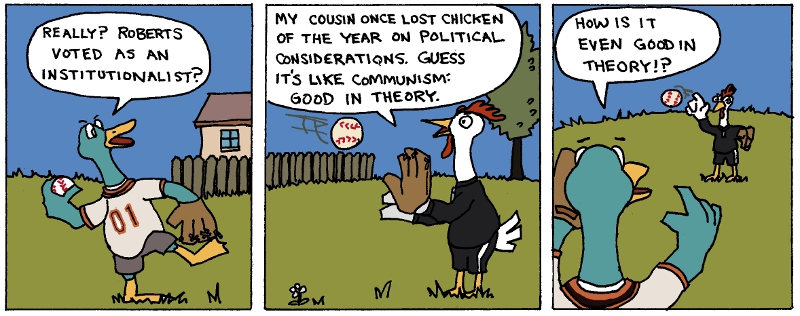
For politicos, the Obamacare decision was something of a “Where were you when . . . ?” moment.  Surprisingly, Chief Justice John Roberts–not Justice Anthony Kennedy–was among the upholding majority.  And the mischievous wording of Robert’s majority opinion memorably made the breakneck news cycle stop for just a couple minutes as reporters rushed to divine the arcane document on live television.   CNN even embarrassed itself (and FOX less so) with a Dewey defeats Truman blunder, but I doubt it will be remembered as long as the original.

Throughout the day I caught a few whiffs of this idea that Roberts’s institutionalist inclination was coming through.  That is, he voted the way he did to spare the Supreme Court from allegations it had succumbed to an intractable polarization along party lines .  It was batted around on NBC’s live coverage, and resurfaced for the evening’s All Things Considered.  Hard liberal Robert Reich presciently cited this institutional loyalty a day in advance.  Supposedly, John Roberts is not even the first chief justice to spike his vote in the hope of saving the court’s influence.

If this protective phenomenon of institutionalism is real, isn’t it self-defeating in practice?  It would seem the court is compromising its deliberative process in order to not appear compromised.

Yet, short of Justice Roberts being interrogated with truth serum, the institutional motive will probably remain just speculation.  There’s been profuse coverage and the decision’s dissection will only become more detailed and complete over time.  I cannot pretend to be an expert on jurisprudence, so I trust those who say Roberts had good reason for pegging the mandate as a tax.  Indeed, it may have been more a pebble in Democrats’ shoes than a charitable move.

It seems at this point that the GOP has been invigorated considerably by the shock that for some is also accompanied by a sense of betrayal.  I’m surprised that there are still holdouts coming out of the woodwork to support Governor Romney.  It’s like those Japanese soldiers who only surrendered to American forces in the age of disco.  What a trauma that must have been.

The response on the Right, including over one million spontaneous dollars taken in by Romney’s campaign today, is encouraging for those who hope to roll back the collectivist tide.  It seems conservatives have their own way of going “Forward.”

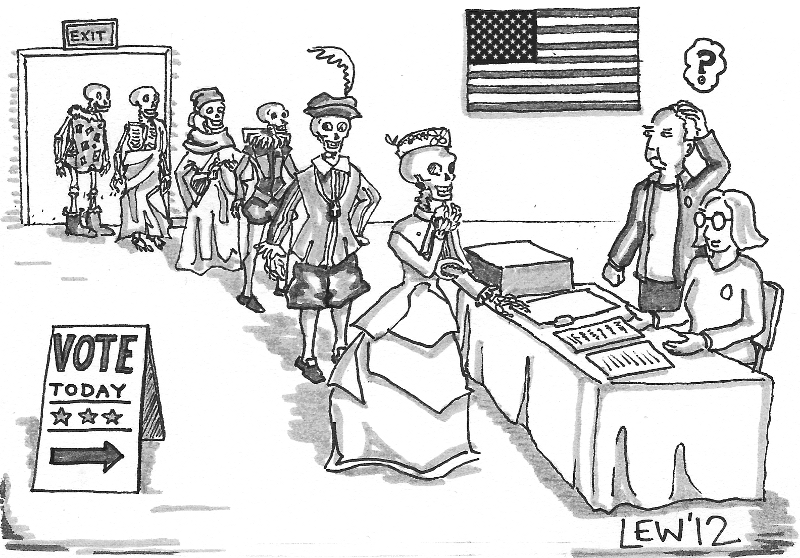
Democracy of the dead

What is democracy of the dead?  No, it has nothing to do with zombies voting Democrat.  Although recently a dead dog did receive a voter registration form.  What I’m referring to comes from that emir of aphorisms, G.K. Chesterton.  Consider this idea from Orthodoxy (also available as a free PDF):

Tradition may be defined as an extension of the franchise. Tradition means giving votes to the most obscure of all classes, our ancestors. It is the democracy of the dead. Tradition refuses to submit to the small and arrogant oligarchy of those who merely happen to be walking about.

That those many souls who came before us might not have been complete fools is a refreshing perspective in our age of progress for progress’ sake.

Chesterton–himself now among the dead–enriches our idea of tradition with literary wit.  Meanwhile, Thomas Sowell  provides us a more rigorous understanding, by way of broad philosophical survey in A Conflict of Visions.  Looking to English arch-conservative Edmund Burke, Sowell posits “the constrained vision” : a philosophy that directs human society to seek “cultural distillations of knowledge” within the confines of a “tested body of experience.” The idea is not a mere impulse to conserve tradition, but an acknowledgement that wisdom flows down naturally and systemically through culture, from one generation to the next. Between Chesterton’s democracy of the dead and Sowell’s constrained vision, we glimpse what may be the most appropriate definition of conservatism.

Not everyone is so fond of tradition. There are those invested in seeing each generation break free from the tyrannical chains of its ancestors. Consider this inscription at the Jefferson Memorial:

I am not an advocate for frequent changes in laws and constitutions. But laws and institutions must go hand in hand with the progress of the human mind. As that becomes more developed, more enlightened, as new discoveries are made, new truths discovered and manners and opinions change, with the change of circumstances, institutions must advance also to keep pace with the times. We might as well require a man to wear still the coat which fitted him when a boy as civilized society to remain ever under the regimen of their barbarous ancestors.

Progressives should be quite fond of Thomas Jefferson’s thinking here. He speaks of humanity’s “progress” and how it will “advance” from a “barbarous” state.  Just as he took scissors to his least favorite parts of the Bible, there are those today all too eager to make their own redactions to the traditional moral fabric.  Take New Atheist Sam Harris.

In a 2011 debate on the foundations of morality, Harris dismisses the God of the Bible as a mere “Iron Age god of war.” His epochal delineation recalls the popular formulation that certain Abrahamic belief systems may have been tolerable enough for goat herders or a pastoral society, but are utterly unsuitable for our modern age.  A bit later in the same debate, Harris insists that anyone today could come up with a moral code superior to the Mosaic law if given five minutes’ thought.  So much for his estimation of past wisdom.

Whether inspired by the Enlightenment or the New Atheists, there’s no question modernist arguments hold serious sway over the contemporary mind.  But postmodern sensibility won’t tolerate the sweeping assumptions.  For all the aspersions the modernist might cast on the dead of generations past, the postmodernist would be right to call him “judgmental.”

The critique is rooted in history.  From gas chamber genocide to the threat of thermonuclear annihilation, the distinctives of the twentieth century disabuse us of the naivete that mankind is steadily rising above some past state of barbarity. To characterize people long-gone as “barbarous” or less thoughtful than those living today is to ignore a twin loss of epistemic and moral confidence the world has yet to recover from.

Where does that leave us?  We were never without hope.  Harris’ debate opponent, philosopher and Christian apologist William Lane Craig insists on the way: backward, not forward.  Modernity is overly confident in its presuppositions.  Postmodernity is quite useful at deconstructing worldviews, but not so helpful with building up a shared body of knowledge.  If we want to access the lasting truths about human existence, how to live, and how society was meant to be, we need to recover a premodern worldview.

Just think.  We’re all here kicking and alive today.  All those dead and buried folks of past generations must have gotten something right.

The AP, Obama, the ‘S’-word and E.J. Dionne

I never get tired of calling out the mainstream media.  Its reporters give us steeply slanted stories and we’re supposed to believe they are fair and objective.  A recent AP piece–not marked by Yahoo! as commentary or analysis–defends President Obama against the “socialist” label while simultaneously slapping down conservatives.

The article’s language allows the writer to circuitously vent his disdain for Obama critics.  In his prose, they “pounce,” “slur,” and “denigrate.”  Other words color the tone for us: contention, epithet, shock value, nonsense, insult.

He weaves quotes from academic experts.  One proclaims he is “weary” of the socialist label.  Another points to a “hysterical outbreak of abuse” and “animosity” coming from a “certain segment of Americans.”  In other words, racist bigots are saying bad things about the President.

Besides saturating his article with inflammatory language, the writer gets smarmy by informing the reader that it was a socialist who wrote the Pledge of Allegiance.  He faults Obama critics for missing a strict definition of socialism, but goes on to quote and mention people who do not fit the bill he uses.

As written, this purported news story is just a string of unsubstantiated quotes and couched words meant to take conservatives down a notch.  But this patronizing corrective is not the first.  I remember NPR running a piece like this just prior to election day 2008.  For years now mainstream journalists have been meticulously removing criticism from the President as if they were remora eels attached to the belly of a giant, lumbering whale.  Hopefully a one-term whale.

These nominally non-ideological reporters work in tandem with analysts and commentators who are open about their Left/liberal leanings.  E.J. Dionne is among the more effective of this clean-up crew.  Whether in his weekly sparring with David Brooks or on the talk radio circuit promoting his new book, Dionne often comes across as sharp, earnest, and even magnanimous.  For many in the political middle that could be swayed, his style threatens to give credence to his thesis that conservatives have moved radically rightward, abandoning what he calls a traditional balance between private and public, individual and community.  Never mind that he conflates government with community or that families, churches, and civic associations don’t neatly fit into his talking points.  For some swing voters, tone and presentation will matter more than substance.

Anyone who wants to stave off the misfortune of another four years of Barack Obama and his liberal, Leftist, progressive, and Democratic friends should consider carefully how they’re talking about him.  “Socialist” may be a cogent term that energizes the base, but it will turn off at least a few independents who are paying attention.

What I’m suggesting is not the abandonment of principle but getting fancy with footwork.  In conversations that count, identify the common ground and frame the choice in those terms: personal responsibility, the dangers of centralization, or whatever it may be.  Make it clear that even if Obama and Democrats don’t satisfy some strict definition of “socialist,” it is a distinction without a difference.

We don’t need to renounce our partisanship like mainstream journalists do; it’s better to confess rather than suppress your bias.  But beyond the statistics, labels, and gotchas that get thrown about, we must connect the dots, clearly articulating why it is we believe what we believe.

Spirit guide

Humor is a subjective thing, so I’ll fill you in on the gaps.  Our pig of course shares a lack of certain scruples with Elizabeth Warren.  The totem gig comes from two sources.

First, I heard interviewed last year on The Michael Medved Show a remarkable performance artist.  She was commissioned via Kickstarter to circumprostrate herself around Mount Rainer.  It’s not as dirty as it sounds.  From all the bowing down, I guess there’s a spiritual dimension to it, but I can only scratch my head in wonder as to who paid for this and why.  Nonetheless, as a free marketeer I say more power to this woman if she can get people to pay her for her art.  It’s something I’m working on myself.

The second part of the totem reference also originates in the Pacific Northwest, which is a sort of epicenter of ecological writing.  There’s a whole lifestyle and philosophy that’s captured by folks like now-retired English professor and poet Gary Snyder.  Early in life, he saw the world as a merchant mariner, caught Zen Buddhism, and subsequently married it to Native American spirituality among other things.

From time to time in my day job, I encounter some works in this tradition.  I find the children’s literature to be especially striking.  One story book features a privileged white kid who is empowered by the spirit of Raven to oppose some mean guys in hard hats who cut down trees for a living.  Another encourages children to connect to “place” and maybe discover for themselves a special inspiring animal, or totem.  As the child of one Asian immigrant (and a native-born American) I can’t help but be tickled by how my fellow, privileged Americans turn from their rich heritage in search of more resonant truths.  By accident or providence, I’m on the opposite end of the divide from those Beatniks and baby boomers disaffected with Western modernity.  Once I came upon the scene, I was taken with the strange idea that America is a singular land of opportunity, that democracy and free market enterprise were vindicated by the end of history, and that we all have God to thank for it.  I still hold to this, by the way.

There’s one more piece to the punchline, if like me you don’t recall much of ancient literature.  It’s that Gilgamesh is 2/3 god, and 1/3 mortal.  But how does one get such a proportion of pedigree?

Scientists campaign against Republican, conservative brains

Back in April, I was dismayed to learn that my alma mater was hosting a speaker promoting a new book titled The Republican Brain: The Science of Why They Deny Science and Reality.  (Read Jonah Goldberg’s take on the book here)  It’s become a refrain of mine that no one should be shocked at liberal bias in media or academe. But that a campus would sanction an event branded with such a patent insult is a new low for discourse.  Doubtless, the glorified ad hominem that Republicans are wired to deny reality would go unnoticed by the campus’s “Civility Project,” which rather than treat civility seriously, reinforces notions of victimhood and grievance.

Andrew Ferguson at The Weekly Standard has managed to capture the zeitgeist of liberal academics who try to analyze conservatives. The New Phrenology, as he calls it, has roots as far back as the “F Scale” psychological test of the 1940s. It was meant to gauge one’s conservative tendencies. The “F” stands for Fascism.

Looking at more recent studies of the same vein, Ferguson finds some recurring faults. In a couple of cases the sample groups consisted entirely of college students. Hormonally-driven and still maturing, these folks are hardly suitable representatives for the population at large.  Furthermore, the subjects were also disproportionately Asian-American and female. One study assessed subjects’ conservatism by asking whether they felt “powerful” that day. The methodology leaves much to be desired.

Remember when Farleigh-Dickinson University’s Public Mind Institute reported that watching FOX News makes you dumber? They recently touted the study’s results were “confirmed” with a follow-up. But by asking the same questions as the first time, they repeated the same mistakes. A self-reporting NPR or evening news consumer is going to get a solid block of news, but a watcher of a 24-hour cable news network quite possibly could miss out on substantive programming. And the questionnaire’s focus on Syria favors a misguided, cosmopolitan set that believes the UN might actually be effective. It’s not FOX News but The Public Mind Institute that has made the world dumber with its junk studies.

Meanwhile, one Marcus Arvan has attempted to pin conservatives on the pages of a journal called Neuroethics. The determinism implied in the journal’s title is striking; as if morality were some lightning to be captured in a materialistic bottle. Arvan alleges conservatives share in a “Dark Triad” of personality traits, among them a Machiavellian bent. It’s nothing to worry about. That’s just what people label realists when they don’t like what they have to say.

But on the contrary, anthropologist T.M. Luhrmann finds evangelicals to inhabit a fantasy land.  She sees her native tribe of secular liberals as results-focused, but evangelicals as strangely obsessed with self-improvement and how people could be. Last time I checked, it was liberals who were pie-in-the-sky, swaying to John Lennon’s “Imagine.”  Serious Christians remain firmly rooted in reality, thanks to a cognizance of sin. Among other things, this is the idea that no one, not even ourselves, is perfect or perfectible on this Earth. The Incarnation excluded. Far from enabling delusion, real knowledge of sin and fallenness equips Christians with an ideal, double-edged skepticism. Like the kind that informed America’s great system of governance.

If anyone, it’s secular liberals who ought to be concerned for their own views of reality. Progressives can’t question the very thing they’re progressing toward. There’s no room for genuine critique if there’s a real war on with capitalism, patriarchy, scientific illiteracy, or some other ill of preference. And, as with war, secular liberals demand that problems be dealt with centrally and in totality. This embarrassing prescriptivism should have died with eugenics and all the other awkward progressive-era vestiges long ago.

Still, we are burdened with the unquestioned assumptions of the liberal-scientific consensus. We’re not allowed to question computer models of climate change. But the layman recognizes the hubris in forecasting a city’s weather one month in advance let alone global conditions one hundred years hence. On policy, the consensus demands economy-crushing carbon taxes, lest famines and war break out. But these conditions prevail already.

It’s maddening that the liberal-scientific consensus recuses itself from the possibility of error. Meanwhile, it treats people and the environment as fragile and unable to adapt–in fact, in need of a strong, capable hand–a scientific and liberal hand.  On this view, everything is material, knowable, and solvable. Their knowledge is so certain that even their critics’ reasons for criticism can be deconstructed with empirical precision.

No one likes to deal with this kind of impenetrable certitude. All the more that liberal scientists and academics should abandon their shameful quest to dismiss conservatives with the cudgel of science. Then we can get around to solving real problems.
Economics and fairness: California’s Prop 29

Last Wednesday I was listening to Insight, a locally-produced public radio show.  Jim Knox of the American Cancer Society was on promoting Proposition 29 in advance of this Tuesday’s California primary election.  Sharing air time with Prop 29 detractor David Spady, he mentioned tobacco company funding every other sentence, seeking to trigger anti-corporate, Pavlovian antipathies in the listening audience.  More striking though was his argument that California is only one of three states that has not raised tobacco taxes in the 21st century.  Heaven forbid the Golden state fall behind the unyielding curve of progress!

Two previous, successful propositions in 1988 and 1998 have brought California’s current cigarette tax to $1.87 a pack.  Prop 29 proponents anticipate it would raise an additional $700 million annually, deter youths from picking up smoking, and get 110,000 adults to quit the habit.  That’s possible, but given the inelastic demand of a highly addictive product, such a steep price increase will unleash a number of unintended consequences.

On Prop 29’s passing, many smokers would simply shift to alternative forms of consumption.  For all the trouble of a new bureaucracy, the state would end up arbitrarily boosting the home-rolled industry at the expense of cigarette pack producers.  With the tax hike, some smokers would make more purchases out of state.  Yet others would resort to stealing from vendors or neighbors.  Even if not victimized by robbery or theft, convenience stores would lose revenue on impulse buys incidental to a cigarette run.

The tax would burden a concentration of the vulnerable: the addicted, those suffering from smoking-related health impacts, lower-income persons, and the businesses that serve them.  Perversely, those who would benefit most would be relatively well-to-do researchers and scientists.  Talk about reverse Robin Hood!  Nothing wrong with getting wealthy, but it’s unjust and inefficient when redistribution occurs through such ill-considered legislative interventions.

Arthur Brooks, who has been promoting his pro-market ethical manifesto The Road to Freedom, decries not just the harm but immorality that comes from the one-way push for ever more taxation and regulation.  It’s easy and often that a society decides through government that a certain problem exists and can be solved by taking money from one place and throwing it at another.  This is the profound moral hazard that every democracy must surmount if it is to survive.  California’s prospects prove dimmer with each election.  On the flip side, we have to bottom out at some point, right?

Resurrecting birtherism, questioning leadership

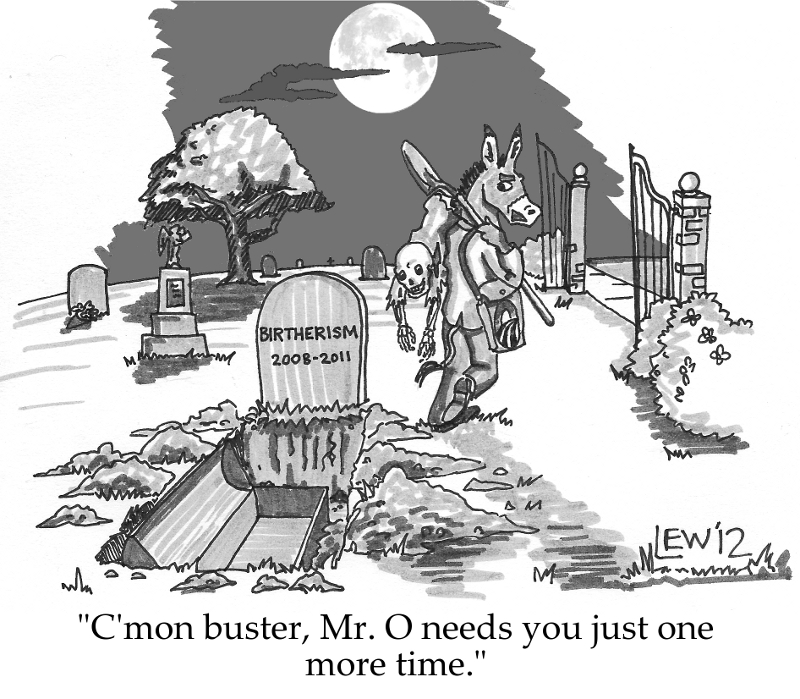
The Obama campaign resurrected the birther bogeyman this week with the release of a video questioning Romney’s ability to lead in light of his ties to Donald Trump.  This is an odd accusation coming from a president who forfeited leadership in shaping Obamacare, his crowning achievement, to his Democratic allies in Congress.  Meanwhile, his best claim as a bipartisan leader is the glorified photo-op of playing golf with John Boehner.  Much good that did.

Ed Klein’s new book, The Amateur: Barack Obama in the White House, reveals just how incapable a commander the president has been. In a recent Michael Medved interview, Klein contrasted Obama’s lack of day-to-day communication with President Reagan’s warm and regular phone calls to Democrat House Speaker Tip O’Neill. Today, Obama’s allies, to say nothing of his opponents, complain they never hear from him.  Maybe he’s been out on the links too much?

The biggest danger President Obama presents is not his race, his place of birth (Hawaii, USA) or his alien religion (secular liberalism). It’s his incompetence. This, combined with his unpopular, stubbornly-held big government liberalism, is why his campaign must constantly churn out red herrings like the birther issue.

Make no mistake.  Romney may not be the warmest character or give you leg-tingles, but his substantial experience heading up real, successful, and reputable enterprises give him a serious advantage over the incumbent, whose rock star status sheltered him and left him clueless as to how an executive should actually operate.

Prairie fire and cowpies make campfire politics

What happens when an unstoppable force hits an immovable object?  Who knows.  The more pertinent question for this past week: What happens when a prairie fire hits a pile of cowpies?

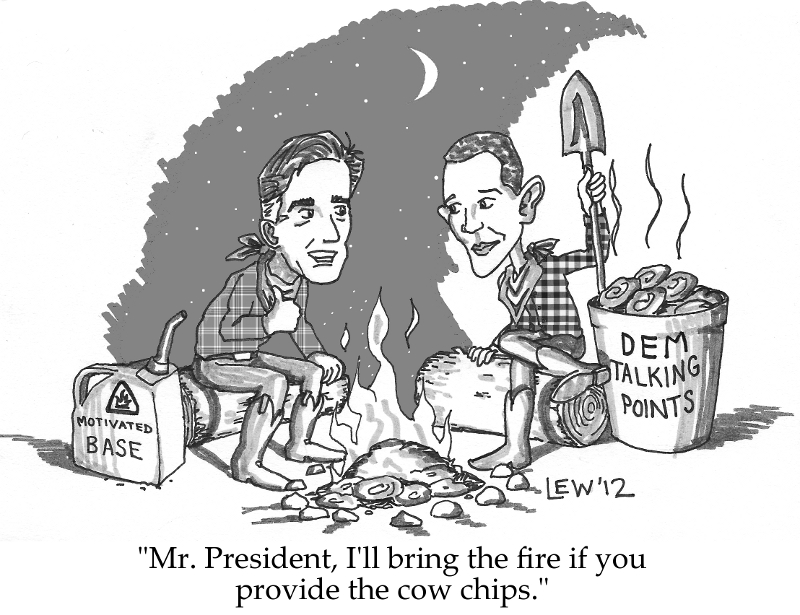
Both Mitt Romney and Barack Obama have been tweaking their rhetoric for Iowan ears.  Responding to Romney’s accusation that he’s tended over a “prairie fire of debt,” Obama has described his opponent’s criticism as a “cowpie of distortions.”  Our President continues to debase the discussion with a vulgar allusion to a steaming pile.

Meanwhile, the White House and the Left have tried to play off of the ill logic of Rex Nutting, who contended earlier this week that Obama has grown Federal deficits at the lowest rate since the Eisenhower administration.  Many observers have debunked this idea.  James Taranto put it well when he noted that Obama has treated Bush’s one year, necessary TARP swell as a baseline for subsequent years’ Federal budgets.

It’s as if you, the head of a household, assented to spending $10,000 to repair a sudden, gaping hole in the roof one year, but decided to keep spending that same extra amount for each of the three following years.  And this spending is not on other emergencies, but pet projects.  All the while, you claim to be a fiscal hawk because your spending hasn’t grown significantly since the initial boost that you approved when you first came in.

So Romney’s prairie fire claim isn’t so . . . smelly after all.  What we’re left with is a challenger with a base itching–on fire, in fact–to vote out an incumbent whose campaign and allies never seem to be in short supply of well, cowpies.  At least you can dry them out and use them for fuel.

Thoughts on San Francisco

Yesterday I visited the California Academy of Sciences in the heart of San Francisco’s Golden Gate Park.  As beautiful and therapeutic as the city’s green expanse is, folks from flyover country can’t easily forget just what an epicenter of liberalism it is either.  Less than a week after Mayor Ed Lee renamed prosaic-sounding Middle East Drive, I had the honor of seeing with my own eyes the newly-christened Nancy Pelosi Drive.

I can imagine the mayor telling the city council they would have to pass the renaming measure before they could find out what the street would be called.

Now there’s been a great ballyhoo about the U.S. Census release claiming that white babies are now a minority.  If you’re somehow concerned about this, don’t worry; all the unaccounted-for white kids can be found being pushed in strollers through the California Academy of Sciences museum.  There, they learn valuable truths, like the fact that toilet bowls do not harbor a safe supply of emergency drinking water.  Seriously though, I did enjoy exhibits like the rain forest and the planetarium show.

Like many other Americans, I drove a car to reach my Memorial Day weekend destination. Coming from the Sacramento Valley–which is worthy of the flyover country honorific in it’s own right–I decided to skip the parking lot that is called Berkeley, taking instead the scenic U.S. Highway 1/101 south.  As I passed Muir Woods, I was reminded of last year’s blockbuster remake Rise of the Planet of the Apes.  In the film’s climax, sentient apes escape a grossly distorted, Hollywood version of San Francisco, fighting authorities in a pitched battle on the Golden Gate Bridge before swinging to the freedom of Muir Woods.

What do I mean by a distorted, Hollywood version of San Francisco?  The protagonist’s neighborhood looks less like a crunched row of Victorian three-story homes than it does a line of oak-shaded tracts transplanted from the middle of Anytown, USA.  There are no hemp-adorned hippies, hat-and-beard hipsters, or any hint of Chinatown.  The film depicts no Asian-Americans save the heroine, India’s Frida Pinto.  That there would be a corporate science facility doing testing on primates in the environmentalist Mecca-by-the-bay strains viewers’ credulity.  And rather than flee before the apes, some San Franciscans would surely take to their side to hurl rocks against mounted police.

In one sense, I suppose I shouldn’t find these logical lapses strange or noteworthy.  After all, Hollywood, like much of the rest of the Golden State, is a land where make believe rules.

Why should government endorse same sex marriage?

The above fictional account touches on the gimmicky raffles the Obama campaign has been using to raise money.  Small-time donors first had a chance to meet George Clooney, and now  Sarah Jessica Parker.  For Mother’s Day, there was the opportunity to win mom a tweet from the President himself.

The other issue I’ve depicted and invite you examine for the remainder of this post is gay marriage.  The tendency in the public square is to conflate cultural practice with government endorsement.  We saw this two weeks ago when some folks were upset with North Carolina’s poll but pleased with President Obama’s evolution.  If we want a lucid discourse on marriage, we need to parse the cultural practice from government endorsement.  The critical question to ask: why is this new task of endorsement—with its associated costs—necessary?

Supporters of gay marriage often say it’s a civil  rights issue, inviting a comparison to the historic plight of racial minorities.  But the gay community’s experience today is nothing like the suffering under Jim Crow.  The collective socioeconomic status of homosexuals doesn’t reflect some sort of pervasive systemic bias.  And Federal laws already protect against sexual orientation discrimination.  The relative lack of exigency is a strike against the necessity of endorsement.

Yet, through personal experience, many feel gay marriage to have the moral force of a civil rights issue.  “Equality!” is the cry.  What is government supposed to equalize: individuals or relationships?  The state certainly treats individuals differently.  Men must sign up for selective service; women don’t.  Divorcing mothers tend to win custody over fathers.  And government  justifiably treats relationships differently too:  marriages are proscribed on the basis on age, blood relation, ability to consent, or number of  partners in the relationship.  Having strong feelings about equality doesn’t make government endorsement necessary.

The question remains, why endorse?  One with an expansive view of government may say that endorsement validates or affirms the humanity of gay individuals.  But personal affirmation is not the state’s  business.  We all have God-breathed dignity in spite of what government says about us.  Dissidents living under oppressive regimes around the world know this.  It’s our patrimony as Americans to know and live this truth without such pointed help from Uncle Sam.

In opening up two weeks ago, Vice President Biden gushed about commitment and love.  But governmental recognition of marriage, which boils down to enforcing a contract, is an unsexy thing.  It’s not about feeling love or commitment.  It’s a man and woman assenting to being bound by the law, with the end of raising children well in mind.  With the contract, the couple faces an increased cost of separation, and so does the court system for that matter.  This is another reason why government shouldn’t recognize relationships it doesn’t have to.  And it doesn’t have to because same sex couples never produce children naturally, while opposite sex couples do all the time.  Simultaneously, they face pressures that would separate them from each other.  It’s a bit ignoble, but that is the human condition.

All this to say government needn’t recognize gay marriage.  In fact, the  push for recognition sends the dangerous signal that government’s role is to correct every perceived societal slight, or worse, validate our personal feelings.  Each of us should feel free to pursue any relationship or endeavor we find fulfilling.  Just keep government out of it if you’re able.