Duel of the embattled visages

You know how news websites usually have a most-read stories box.  Sometimes, the Christian Science Monitor inexplicably has an old report at the number one spot.  Earlier this week, a January story critically probing Mitt Romney’s record at Bain Capital was on top.  The lead photo struck me as over the top in conveying the anti-business tone of the article.

Christian Science Monitor

From the side, a harsh light defines the subject’s face.  Squinty-eyed, she stares off into the distance, as if in the midst of a hardscrabble existence.  We know she’s not happy.  Maybe you can imagine the photographer coaching her, “No, not quite.  Try to look a little more . . . off-put.  Turn your head just a little more to the left.  That’s it.”

The photo surely recalls an iconic image from one of the more trying times of last century.

Migrant Mother, Dorothea Lange, 1936. Wikimedia.

I wouldn’t try to question the artistic merit of Lange’s photography.  But given today’s sensibilities, to stumble upon such a spitting facsimile of her work’s form and style ought to puzzle if not disturb us.  In Lange’s time, America was reaching, in ways more benign than in other parts of the world, its own totalitarian zenith.  Government drafted artists en masse to produce, well, propaganda.  And surely, that’s what Lange’s work is: biased, and with a story to tell.  This is not bad in itself, but in our jaded, post-Vietnam, post-Iraq culture, there’s a double standard at work.

It’s routine and accepted for journalists to play up poverty as grinding.  But they can’t allow themselves to show private sector success as uplifting.  Not alarmist enough, or in tow with liberal media execs’ worldview.  When we hear or read “Bain Capital,” we expect to see grizzled profiles rather than glowing families.  Such a sustained slant is pernicious to our way of thinking, and in turn to the way we live.  At least there are those who would straighten the record.

President Obama’s off-base

The White House’s campaign messaging has been all over the place in recent weeks.  And contrary to his 2008 promise, the President has come off as more of a divider than a uniter.  Not to be confused with President Bush, who was mocked for proclaiming himself the “Decider.”

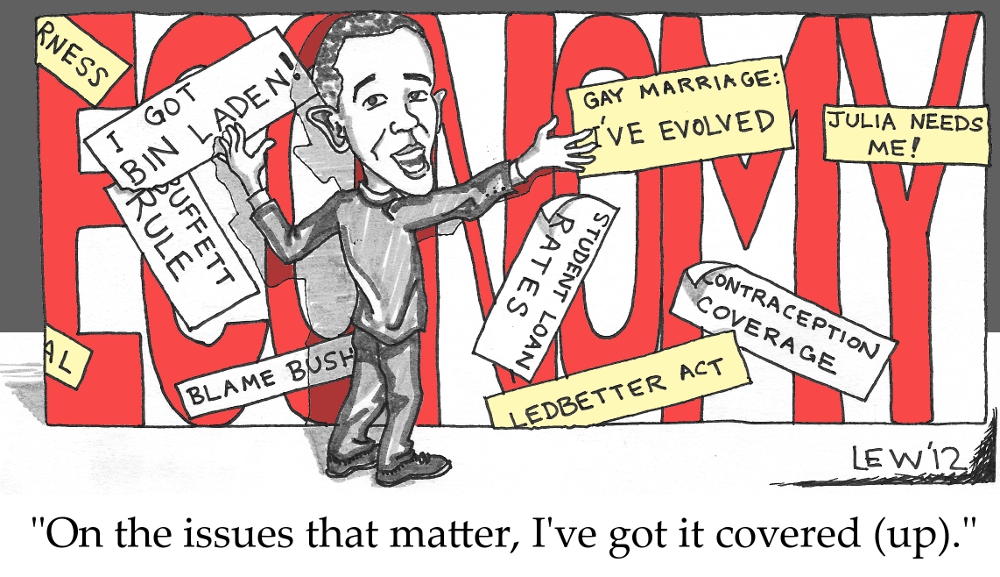
The Obama team’s trail of message wreckage started with February’s awkwardly handled contraception mandate work around, which, for all the trouble, still leaves some religious organizations paying indirectly for services they find unconscionable.

Then, erupting inconveniently last week was President Obama’s personal “evolution” on gay marriage. Many observers saw the President’s hand forced by discretion-challenged Vice President Joe Biden.  What’s most vexing about this iteration of the marriage debate is not the particular stance taken, but the justification as to how one arrives there.  Biden baffled us all with the idea that the 1998-2006 sitcom Will and Grace was for him some pivotal, moral tour de force.

As one poll shows, Obama and company seem to have alienated swing voters on the social issues.  But  they have tried mightily to boost their standing with female voters, trumpeting the 2009 Lilly Ledbetter Fair Pay Act as a great and early first term accomplishment.  All the act does is give women more time to sue their bosses for the phantom menace of wage discrimination–a boon for Democrat’s loyal base of litigious attorneys.  Touted as historic and consequential, the act is only known because the Obama team has dusted it off as a showpiece for the 2012 campaign.

Indeed, the Ledbetter Act featured prominently as part of the Life of Julia, a fictional every-woman whose slideshow biography was quickly and widely ridiculed for its earnest portrayal of a hopelessly lonely, overly dependent, Obama-centered life.  Rather than making the conventional, family-oriented “Harry and Louise” kitchen table-type pitch, The Life of Julia deliberately caters to the fervent, perennially disaffected fringe that is Obama’s base.

To see just how hard the Campaigner-in-Chief has tacked toward those who self-identify as embattled and aggrieved, we need only look to the recent “dueling” commencement speeches delivered this past week.  Conservative commentator Michael Medved noted that of all the colleges in the country he could have spoken at, President Obama chose the elite, astronomically expensive Barnard College.  His audience at the women’s liberal arts college was a particularly concentrated sample of privilege: women now far surpass men in educational achievement by the numbers, from undergraduate enrollment to attainment of advanced degrees.  Yet, the faculty and students were ebullient when the President was introduced as one who appointed so many women and minorities to the highest offices.  Meanwhile, Mitt Romney’s receptive audience at Liberty University, with its larger student body and more affordable tuition, was a far more representative cross-section of America, on the socioeconomic level not to mention anything of gender representation.

The White House has garnered a few days’ media attention on other issues: “spiking the football” at the anniversary of Osama bin Laden’s death, and the economic distractions of the Buffett Rule and the student loan rate relief.  The former was no help to the incumbent, with liberal Arianna Huffington calling one Democratic campaign spot “despicable.”  The paltry Buffett Rule captures more class resentment votes than it would actual marginal revenue from the wealthy.  Likewise, the playing up of the student loan rate extension nakedly caters to the college age vote, while dangerously distorting market decisions about the relative value of earning a degree.

All told, the President seems pretty set on stoking his base with the visceral fuel of social, class, and identity politics.  Meanwhile, substantive solutions for the economy, as well as the sensibility of swing voters, remain neglected.  Sending Biden around with the fib that he’s working class will only go so far.  We’ll see in the months ahead if the Obama team can refocus, or if Romney, sticking to the economy and clearly rising, can build and maintain a respectable distance.  Let’s hope so for our country’s sake.


The immorality of sit-ins, hunger strikes, and other protests

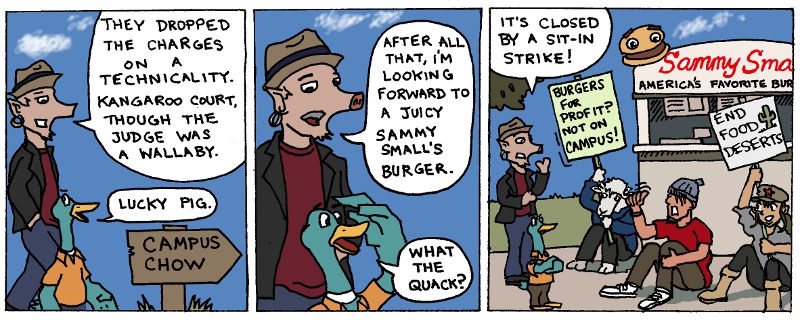
This latest comic is inspired by two anti-business movements in the Sacramento area.  In April, activists petitioned Sacramento’s city council to block a McDonald’s from opening in the midst of what some would term a “food desert.”  This followed on the heels of a January through March sit-in strike that successfully closed the U.C. Davis branch of U.S. Bank.  Both campaigns were driven by a misguided desire to narrow free market choices available to the community.

While these kinds of paternalistic projects are at odds with the values of free choice and personal responsibility, at least the anti-burger campaign was conducted within the limits of the local political process.  But the anti-bank sit-in demonstrates the widespread and reckless abandon with which too many progressive protesters pursue their cause today.

It’s common and commendable to ask if the ends justify the means.  The anti-U.S. Bank campaign is a clear case where neither the ends nor the means are justified.  In blocking physical access to the bank, members of Occupy UCD actively prevented customers and employees from engaging in mutually beneficial commercial transactions.  Such stunts that diminish the legitimate choices of others are a real threat to freedom.

The university administration, perhaps still reeling from November’s pepper-spray incident, was complicit in its failure to remove the blockaders.  Now, U.S Bank is suing the campus for breach of contract because its police did not effectively enforce an ordinance barring people from blocking public spaces.  On top of $2 million+ lost in future rent and revenue sharing, U.C. Davis stands to shed additional dollars fending off the suit.

By allowing those with gut-felt convictions to run roughshod over the rule of law, the administration betrayed the civil society it claims to honor and cherish.  In an even greater let down, Seattle Mayor Mike McGuinn allowed a large, organized, and anonymous mob of masked “black bloc” protesters to smash  numerous store front windows on May 1.  Among the infamous moments captured was the hypocritical smashing of a Niketown window by a Nike shoe wearer.

The solipsistic morality that drives most protest should give us all more pause than it does.  Besides actions that violate others’ rights of movement or property, there are protests of self-inflicted harm.  Consider the multiple self-immolations that ignited the Arab Spring last year.  Or, look at the not-so-fatal hunger strike.  This act of protest is way overrated.  It’s akin to terrorism in that the protester threatens violence if the target of coercion refuses to grant the demand.  The only difference is that the protester supplies his own body for the violence rather than that of a hapless victim.  Self-sacrifice is warranted for ends like saving children in a burning building, but harming oneself to coerce another is as immoral as harming others.

When protesters stop respecting the rights of others or even the value of their own bodies, civilization takes a step backward.  Rather than romanticize protest, which devolves to a gut appeal, our culture should uphold the truly constructive engagement that arises from our more measured, non-coercive political and economic processes.

Paul Ryan, Ayn Rand: Can a brother shrug?

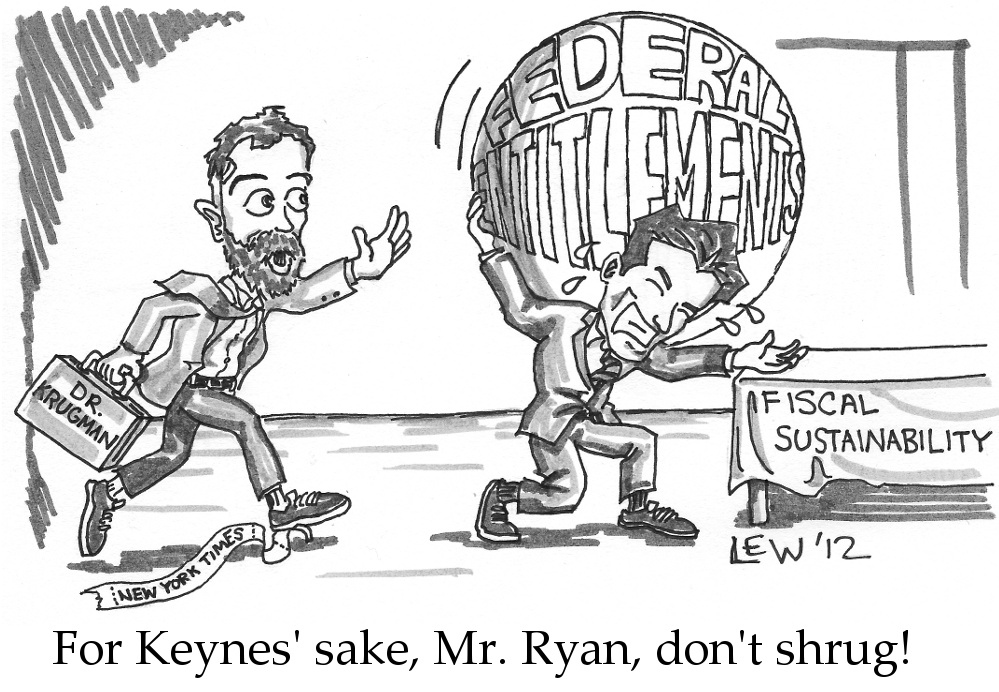
In the past few weeks, Paul Ryan has been the prime bogeyman of liberals and progressives.  His proposed Federal budget plan trims entitlement growth more than Democrats would like.  Supreme Keynesian Paul Krugman has accused Ryan, a father of three from Wisconsin, of being an Ayn Rand fanatic.  The Congressman has played down his affinity for Rand’s egoistic philosophy of Objectivism.

Liberals’ groaning over Ryan intensified after he delivered a policy speech at the Catholic Georgetown University last week.  Here he hoped to justify his policy decisions in terms of a personal understanding of his Catholic faith.  Invoking church doctrines creatively and boldly, he suggested that the moral obligation of solidarity with the poor might best be served by a prudential application of subsidiarity.  In layman’s terms, our society can help the poor better by learning from history and subsequently devolving aid responsibility from the highest offices of power to the smallest practicable unit.

Ryan’s speech was thoughful and provocative, but perhaps too threatening to the Georgetown faculty’s belief that Catholic social teaching is an automatic endorsement of unmitigated big government.  Ninety of the school’s faculty signed and sent Congressman Ryan a scathing epistle rebuking and encouraging him to bone up on the doctrines he cited.

So recently, Ryan has aggrieved his fellow parishioners and has been linked with one of the grumpiest, most selfish atheists of yesteryear.  Is he just a glutton for punishment?  No. If we heed Mr. Ryan’s call to look at history and experience, we’ll find that his Christian faith and Rand’s Objectivist philosophy furnish common ground for resisting America’s decades-long progressive drive toward cultural and fiscal oblivion.

In Ayn Rand’s most influential work, Atlas Shrugged, we get to see a worldview shaped by the author’s firsthand experiences of two historic catastrophes: Russia’s Bolshevik revolution and America’s Great Depression.  The first impressed her with man’s capacity for coercion, and the second his capacity for incompetence.  And it’s this second lesson that remains pertinent to us today.

We can trace the more salient markers of the the progressive quest for social equity: FDR’s New Deal entitlements of the 1930s, Lyndon Johnson’s Great Society of the 1960s, and lately, Barack Obama’s budget-busting program expansions.  The unending accretion of altruistic programs has done more harm than good.  We’re saddled with triplicate and quadruplicate bureaucracies that don’t produce results.  A little empirical evidence demonstrates just how ineffective Federal social programs have been for the past half century.

Progressivism, the worldview that drives the long leftward march, prefers central planners to do the thinking of everyday life rather than families or individuals. The result of such a society is what Rand’s Atlas warns against: a world where people exchange the virtues of thought and creativity for pity and manipulation.  Among the classifications she assigns to the degenerate denizens of the Atlas world: “moochers” and “mystics.”  People who’ve stopped working and stopped thinking.

It’s in vigilance against such a fate that Christians share with the Randian cause.  Apologist and philosopher J.P. Moreland warns us against the sensate society, where people make decisions less with their brain and more with their gut.  One of the central truths about humanity is that each of us bears Imago Dei, God’s image.  We resemble him in our ability to reason and to create.  Even these two activities are at the core of Ayn Rand’s Nietzschean pursuit of existential necessities.

How do we turn back from a world where centralization has elevated entitlement and choked out incentive?  Atlas only offers the dramatic cataclysm of a Capitalists’ strike.  But fortunately, in the real world, Congressman Paul Ryan encourages us all to re-think our march off the cliff of uncritical, state-driven altruism.  If we can get around the Left’s pipe dreams, maybe America can jettison the vice of entitlement and recapture the values of reason and creativity.  Then we will have a truly compassionate and just society.

Reflecting on Campus thought police

In my recent post Campus Thought Police, I suggested that all the attention campuses pay to hate crimes and intolerance ends up diminishing individuals’ sense of agency and empowerment.  Looking at it after the fact, I wondered if I could make the connection more clear.

To clarify on sense of agency: when the community is given no sense of progress, it comes to feel powerless.

The messaging that comes from the campus establishment treats hate and intolerance as if they were perennial, unparalleled mortal dangers.  The constant use of such an urgent tone makes it seem as if the Civil Rights era counted for nothing.

But there has been much progress.  Racism, sexism, and other bad -isms have become stigmas to a culture that is now loathe to harbor stigmas.  Nonetheless, instead of placing us somewhere on the long arc of the moral universe, campus voices convey to us that we are in a Sisyphean task: rolling the boulder ever up the hill with nothing to show for it.  The unending klaxon calling us to battle stations against intolerance eventually convinces us that we are fighting some insurmountable evil.  No reasonable observer can maintain hope if they take the academy’s message at face value.

To clarify on empowerment: activism shunts individuals to the radical margin when they should be integrating with the mainstream.

All the prevalent theories on race, class, gender, and so on shove earnest young souls like cattle onto the divisive boat of oppression politics.  If they stay for the ride, they go on to commit civil disobedience, plan direct actions, and lead generally counterproductive lives.  The dogma that they are in mortal combat with oppressive forces locks them necessarily into solidarity and cooperation.  For the sake of comrades and self, they’re never free to think that oppression may not actually define their existence.

But if their worldview is mistaken, then in all their sound and fury they are missing their true calling.  Instead of uncritically fighting on some far flung front of the war on oppression, students should be preparing to constructively enter a society that is on balance more just than unjust.  They should experience the wonderful challenge of interpersonal competition rather than the dull drumbeat to cooperate with comrades.  The university prides itself as a marketplace of ideas, but if there is any such competition, it hasn’t pierced the Berlin Wall that upholds the politically correct dictums of the academic establishment.

Campus leaders’ actual if unintended conveyance of a lack of progress erodes onlookers’ sense of agency.  The shunting of students into unfruitful radicalism not only bereaves society but dis-empowers the students as well.  The leading voices of the academy need to re-examine the message they’re sending to the world.

How Buffett bluster boomerangs; or, Taxosaurus Rex

The unvarnished rhetoric coming out of the White House over the past two weeks has been just too delectable for conservative commentators.  In a recent WSJ piece, Daniel Henninger suggests that Democrats’ furious assault on Paul Ryan’s budget plan is desperate “thermonuclear” overkill.  Indeed, all the accusations of Social Darwinism and “trickle-down” economics cannot make up for Democrats’ utter lack of seriousness when it comes to the national debt.

As the White House rolled out the practically inconsequential yet politically expedient Buffett Rule this week, I was amazed at the justification given by allied economist Alan Krueger.  The Christian Science Monitor quotes:

“In addition to fairness, in fact it’s a step in the direction of economic efficiency,” said Alan Krueger, chairman of the Council of Economic Advisors. The Buffett rule allows people to “devote more effort what their focus should be, which is to their jobs and job creation … rather than restructuring their income to minimize their taxes.”

He’s alleging that the tax increases economic efficiency.  But how does government spend anyone’s money better than they themselves would?  During the global high tide of state central planning in the 1940s, F.A. Hayek explained cogently in his The Road to Serfdom who spends money best: the one who earns it.

When given other people’s money, legislators face the temptation of buying constituents’ votes with pork rather than allocating it wisely.  Then the money goes to bureaucrats, who are not careful enough with it.  Their lack of accountability flows from the political difficulty of de-funding them.  It is the original income earner who best appreciates the sweat and effort it took to get the money.  She appreciates the reality that her income might dry up tomorrow, and so will handle it more carefully than the central planners.

According to his critics, the car elevator in Mitt Romney’s mansion is a bad thing.  But he used his own money, which he only earned in the first place by benefiting others in voluntary transactions.  And the construction provided gainful employment to all sorts of craftsmen.

President Obama, meanwhile, either had to grow our debt or tax money out the economy to give us public project flops like Solyndra and the constipated stimulus weatherization projection.  Money that otherwise would have been carefully spent in private hands was squandered by legislators and bureaucrats.

Of course, not all government spending is bad; some spending is necessary.  But Krueger’s claim that a tax increases efficiency overlooks government’s great tendency towards inefficiency.

The case against the Buffetteers may be clearer when we look at that favorite magic word of progressives and liberals, “investment.”  Any public project from education to high-speed rail becomes an unmitigated good if it can be spoken in terms of investment.  But our current, low tax rates vindicate private investments as an even greater good.  This is why Buffett and Obama pay less in taxes than their secretaries.  The Monitor quotes Marco Rubio:

“What [Americans] need to understand is the reason why he may pay less than his secretary, in terms of the rate, is that she makes her money on a paycheck and he makes his money on investments,” Senator Rubio said. “We have always wanted Warren Buffett to, instead of putting that money in a coffee can, to take his money and invest it, because that created jobs.”

As much as the Buffett-minded would increase taxes on private investment earnings, they would demolish the incentive to invest and crash the stock market.  In this way the Buffett Rule boomerangs back on itself.

Class envy can’t lift up the poor, but it can bring us all down.  Let’s all move past the Buffett distraction.

William-Sonoma Republicans: The Exotic Other

I’ve been reading Yahoo! News for years.  Once upon a time, they relayed to the net denizen a spartan diet of AP and Reuters articles.  Now, they’ve cultivated their own crop of value-added content.  The term “value” must be used advisedly here.

You’d think that when it comes to presidential campaigns, journalists should be delving deep into the issues.  But the currents of today’s media markets dictate other priorities.  Take Mitt Romney for instance.  Instead of scrutinizing his policy positions, Yahoo!’s The Ticket blog has waged a systematic campaign of making Romney and his wife Ann look bumbling, aloof, and inscrutable.

Every time the Yahoo! bloggers post, the news spin is so swirly and the story so inconsequential.  In the hope of highlighting his awkwardness, one January post was dedicated in large part to Romney’s hurling bags of Cheetos to unfriendly journalists on his campaign plane.  When the primary came to Arizona, the fact that Romney’s supporters’ signs appeared to be hastily printed on resume paper figured prominently in another post.

And then there were multiple reports on Ann Romney’s Pinterest account.  First, that she followed no other Pinterest members.  Should we really expect more tech savvy from a grandmother in her sixties?  I don’t even have a Pinterest account.  Then, one Viriginia Heffernan took up a wordy post to scrutinize why Mrs. Romney would pin Anna Karenina on her Pinterest board.  Seriously, do we have a misallocation of journalistic resources here?  In magnifying and dragging out these silly details, this crack team of liberal bloggers is hoping to quash Romney’s chances by a death of a thousand embarrassing paper cuts.  The all-too-cool President Obama certainly doesn’t get the same treatment on The Ticket.

To top it all off, one of Heffernan’s latest contributions catalogs for us the traits of what she calls “William-Sonoma Republicans.”  She cites an old story by the Los Angeles Times to launch her own confused musing on The Other: in her case, middle and upper-middle class Republicans who support Mitt Romney.  You can’t help but suspect a bit of journalistic retaliation when she tries to cast this Other as a counterpart to the “sushi-eating, Volvo-driving” latte liberal.  How exotic is this strange group of people who would support Mitt Romney?  Among their most salient traits: they live in large suburan houses, take pride in their living spaces, and–most shocking of all–cook food in their own kitchens!

The nadir of this journalistic exposé comes when the author consults the William-Sonoma website. Noting that it prominently features an Easter sale, she concludes erroneously and with lament that the clientele is meant to be exclusively Christian.  She plays up an ad that suggests W-S customers might like to eat leg of lamb with sea salt and shallot butter.  I’m sure lots of Jews, Muslims, and atheists wouldn’t mind a bite of leg of lamb in April either.  And if having an Easter sale signifies some sort of oppressive exclusion, Heffernan had better not look at the transcript for the White House Easter prayer breakfast.  How far overboard can a liberal blogger go with her disdain for traditional lifestyle and faith?

We shouldn’t blame the media for their failure to cover the substance of the 2012 Presidential campaign.  After all, they have to pay the bills somehow.  Just remember to do your homework before you go the polls in November.  Hint: Yahoo! News won’t help.

Campus thought police

Hate crimes have received a bit of press lately, with the news supernova over Trayvon Martin as well as the recent conviction of Dharun Ravi in the Tyler Clementi case.  Much ink has been spilled on these things already.  I will spare you but to say that hoodies are not a good symbol to rally around, and that Mr. Ravi’s disproportionately harsh sentence tells us just how powerful the politically-driven liberal witch hunt for bullies is.

Now only occasionally do hate and intolerance receive as much attention in the public square as they do on university campuses.  The past couple of years there has been great hand-wringing across the University of California system.  President Yudof issued this open letter in March.  The academic establishment typically shies away from moral and absolutist language, but its use in this letter betrays the community’s critical-thinking blind spot.  In response to one act of vandalism, the UC President sounds more like a back-bending diplomat when he applauds the “rapid and vigorous condemnation of this cowardly act.”  This kind of language is reserved for when some ultra-important party has been ticked off and must be mollified.

That party is a large one, animated in its adherence to the orthodoxy of victimhood.  It is driven by the oppressor-oppressed paradigm, and it continuously demands urgent, corrective action.  As a modern day Sisyphus, the university president or chancellor must repeatedly expend campus time and resources condemning every little act of vandalism and thoughtless transgression.  Furthermore, their chains require them to assure that such crimes will be expunged completely from the grounds of the academy.  But there will always be insensitive yokels ready to wreak havoc, if for no other reason than to elicit a response from the ultra-sensitive communities on campus.

A couple of news items from last fall help us see a fuller picture of the campus orthodoxy that dictates these responses.  After a student column on some regrettable phenomenon called “jungle fever,” The California Aggie editorial board informed its readership that its staff were to undergo “diversity training.”  This prescription can’t help but remind me of Communist-era reeducation camps.  And after some abortion opponents surreptitiously distributed the “180” video on campus, the campus Women’s Resource Center not only condemned the act but felt compelled to offer support to “students identifying as Jewish, Queer, People of Color, Women, Transgender, Romani, and folks with disabilities” who were offended or else menaced by a sense of “erasure.”

There are limits to sensitivity on campus and in the public square.  Authority figures always take it upon themselves to reassure the public through their actions, but these grandiose declarations end up diminishing the sense of agency and empowerment that ought to be cultivated in the individuals of the community.  There is too much coddling of victims and not enough sense of perspective.  If we are to preserve the academy as an arena of critical thought, and if it is to deliver us well-rounded, capable citizens for society, we must shake off the unhealthy campus obsession over hate and intolerance.

A workable green energy solution

We all know the things we’re supposed to spurn the Republican contenders for: vomiting on hearing JFK talk about church and state, offering statehood to a yet-unfounded lunar colony.  The litany against front-runner Mitt Romney is long, if insubstantial: having buddies who are NASCAR team owners, driving two Cadillacs (not Porches or even Mercedes, mind you), being an Etch-a-Sketch candidate.  Since there is no major scandal or outrageous hair-flaming position the man takes, mainstream media must squeeze every ounce it can get out of the latest Romney gaff.  It’s getting old for anyone with half a brain, and fortunately those are the people who tend to show up at the polls.

Republicans have been scrutinized intensely, but what has been coming out of mouths in the Democratic corner?  You wouldn’t know watching NBC or reading Yahoo! News.  Sure, Maxine Waters called Eric Cantor and John Boehner demons.  Nonetheless, it’s the recent speeches of household-name White House officials that are worth looking at.

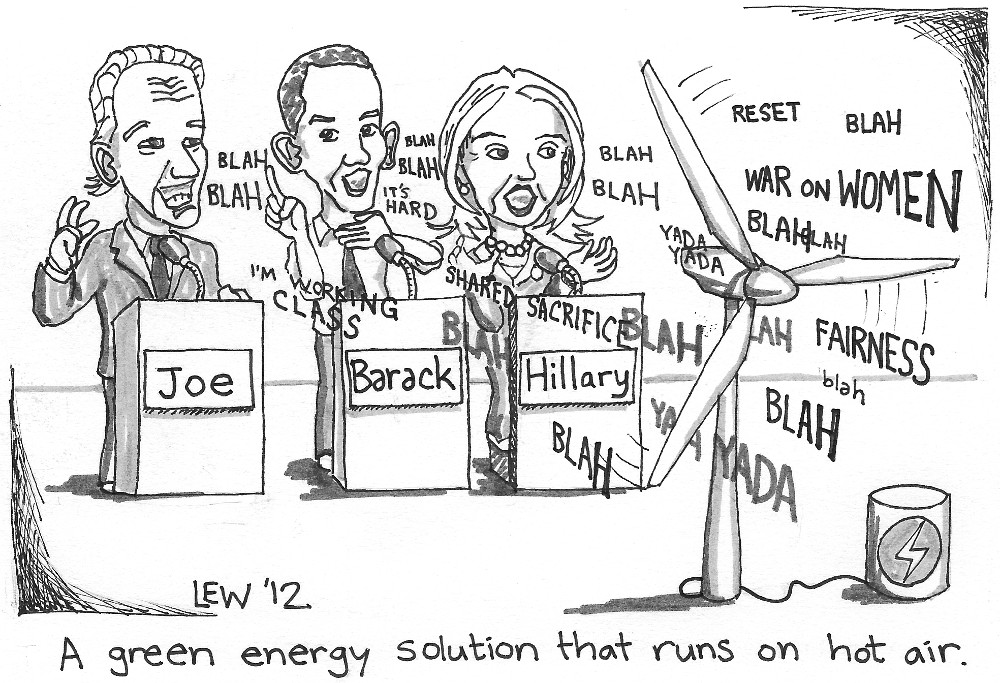
President Obama kicked things off earlier this month, comparing himself to Ghandi and Nelson Mandela.  He claimed that, as with those men in their noble struggles, the fight is hard and it takes time.  But how is the Democratic agenda in 2012 comparable to the effort for Indian independence or the campaign to end Apartheid?  Does this mean the GOP is as brutal as the British Raj or as unjust as the old South African regime?  This sloppy pandering is reminiscent of the racially-tinged “dollar bill” accusation Obama hurled at McCain and Republicans in his 2008 campaign.  But these remarks get scant media scrutiny when they come from this president.

Next, Secretary of State Hillary Clinton spiced things up at the 2012 Women in the World Summit.  She equated more ardent American conservatives with the more egregious human rights abusers in the Muslim world, slapping them both with the common label of “extremists.”  Opposing compulsory contraception coverage is nothing akin to what women deal with every day in Afghanistan, or Egypt for that matter.  Secretary Clinton scores bonus points for lugging domestic politics into foreign affairs.

Finally, Joe Biden rounds out the good times with a speech given to the UAW in Toledo last week.  The Vice President branded his ticket as one offering a “fair shot and a fair shake.”  With this language we might as well have entered a time warp and come out in FDR’s bad old New Deal.  This is the kind of sloganeering given to those who think capitalism is wrong, broken, or dead.  In its place comes Uncle Sam who “takes care of things” for you.  Just like when you need Vito Corleone to get your landlord off your back.  More like fair shakedowns than fair shake.  This rhetoric values shameless deal-making over the rule of law.

It’s no surprise the highest officials in the land get the soft treatment; they’re liberal and progressive after all.  Their rhetoric should have generated some push back from the mainstream media.  If only we could harness all their hot air, we could generate electricity instead.  Then they could deliver on their green energy solutions promises.

Kony 2012 and Afghanistan

I found last week’s hoopla surrounding the Kony 2012 video annoying and disturbing.  Designed to stir souls to a noble cause, the video is worrisome because it is classic agitprop.  It has ignited among its viewers a strong emotional firestorm that bypasses reason.  (On a sadder note, it seems the global explosion of attention and backlash were too much for the maker of the video.)

Everyone agrees that Kony is a bad man, but I doubt everyone agrees on a real solution.  Neither Facebook posts nor monetary contributions stop an evil man like this.  UN blue helmets don’t do much good either; just ask the residents of Srebenica.  It would take a concerted effort by a competent, modern military force to uproot that kind of evil.  Funny though, when that sort of operation becomes reality, as with the Iraq War, people complain about it.  If only text donations were more widespread back then, maybe Saddam Hussein could have been effaced by the collective wireless bills of the Free World.  And what about the fresher atrocities of Kim Jong Il?  By the time of his death last December, there was no 80 million+ hits YouTube video for his crimes.

For all the talk of “capturing” Kony, I would not be surprised if his capture attempt looked and ended up like last year’s righteous and successfully culminated mission against Osama Bin Laden.

Just a day or two after the Kony 2012 media explosion came the sensational storm of the Afghanistan massacre.  But instead of passion to spark a new war, this story reinforced among the public a desire to end an old one.  I instinctively resist the popular sentiment to pull out that comes from seeing casualties and bloodshed.  When I studied “peace and security” as an international relations major, I discovered the great extent of thought that informs decision-making on questions of peace and war.  Such deadly serious business must not be decided by the fickle whims of the public, but ought to rest in the hands of sober-minded policymakers.  Whether we actually have such trustworthy policymakers in power is another story altogether.

The power to make war is a necessary and classic function of government that is not going away anytime soon.  Indeed, Robert Kagan’s latest book argues specifically for America’s need to maintain a prominent profile in the world’s affairs.  What is ultimately entailed in Afghanistan is hard for me to say, but mere public opinion shouldn’t determine whether we send SEALs to get Kony or send our troops in Afghanistan packing.  Our national security and our troops’ sacrifice are too important for that.