Fearing the rhesus revolution

It’s an exciting time.  The Republican National Convention is about to start.  This is Romney’s chance to shine.  But the press has been stuck on the narrative that unwelcome events keep the GOP off message.  This is where media malfeasance has steered us, to meta-news, news about news.  Who is responsible for determining what the media covers?  Whoops, we’re not supposed to ask that kind of question.

The New York Times Magazine commemorates the advent of the Republican convention with a dour examination of the host city, Tampa, Florida.  Writer John Mooallem brings us the saga of a renegade rhesus macaque.  As he tells it, this indomitable monkey has become a sort of resistance symbol and a focal point for anti-government sentiment.

From start to finish, he peppers the piece with liberal complaints.  Opening up, he finds fault with the American flag flying over a local restaurant.  It’s “preposterously large.”  He reveals that, en route to covering the story, he tortured himself by listening to conservative talk radio.  From what I can tell, he’s done this for no other reason than to complain about it in writing afterward.

With respect to the monkey controversy itself, Mooallem makes his sympathies very clear.  He’s supportive of the Florida Fish and Wildlife Commission, who the locals see as “the Gestapo.”  The writer’s sentiment crystallizes in this assessment of the state officers:

But they took a somewhat traditional view: the American people had a right to be protected by their government from wild monkeys. It was disorienting to watch the people of Tampa Bay champion the monkey’s rights instead.

That an idea like freedom might trump the public order deeply troubles him.  To counter such libertarian exuberance,  he quotes one man’s stern warning: “Sometimes, freedom isn’t necessarily a good idea.”  In true liberal fashion, the writer is most at home expressing his convictions as an equivocal miasma.

Nonetheless, he seems to advance a genuine concern about public order and safety.  Mooallem unmistakably condemns Tampans’ refusal to cooperate with the animal control agency.  But I suspect he doesn’t feel the same way about the Holder Justice Department’s bitter reluctance to enforce federal deportation laws.  Per his metric, why shouldn’t the prospect of fellow humans living an uncertain, shadow existence elicit the same kind of concern?

At any rate, pieces like Mooallem’s are the Sunday afternoon grist that Northeastern cultural elites relax by.  Harper’s, Atlantic, The New Yorker, anything that will allow them to look with detached pity and concern upon their benighted countrymen in the far flung regions.

I recall a long-running TV ad from some years ago.  In an effort to get the viewer to subscribe to the weekend edition of the New York Times, a woman would exclaim, “For me, that’s what Sundays were made for!”  Back then, I suspected this woman’s compatriots would profess that Sunday was “made” with a nobler purpose in mind.

With aching essays like the Tampa monkey expose, the folks at the Times demonstrate they are just as aloof of Middle America today as they’ve ever been.

Desperation drives divisive “War on Women” narrative

The Todd Akin controversy has buoyed Democrats’ “War on Women” narrative to a prominence not seen since last winter.  But even prior to Representative Akin’s “legitimate rape” utterance, the party and its allies have been stoking an unfounded fear that Republicans are out to take women’s reproductive rights away.

Consider this 30 second Moveon.org TV spot from a couple weeks ago.  Go ahead and click, it’s a must-see.  The theme is class war, but there’s an out-of-the-blue jab about birth control at the end.  If the NRA is guilty of drumming up a fear of “gun grabbers,” MoveOn.org has one-upped them with the invention of the “pill grabber.”  The childish tone and groundless substance of the ad–it cites a recent, highly speculative Tax Policy Center study–insult the intelligence of all but the most ardent leftists.

Another ad from early August, approved by President Obama, features a montage of women who “think” Romney is “out of touch” and “extreme.”  One chides, “this is not the 1950’s.”  All the while a wind instrument registers gentle yet overwrought notes of concern.  A woman concludes the ad by saying “I think Romney would definitely drag us back.”  With these words, what else can the viewer envision but a grunting troglodyte, club in hand, taking women forcibly to his patriarchal cave?

And now with the Akin kerfuffle, Sandra Fluke has egged on Obama supporters with the idea that Romney and Ryan are in “lockstep” with the Missouri Representative.  But this allegation cannot stand after a Factcheck.org refutation of a recent Obama “Truth Team” claim.

Yet a real undercurrent of popular fear exists.  We glimpse it in Virginia Heffernan’s recent piece on Akin’s comments.  She offers this take on John Edward’s divisive “two Americas” rhetoric:

The twist is that in this election year one America is female and the other male. In the female one, rape—nonconsensual sex as designated by the party that didn’t give consent—is everywhere, wrecking lives and making sexual harmony impossible. In the male America, “rape” is a subject of jokes and pontification. It’s a trope to be employed wantonly with the boys and judiciously when you’re trying to seduce women.

Herein Heffernan amalgamates the gross offense of comedian Daniel Tosh with that of politician Todd Akin.  She condemns American men to the prevalent stereotype of the perennial adolescent.  Anything they say on the matter of rape must be a joke or mere “pontification.”  For the sake of civil discourse, we must refuse the implication that race, sex, or any other status can on its own disqualify one’s views from consideration.

For those who would transcend sensationalism in an attempt to understand what Akin said, The Wall Street Journal’s James Taranto has shed some light.  Here at least is an effort by a brave man to do more than call Akin’s remarks “antediluvian” or reflexively blame “junk science.”  Taranto does better to label the doomed Senatorial candidate “Middle Ages Man.”

Make no mistake.  Akin went beyond his ken of understanding and properly merited a massive rebuke from his own party.  Given the swift and wide disowning this week, is there really some greater malevolent shadow at work among men, Republicans, or whoever else Democrats have being pointing fingers at?

The AP has been excessively charitable in interpreting Democrats’  fear-based, divide-and-conquer strategy as “pointillist” in nature.  But when the party and those who imbibe their views regularly invoke images of cavemen, boorish adolescents, and pill grabbers, it’s not out of line to conclude that, far from “Hope and Change,” it is desperation that drives today’s Democratic party.

Does floating unfounded allegations of racism help Obama?

The other day I came across a commentary in the Christian Science Monitor that absolutely floored me.  Offered by two academics, McIlwain and Caliendo, its headline questions: “Is a pro-Romney ad racist? Five questions to ask yourself.

Apparently, the coauthors don’t think Democrats can ever make a racist appeal, so they only focus on the Romney campaign.  To them, it’s not a question of if but which of his ads will be racist.  As we’ve seen with Joe Biden’s  “unchained” appeal,” this myopic model leaves voters unable to account for racism when it actually happens.

You can’t find racism from the left if you’re only looking right.  But with advanced degrees in the humanities and social sciences, the coauthors command a toolkit that enables them to pick out the finest notes of that pesky racism “dog whistle.”  Funny though, only a self-selecting pool of liberal academics have the authority or ability to discern them.  Good thing they’ve taken the time to help the rest of us out!

The examples the coauthors provide in their commentary are tenuous at best.  They advance their arguments on mere possibilities.  Does this sound familiar?  Elements of Romney’s ads “could be interpreted” or might “imply” some kind of racism.  A string of possible but weakly supported claims puts the piece just a notch above Harry Reid’s completely groundless claim that Romney didn’t pay ten years’ worth of taxes.

In one section of their commentary, the authors warn against the deployment of stereotypes.  Their metric for determining a potential stereotype is wide, vague, and subjective.  They bar Romney from any avenue of attack, while allowing Obama to proceed. Consider this passage on criminality:

For instance, while the Obama campaign might charge that Romney is a felon – a strong attack to be sure – there is no historical association between whites – as a group – and criminality. That association is present with respect to blacks, however. Thus, the message functions as a stereotype, not merely a criticism of one individual.

Have you ever watched a Hollywood action movie?  The villain is always some rich white guy in a suit!

Or, think of the TV series 24.  Each season, there are two levels of bad guys.  The first wave of villains might be terrorists from a fictitious Middle Eastern country, a Mexican drug cartel, or maybe opportunistic African warlords.  But then, somewhere around hour 10 or 12, the ultimate culprit emerges: always a cold, well-heeled white guy who is an unscrupulous industrialist, a crackpot defense hawk, or otherwise a liberal’s gross impression of Dick Cheney.  And this from a show with supposedly conservative leanings!

Although not matching McIlwain and Caliendo’s cherry picked “historical” or “group” criteria, Team Obama’s felon accusation against Romney exploits a real Hollywood stereotype embedded in the American consciousness.

Indeed, racism was a serious problem fifty years ago, but some folks haven’t gotten the memo that things might have improved just a bit.  This fact is easily missed by those who can’t put down their Critical Race Theory books.

It is sad that unsubstantial claims of racism get undying attention in the media.  The effect, whether intended or not, is to silence genuine criticism and steer the conversation into divisive, unproductive territory.  Just by running McIlwain and Caliendo’s commentary, the Christian Science Monitor sanctions a free tarring of conservatives, a gift to Democrats and their allies.

Paul Ryan: naive, inexperienced?

Good philosophy must exist, if for no other reason, because bad philosophy needs to be answered.

C.S. Lewis

As far as I know, neither I nor Virginia Heffernan is a philosopher in the professional sense, but I would submit that Lewis’s dictum is just as valid for bloggers.  And so it is that I must report on the Yahoo writer’s latest hit piece, because it is bad blogging.

Like her other columns, Heffernan’s latest meanders through obscure pop culture references, though fewer than usual.  This time, the most outlandish example is of some dusty blue book that every American must have owned circa 1970.

The author’s alternately snarky and earnest jaunt down memory lane serves an end of course.  In this case, it is to tie herself to her subject, the estimable Paul Ryan.  He is one year her junior, and as such is the first of Generation X to contend for the vice presidency.

The face of inexperience?

Heffernan proceeds to portray her college years as a perigee where she flirted with but ultimately moved away from a Jack Kempian conservatism.  Looking for bonus points with those harboring an unflattering memory of the Reagan years, she offers television character and teenage Republican Alex Keaton as a possible analog for Mr. Ryan.

By the end of the piece, it is clear than in so many words Heffernan has endeavored to say that compared to herself, Paul Ryan is naive and inexperienced in the ways of the world.  But for all of her musings on Generation X, she’s only managed to grasp the one elementary tool of commendation that the relativistic, existentially-driven Baby Boomers left behind: anecdotal evidence, the mere telling of personal experience.

Heffernan supposes that Mr. Ryan never faced a hard day in his life.  Meanwhile, she had some undescribed encounters that delivered her from a simplistic, uncaring worldview.  Maybe she saw a sad, hungry puppy shivering by the side of the road.  That is why, unlike the experientially impoverished Mr. Ryan,   she was able to grow out of an infatuation with that extreme ideology called fiscal restraint.

What a condescending take.  Did Heffernan fail to research that Paul Ryan discovered his father dead in bed when he was 16?  Or that his Alzheimer’s-stricken grandmother moved in for care shortly thereafter?  Indeed, the teenage Paul Ryan worked at McDonalds.  Those earnings, along with Social Security survivor’s benefits, allowed him to go to college.  And when he got there, he supported himself further with a side job selling hot dogs for Oscar Meyer.  Does this sound like some sort of silver spoon background, or the picture of naivete conjured by fictional teenage Republicans of TV yesteryear?  Contrary to her boast, it is Ryan, not she, who is the old soul.

Rather than offer commentary of value, Heffernan merely pollutes the national conversation with solipsistic bubble gum blogging.  She permits her readers to dismiss the latest Republican candidate as heartless, aloof, and extreme.  And in the same moment, they are left with fond recollections of leg warmers and ’80s prom hair.  Given the state of the entertainment establishment, this is hardly a novel achievement.

As I’ve warned before, Yahoo! News is more an entertainment outpost than an outlet for truth.

From Palestine to Anaheim: culture matters

When Mitt Romney dropped by Israel a couple of week ago, he made an observation that the American media all-too-eagerly interpreted as a gaffe.  Drawing from a scholar’s work, the former governor contended that Israel’s relative economic success was a matter of “culture.”

In public conversation, this term has sadly become a stop word for latent prejudice.  And like a good student of the Western Academy, Palestinian spokesman Saeb Erekat demonstrated his fluency in the language of victimhood by calling Romney “racist.”

Back in America, progressives have been busy applying racial spin to a local governance conflict.  In Anaheim, California, activists–with help from the Southern California ACLU–are trying to budge the city council from it’s longstanding at-large representation system to a geographic, district-based one.  They reason that minorities, such as Latinos, have been been effectively disenfranchised by the current regime.  A spate of controversial police actions, including the recent killing of an unarmed man, have helped to propel the campaign.

Two years ago, a small New York village made headlines for a similar move.  After its existing system of staggered elections was ruled illegal, a federal judge bequeathed cumulative voting to Port Chester.  The village council went from being all white to having its first Hispanic, all thanks to elections that allow each voter six votes per office.  Yes, six votes!

The idea behind Port Chester’s civic miracle is degrading to the voter and the candidate.  An individual who identifies with an underrepresented group is supposed to gain representation by voting for the same person six times.  Meanwhile, the majority-status voters would presumably split their vote among several contenders.  Like affirmative action, cumulative voting robs the winning candidate of the confidence that he won on his own merit.  Rather, he can be sure the system was crafted specifically to boost him into office.

The proposal for Anaheim is scarcely better.  Activists have the implicit goal of changing the racial/ethnic makeup of the council.  It may be well intentioned, but it is unprincipled and works against the meritocratic ideal.  And like affirmative action, it is by definition racist.

Sometimes plans that play with racial demographics backfire.  This past primary election season, Redlands Democrat Pete Aguilar was expected to come into a newly crafted U.S. House seat, but was squeezed out by two Republicans thanks California’s new top-two runoff system.

Who is to say if Anaheim switched to district representation, that a Latino would accede to the city council?  Maybe the downtrodden denizens would opt for a Ted Cruz-like Hispanic conservative.  Given the root of the problem, gangs and crime, it would not be surprising if a law-and-order type won.  Not exactly the result progressive activists were aiming for.

Rather than spend sums on lawsuits and campaigns that are ultimately uncertain, progressives should just come out and move a well-connected, rising star Latino Democrat into the city before the next election.  It’s not like they are serious about the underlying issue: culture.

Plenty of smart, reasonable voices tell us culture matters.  Charles Murray has put decades of research into his latest tome, calling on America’s privileged to spark anew in their working-class neighbors the values that drive success.  And Richard Landes backs up Governor Romney’s recent observations on Israel.  But these folks just don’t get play in the liberal world.  Mainstream journalists thrives off of the sensational, but talk of culture upsets their own sensibilities.

As human beings, we are not merely members of our own little tribes, but individuals who reason.  We all are agents that react to incentive, and culture is the framework that shapes our agency.  It’s upsetting to some, but well-meaning government aid programs can breed dependency.  Obscuring your face with a hoodie as a fashion statement can inculcate mistrust.  A Hollywood actress who elects to become a single mom can sanction for some poor, distant child a difficult upbringing.

The values we choose make a difference.  Culture matters.

Shared sacrifice

President Obama unfurled a new school yard taunt this week, calling his challenger “Romney Hood.”  The moniker piggy backs on a study crafted by definitively left-leaning groups that presume to know the details of Romney’s future budget proposals.  Supposedly, Mitt Romney will balance the budget on the backs of the middle class.

But if anyone is taxing the middle class, it’s surely President Obama.  After all, the Supreme Court ruled in June that the penalty component of his Affordable Care Act is for all intents and purposes a tax.  Many who will be paying the new tax will be younger, less-established workers, the up-and-coming who are in many ways at the heart of economic growth.  That is, unless a Republican President and Congress are able to intervene at the start of 2013.

Is the “Romney Hood” label even fitting?  Maybe if you interpret the hugely successful capitalist as Atlas Shrugged pirate Ragnar Danneskjöld, a man who steals from corrupt “people’s republics” and bequeaths gold bars to cloistered industrialists.  However, the “tax cuts” that President Obama perennially refers to are not stealing from anyone.  Continuing with the ten-year-old, boring, existing rate is merely allowing high income earners to keep more of what is rightfully theirs.

If we examine the President’s rhetoric about income and wealth, it’s clear he has little real regard for the deep American tradition of ownership, particularly that which comes from “earned success.”  Consider his 2008 retort to Joe the Plumber, that all he wants to do with the little extra taxed income is “spread the wealth around.”

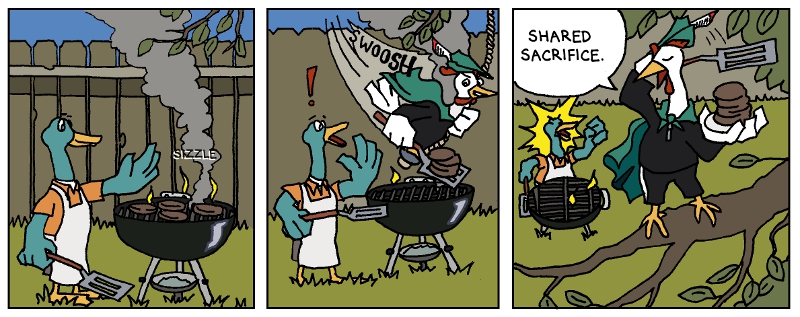
In 2010, and even into 2012, the President repeatedly sprinkled his speeches with references to “shared sacrifice.”  This is meant to conjure up thoughts of selflessness and nobility: folks who step up and offer voluntarily for a good cause.  But how are new taxes “sacrifice” when they are ultimately collected at the barrel of a gun?  This rhetoric ought to be seen as embarrassing and sloppy by all observers.  The rights to the fruits of one’s own sweat and toil, time and treasure are ultimately discarded by such a line of reasoning.  Utterly chilling.

If what we’re concerned with is a green-hooded robber running around in the woods and seizing wealth, we should be more wary of the man who has spent the last three and a half years in the Bully Pulpit than we should be of his challenger.

Liberal outrage boosts carbon emissions

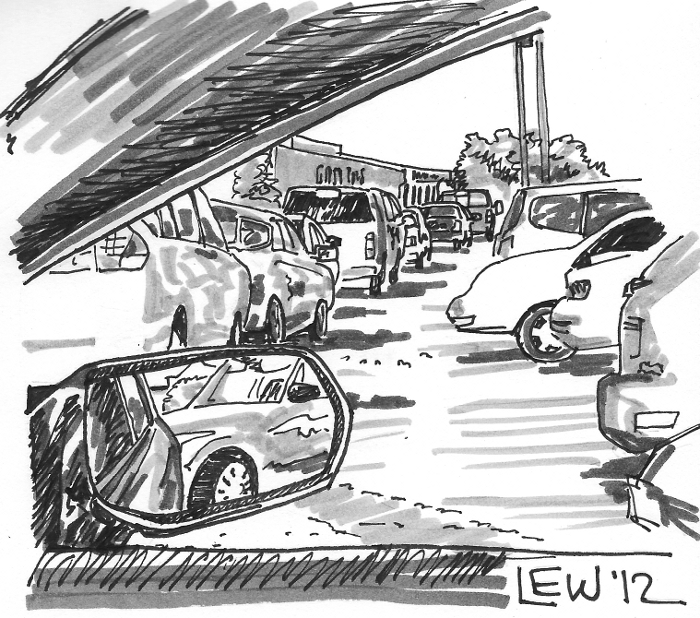
At the end of my workday today, I proceeded to Alta Arden Chick-Fil-A.  As with other locations throughout the country, there was a considerable line at the drive thru.  Many have posted their pictures and made reports.  Instead of a picture, I’m offering here a sketch I took toward the beginning of my hour long wait.

What was the atmosphere like?  Quite congenial from what I could tell.  All sorts of people and cute little kids running around under their parents’ watchful eye.  If there were any bigots there, you wouldn’t know.  Hate levels were negligible, reading at a low 0.029 pico-Sharptons.

For all their outrage, liberals have only managed to launch a thousand drive thru queues.  With all the exhaust spewing from the attendant trucks and SUVs, Leftist indignation correlates to a rise in carbon emissions.  Coincidentally, National Review’s lead essay today deals in part with progressives’ disdain for cars.

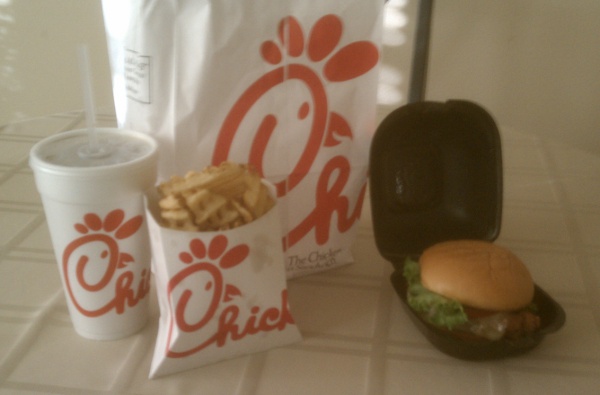
Once I got my order, I sped back home.  I had the spicy chicken sandwich with the waffle fries, and they didn’t disappoint.  The first time I had Chick-Fil-A was when I was staying with family in the South–as in southern California.  Contrary to how the media reports it, the Chick-Fil-A empire reaches far past the Mason-Dixon line.  It’s firmly established in my blue state, as San Francisco mayor Ed Lee certainly knows.  Forty miles is close enough for him.  Fortunately for my taste buds, I am beyond that radius.  The City by the Bay still makes for a nice day trip though.

Surely some nonpartisans are scratching their heads today at the latest culture war battle.  What’s the big deal with this Chick-Fil-A appreciation day?  Some say it’s about affirming Biblical truth, and some say it’s about freedom of speech.  These are both right and good, but the question of tolerance is the most pivotal one.

To remain a free, fair, and open society, we need to recover the original meaning of tolerance.  That means respecting the person who disagrees with your views.  This does not happen when traditional marriage defenders are dismissed out of hand as bigots and haters.  As with many things that touch on God, judgment, personal choice, and equality, too much of the conversation is controlled by the gut and not by a clear and open mind.

Today’s massive Chick-Fil-A turnout is not a mere spectacle, but a stand firmly taken.  A stand not in the name of blind faith or bitter clinging, but in the hope of a more charitable discourse.  Just maybe, we’re turning a cultural corner.

Obama’s “Our plan” pitch doesn’t work

With many buzzworthy stories washing over news audiences lately, President Obama’s attempt to claim Bill Clinton’s economic record has not garnered as much attention as it ought.  Nonetheless, ABC dutifully reported the incredible credit grab last Friday, dubbing it “Our Plan.”  As in when the President declared, ““We tried our plan–and it worked.””

Reading the story (linked above), you’ll find the writers were a less than thrilled at poking a hole in “Hope and Change.”  The following gem conveys their reluctance to call the President out on his silly move:

This pitch on occasion has meant that President Obama at times sounds as if he’s claiming some ownership of the Clinton economy – referring to “our plan” — which has allowed Republicans an opening to act as if the crowing he’s engaged in about the Clinton economy is out-of-touch braggadocio about the current economy.

Can you find the several qualifying phrases the writers deploy to effectively neuter their own critique?  They further blunt the impact of their work by twice calling the story’s developments merely “interesting.” The repeated use of this ho-hum descriptor either indicates grade school student authorship, or else is a euphemism for harsher terms the journalists can’t bring themselves to say.  Or maybe both.  You can decide what is more likely.

Whatever the case may be, the President’s team at Health and Human Services  haven’t helped the “Our Plan” claims.  Just a couple of weeks ago,  they watered down the Clinton-era welfare reform work requirements.  This signature achievement, only adopted at the prodding of a Republican Congress, has been generally acknowledged as a policy success.  But with the new HHS changes, we can expect entitlement culture to crowd out any productive behaviors the reform had brought.  Like the greatly expanded food stamp program,  this makes for a significant departure from the Clinton policy environment.

Now let’s look at “Our Plan” by the numbers.  On one level the numbers game is disingenuous.  Obama’s main claim to Clinton’s tax policy hinges solely on the top marginal rate, which he wants to boost from 35 to 39.6 percent.  Any revenue increase, even if dynamically scored, will only be a drop in the deficit bucket.  A host of other variables outside of the control of “Our Plan” will hold more sway over the economy.  But if the game is to be played, there’s a pretty good case to be made against the Democrats.

That 22 million jobs came into being under Clinton’s two terms has been echoed far and wide by Democrat acolytes.  Never mind that Obama’s net created jobs won’t be positive by election day.  But what about unemployment rates?  They’re readily available from the Bureau of Labor Statistics.  Combining Clinton’s eight full years and Obama’s first three, the average annual unemployment rate under “Our Plan” is 6.4 percent.  How much does this cream Bush’s average rate by? It’s the other way around.  At 5.3 percent, Dubya beats “Our Plan” by over a point.  Not that Mitt Romney is running as Bush anyway.

Taking things a step further, let’s attribute the unemployment numbers to Congress instead.  The average annual rate was an ultra low 5.0 percent from 1995-2006, the time Republicans had at least a tenuous hold on both houses.  By comparison, Nancy Pelosi and Harry Reid’s Congress pulled 7.3 percent from 2007-2010.  Whether looking at Congress or the White House, the employment rate tends to be healthy over the broad sweep of recent Republican tenures.  It’s those pesky times of transition to and from Democrat control that correlate to a high rate of joblessness.

When President Clinton speaks at the Democratic National Convention this September, will he be pitching the strained reasoning of “Our Plan?”  As with previously tried campaign themes, I doubt it will have the legs to carry Democrats forward.  Maybe Mr. Clinton will be singing a different song.

Chick-Fil-A and the language of (in)tolerance

A few days ago, Boston mayor Thomas Menino told burgeoning restaurant chain Chick-Fil-A it was not welcome in his city.  Responding to chain president Dan Cathy’s personal opinions–on city letterhead, no less–he decried the restauranteur as “prejudiced,” insisting there’s no room in Boston for “discrimination.”  He concluded that to allow Chick-Fil-A in his city would be an “insult” to gay couples whose marriage ceremonies he proudly presided over.  Fellow mayor Rahm Emanuel soon tried to one up Menino by appealing to “Chicago values,” an incredible claim for a place which, politically speaking, is a values wasteland.

Menino’s letter in particular is unwarranted in its use of charged language.  He and his allies have read base motives into Dan Cathy’s recent comments, which were issued earnestly in a radio interview.  If you listen, it’s clear he’s not hopped up on hate, or motivated by bigotry; his words flow from a reasoned, sincere conviction.  Neither has his company been yet charged of legally-actionable discrimination.  The mayors and their fellow critics are free to dislike Cathy and his firm, but while their claims of prejudice and discrimination go unsubstantiated, they cannot be taken seriously.

Some have justified their indignation by pointing to Chick-Fil-A’s past charitable contributions.  Media reports (here, here, and here) have alternately labeled Cathy, the company, and the donation recipients as “anti-gay” for ultimately opposing same-sex marriage initiatives.  But within these reports, the label goes unexplained and unchallenged.  The reader must naturally take it to be descriptive of one who is against gay people themselves, an utter slander that people of good will ought to reject.

In a similar fashion, the broad, vague charge of “homophobia” came with coverage of Google’s recent “Legalize love” campaign.  To call one homophobic is just as destructive to discourse, as it imparts a motive of irrational fear to the one being described.  In popular usage it is synonymous with hate.

These words ought not to be bandied about by press claiming fairness and objectivity.  Yet, media have a long, bad habit of describing conservatives as phobic and painting them in “anti” terms, as in anti-abortion or anti-spending.  Pro-choice advocates are never referred to as anti-unborn or anti-child.  Deficit spenders are never called anti-frugal.  This is a function of the Orwellian intersection of the tolerance paradigm and positive rights.  Tolerance as presently understood never allows us to question the ever-expanding field of rights, even though reason assures that absurdity must ensue at some point.

Those who want real tolerance have to abandon these loaded terms that implicitly judge the hearts and inner motivations of other individuals.  The hypocrisy of using such labels hurts one’s own cause as much as the conversational climate at large.

Fortunately, the mayors have backed off a bit from their testy declarations.  As the controversy continues to roil, may more people become cognizant of the language used, and realize that same-sex marriage opponents should not be automatically equated with bigots.  We all carry our own personal experiences, shadowboxing with traumas of the past.  Let’s not allow these to cloud an important and necessary conversation.

Reflections on The Dark Knight Rises

I thoroughly enjoyed The Dark Knight Rises for many reasons, not the least of which is Hans Zimmer’s ominous and expectant musical score.  Like the preceding entries of Christopher Nolan’s trilogy, the film is rich with the timeless tensions we face both as individuals and as a society. And though some have denied it, it can be read as a social commentary relevant to the divisions that rend our world today. Here are some observations on my part.

Rebuking Revolution

One strand of Rises’ plot sees Gotham City, a self-contained symbol for society, undergo the trial of revolution. There is a scene clearly meant to evoke, in a twisted way, the storming of the Bastille at the onset of the French Revolution. We also witness the workings of a kangaroo court, another French legacy replicated by Marxists and other would-be world changers.

On facebook I’ve seen at least one anarchist express a sense of betrayal and disappointment with Christopher Nolan for what he saw as a manifestly reactionary tone. Yet, the varied dispositions of Gotham’s denizens, from apathetic to licentious, continually tease the viewer with the idea that Gotham might not be worth saving.  This tension, as with the previous films, is at the crux of the narrative itself. Rises certainly airs out the ugliness and excess of revolution, but it is not authoritarian agitprop.

The Thin Blue Line – Campus Observations

For any Hollywood production, it’s refreshing when the police are not the all-out bad guys.  Of course this makes for an awkward tension with cinema’s core consumer, the disaffected adolescent male. But just as Batman puts himself on the line to do what is necessary and right, so it is good that self-indulgent audiences get a dose of reality as to who and what holds civilization together.

One way I survive working on a liberal university campus is listening to podcasts. The other day I had to get new ear buds for my personal player, so I traversed the student union to reach the campus bookstore.  Signs every few feet admonished passersby to not block physical access to the unions’ various businesses.  Last winter, Occupy had done just this to force a closure of U.S. Bank’s campus branch.  Where services were once transacted, only a dim, empty room remained, pocked by outlets sprouting unused cables.  “Direct action” is good at tearing down, not building up.

The posted signs attest to our litigious society, where personal responsibility has been completely outsourced to superfluous fine print warnings. The larger civilizational failing is that the campus administration, out of fear of seeming heavy-handed, allowed a group of kids to shutter commerce and diminish the vitality of the campus.  And then there is the needless lawsuit that followed.

As if these signals of decline weren’t enough, the very headphones which I purchased were branded “Riot,” with a cartoon depicting dozens brawling in mayhem, not unlike the criminal vs. cop melee at the climax of Rises. Also included in the packaging were stickers and a spraypaint stencil with which to vandalize one’s environs and allay whatever sense of self-righteousness and alienation one’s music might produce.

Despite these dire signs, there is still hope.  On the same campus can be found a quiet, green spot where parents walk their small children.  Once, I spied a bicycle cop stopping by one mother and son.  The boy instinctively hid behind his mother’s skirt.  The policewoman produced a small candy for him, and some words were exchanged.  This kind of scene is the hallmark of civilization: parents passing healthy attitudes onto the next generation.  In case you missed it, cops are there to serve and protect us.

Who is the real hero?

As with the previous two films, Rises tracks two parallel crises: that of Bruce Wayne, and that of Gotham as a whole.  Bruce must confront his own doubts and limitations to prevail, but each of the city’s citizens must also.  At one point, when hope of outside deliverance appears lost, Jim Gordon proclaims the city must be saved from within.  Powerfully revealed in the course of the film is the idea that even small virtuous acts by ordinary citizens can have outsized consequences.  As dark, tortured, and brutal as the film is, the viewer cannot escape the boy scout ethic–a confident, selfless, and felt moral responsibility–at the drama’s core.

Much in this lavish, blockbuster epic points to the ineffable nature of morality, the “oughtness” we feel and the volitional nature of doing good.  Ultimately, nothing is determined but what we will.  It’s rare and good when we can get a hint of this in a summer action hit, as we did with The Avengers.  To be sure, we get this in spades in The Dark Knight Rises.