The failed citizens

With the exploits of the pepper spray cop, UC Davis is now thrust into the media spotlight.  While everyone is angry at how the administration and its police have treated the students, no one seems to be angry at how society has failed to make them into decent citizens.

Their cause could be the most noble of causes, but the protest movement at Davis has paralleled and now in fact merged with the morally and effectually bankrupt Occupy movement.  The tents first popped up on the quad last Thursday night, and on Monday they re-emerged, scores of them.

Reporters have widely documented the headaches that come with these Occupy camps, namely sanitation, property crimes, and violence.  Recently, authorities were faced with removing 200 pounds of human waste from the Santa Cruz Occupy encampment, and other sites have spawned rats, hookworm, and scabies.  I recalled this today as I walked by a pair of port-a-potties on the edge of the UCD quad, supplied by Lord-knows-who.

I’ve also wondered, given the reported rapes at other Occupy sites, whether the campus Women’s center would ever break the sacred bond of “solidarity” to inveigh against the squatter village.  But with the pepper spray outrage so fresh, it seems to me the weight of visceral outrage is too strong a tailwind for such a reasonable course to prevail.

But more disturbing than the safety and health concerns is the occupiers’ inherent disregard for others’ property, time, and resources.  Whether they occupy the administration building, the library, or the grassy quad, they force the university to spend extra dollars paying employees to keep the lights on and otherwise look after them.  When law enforcement from adjacent jurisdictions are called in, taxpayers take an additional hit.  I wonder if the poli sci majors out there would ever suppose they are playing out the tragedy of the commons.  Everyone suffers when occupiers break the rules to abuse public spaces and public resources.  They preclude others from the use of those spaces, and at the end of it all, someone has to pick up the tab.

On top of this, protesters fail their fellow citizens with their decibels of anger.  Occupiers are well-known for saying they want to “start a dialog,” but its kind of hard to have a conversation with a human microphone.  Pithy mantras and signage abound, but the idea that a hopped up crowd is the best way to facilitate a substantive, calm, and rational discourse is a delusion.

Speaking of delusion, what good do protesters think they are doing by adopting socialist revolutionary modalities?  They hold “general assemblies” like they were on the ramparts of the Paris Commune or were maybe a more effective incarnation of the UN.  And this upcoming Monday will be a “general strike,” reminiscent again of the tools by which European citizens secure the economic mediocrity of their welfare states.  Amazingly, UCD occupiers even considered whether to “declare campus as an autonomous sanctuary space based on international historic model.”  I wonder how many students are aware of how all of twentieth century history testifies to the failure of this kind of business.

At last, its interesting to note how protesters and occupiers never admit to any wrongdoing.  While large crowds of people are generally prone to interlopers, chaos, and emotional firestorms, occupiers would have us believe they are always decent, always innocent, and always right.  Their public relations strain our credulity.

Hopefully the UC Davis campus will soon regain an administration and police force with some moral currency, so they can sweep away the encampment, this time cleanly and non-offensively.  That will surely save us from great troubles down the road.
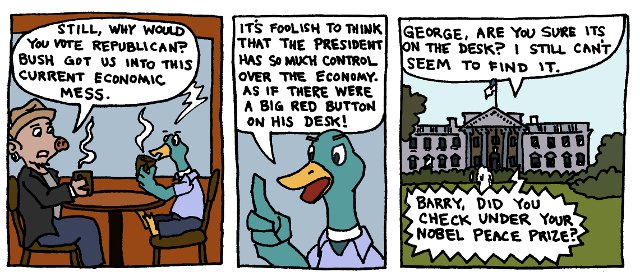
The Economic Red Button

The economic red button

Today’s strip continues the cafe conversation.  Probably you’ve heard people try to judge presidents by the shape of their economies.  This kind of logic is mistaken, but it is the bread and butter of progressives and Democrats.  They survive pretty much on promises of government activism.  But because of the harm that most often comes from government meddlings in the market, the best kind of president would lead with a hands off style.  Better a good steward than an all-out commander.

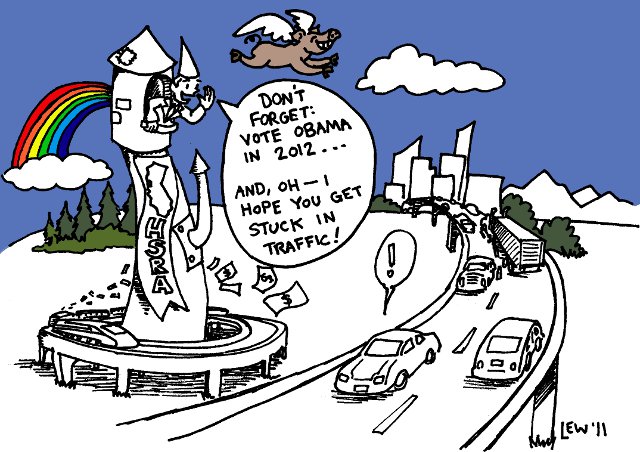
HSRA: Get stuck in traffic?

California HSRA hopes you get stuck in traffic?


The Sacramento Bee has offered us a strange, new angle on California’s budget-busting high-speed rail project.  Having interviewed the HSRA’s chair this week, they inform us that the Authority’s latest business plan hinges on a friendly Washington budget environment in the years ahead.  Basically, HSRA is betting its chips on President Obama’s re-election.  With forecasters putting his odds somewhere in the neighborhood of 50-50, isn’t this plan a little reckless?

As it is, Jerry Brown’s gimmicky budget for the current fiscal year is  well on track to trigger further cuts.  And we all know the long line of agencies begging for fiscal mercy: education, prisons, parks, sundry social services, and so on.  Given these dire straits, where will the money come from?

The global track record for high speed rail is abysmal.  These extremely capital- and labor-intensive projects don’t recoup their start-up costs, and there is no reason to believe the latest projected ridership numbers, given the stubbornness of the American Love Affair and the high level of competition airlines will bring to bear.  Train passengers might not need to stand in security lines, but the door-to-door times will be comparable, and at the end of it all they will still need to get picked up or rent a car anyway.

The funny thing about the article though is the last bit about getting stuck in traffic.  It’s not clear whether the Bee is trying to be cute, or imply something more sinister about the Rail Authority.  Even then, local traffic patterns only have partial bearing on the need for a high speed train.  When was the last time you were caught in traffic outside of Harris Ranch?

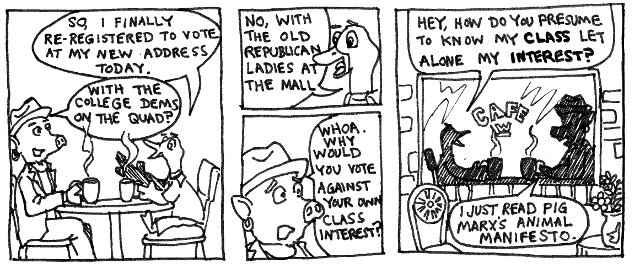
Voting against your own interest

#1: Voting against your own interest
Have you ever heard this kind of musing before?  The idea is that Republicans exploit social “wedge issues” like gun ownership or gay marriage to get lower-income conservatives to vote against their own  self-interest.  And that is supposed to be to get government to take money from rich people and dole it back to the poor masses of which they are a part.
I was reminded of this trope while listening to Michael Medved interview Corey Robin about his new book, The Reactionary Mind: Conservatism from Edmund Burke to Sarah Palin.  Robin himself used the worn line about voting against self-interest, and it recalled the spirit of the 2006 book What’s the Matter with Kansas?
I wonder if the people who say or write those things are ever conscious of how presumptuous they sound.  Somehow, they know what you should objectively be voting for, and you are just duped by your blind passions.  Not a very charitable view of a fellow citizen.  Worse than the attitude though is their ignorance of the fact that redistribution schemes, whether born of a patronizing benevolence or a covetous “self-interest” of the masses, do not benefit the targets of socio-political largesse  but only beget greater misery for everyone in the society.

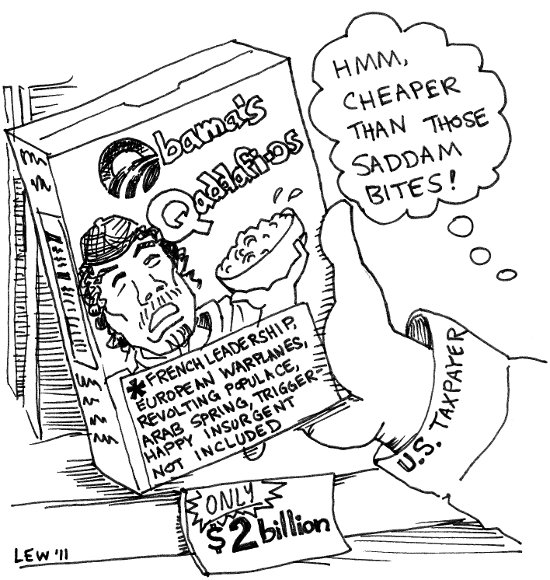
Truth in Advertising

Premiering an in-house political cartoon:

Political Cartoon: Truth in Advertising

Truth in Advertising

It didn’t take long after Muammar Qaddafi met his end last week for ill-conceived boasts to emerge.  And of course, they issued from deep within the biggest spin zone of our current day: the Obama White House.  Vice President Biden touted that it cost the U.S. only $2 billion to bag Qaddafi.  Not that we were after his head in the first place, right?

Such wrangling from Biden is reminiscent of the false economic paradigm everyone seems to be caught in: giving presidents too much credit for the state of the economy.  When it comes down to it, a president and even the government only have so much influence over economic performance.  The same is true for foreign affairs.  The current administration merely sent a token greeting card to the Libyan revolutionaries, and now that good weather comes their way, they take as much credit as they can grab.  But you couldn’t blame them given the current approval ratings.

Men of service shaping up

In case you haven’t been looking lately, our men in uniform have been shaping up.  No, I’m not talking about PX90 drills or rehearsing counterterrorism scenarios.  The martial professions that at their fashion zenith brought us the wonders of baldrics and dress blues have since democratized and reinvented themselves for the metro age.

The Wall Street Journal has spotlighted a purported eyebrow “scuplting” craze peeling through the ranks of America’s fighters in Afghanistan.

Pfc Guillemette

Pfc Guillemette. Courtesy The Wall Street Journal

Meanwhile, one plainclothes detective of NYPD’s thin blue line has traded down to a thin blue tie, earning delectable internet glory as the “hipster cop.”

Detective Rick Lee, NYPD

Detective Rick Lee. Courtesy Associated Press.

Without a doubt, these men of our uniformed services are serving us honorably, protecting us from mad mullahs and disgruntled hippies.  Now, they may be just a little more fashionable than the rest of us.

Journalists, academics try to understand God and government

Here’s an interesting and recent headline from the Christian Science Monitor: “Does government do too much? That could depend on your view of God.”

Some folks at Baylor did a study on the intersection of small government conservatism and Christian faith.  When both the journalist and the academic undertake an investigation like this, I think there tends to be an outsider’s bias.  They are kind of scratching their heads, asking “Why on Earth would anyone think this way?”

At least the journalist MacDonald does a fair job by getting a counterpoint from Woodard, an academic with rightward sympathies.  Yet the article, sadly typical of mainstream media work, smuggles in the notion that conservatives are by nature angry.  Researcher Froese conjectures that since small government Christians tend to be poorer and less educated, they are probably anxious and depressed.  According to this line of thought, they are then given to believing in a wrathful and angry God.  But reading on about the study, one really wonders why the secular/liberal types who believe they cannot find the meaning of their lives wouldn’t be even more anxious and depressed.

To me it follows that any Christian who takes his faith seriously will have peace and hope.  I know somewhere there is a statistic that Christians actually achieve higher levels of education than the general population.  But ultimately, the article’s discourse is muddied by juggling so many overlapping identities.

Between the two opposing interpretations that Froese and Woodard offer on small government Christians, I have to commend Woodard’s view.  After all, it would take a fearful or angry liberal to have such an uncharitable view of his Christian neighbors.

Responding to Income Inequality

A recent study by Norton and Ariely on wealth inequality in the United States has generated a bit of buzz in the past few weeks.  The media and public response has been predictable: an overblown amen chorus finding our wealth inequality to be a grave problem.  But the real peril flows less from the inequality itself than the implicit and perennially popular redistribution impulse that follows.

The study invites dangerous thinking by asking participants to indulge their Rawlsian side and imagine an equitable income distribution.  They find that even wealthy and Republican respondents conceive of an ideal distribution being much more equal than it is now.  Surely the study is fine empirical work, but what are the normative implications?  What ought we do about it?

Sadly, popular dissatisfaction with wealth inequality is rife for political exploitation, especially given the undying misconception of a fixed economic pie.  On this view, wealth is a pie that can be divided, but cannot grow.  Our economy is a zero-sum game.  If Jack becomes rich, it must have come at the expense of Jill.  Justice then would be to confiscate Jack’s excess slices of pie and give them back to Jill as an entitlement.  This is what President Obama essentially endorsed when he told “Joe the Plumber” that we need to “spread the wealth around.”  The need for activist government has been the mainstay of the Democratic party for decades.  But when politicians are the middle men for our collective wealth, they naturally exploit it for their gain, at the cost of simplicity and consistency.  Vote-getting tools like earmarks and tax exemptions only make our economy more muddled, unpredictable, and subject to political patronage.  This hurts wealthy and poor alike.

The destructive nature of zero-sum and redistributionist thinking is no surprise given they are at odds with classical economics.  Take the foundational idea that voluntary transactions between rational agents generates new wealth.  If this is true, it undermines the narrative that American wealth is an economic injustice built on stolen land, slave labor, and gunboat diplomacy.  It robs the progressive, technocratic welfare state of its raison d’etre.  So can a solution to wealth inequality really be found in classical economics?

David Brooks recently shed some light on the divide between economic libertarians and statists by explaining his own identification with “epistemological modesty.”  He sees the European enlightenment as split between hyper-rationalizing French like Descartes and Rousseau and intellectually modest Scots like Adam Smith and David Hume.  I find this to agree with Thomas Sowell’s concept of the “unconstrained” and “constrained” visions.  On the one hand are those who believe the world is totally knowable and perfectible, and they trust that educated elites will guide us into a technocratic utopia.  On the other, there are those who believe our ability to understand and shape society are limited.  They trust in traditional institutions–church, family, free markets–as generational accumulations of human wisdom.  All things being equal, it would be better to work with what our predecessors have left us than to rebuild our society according to a radical vision.

If we reject the temptation of technocratic utopias, we will find that the traditional institution of the free market provides the best way to distribute goods and services.  Using government or some other centralized agency to circumvent the market will only yield bread lines and corruption.  The Scottish or “constrained” approach not only maximizes societal utility, it is just in limiting economic activity to voluntary transactions.

So if redistributing wealth through legislation is counterproductive and unjust, what can be done to improve the American situation?  Strengthen the free market by shrinking and simplifying government.  More predictable markets that are less subject to political manipulation will make fairer playing fields.  And we can increase social mobility a couple of ways.  One would be to end unions’ status as exclusive cartels of labor.  Consumer and business loans can lower barriers to market entry, but market criteria must rest on the basis of merit rather than need.  Ultimately, hashing these policy particulars is not as useful as promoting the cultural understanding that progress comes less from centralized political pushes than from individual initiative that works within our traditional institutions.

California Rust Belt?

Election day is less than two weeks away, and political ads are saturating California’s airwaves.  And since both Democrats and Republicans have exhausted their brand credibility in recent years, candidates are reluctant to even mention their party affiliation.  But the discerning listener need only catch a few buzz words to know who’s who.

Anytime I hear an ad slamming Wall Street bonuses, billionaire tax breaks, or Texas oil companies, I know to vote the other way.  Castigating big business and playing up class war are the bread and butter of liberals and Democrats.  They proclaim that some big, wealthy person or corporation does not have your best interests in mind.  The implication is, then, that some Democrat will be the altruistic champion of your cause.  But Democrats have no incentive to be responsive or responsible; they have a lock on unions, youth, academics, and self-perceived victim groups.  As Amity Shlaes reminds us in The Forgotten Man, they have been working with the same basic backscratching coalitions since FDR’s 1936 reelection.  This unpleasant fact aside, altruism is not something we should be looking for in a candidate anyway.  As Ronald Reagan said, the ten most dreaded words in the English language are, “Hi, I’m from the government, and I’m here to help.”

What then, is the answer?  Mutual self-interest.  Adam Smith observed more than two centuries ago the synergistic effects when two people agree to cooperate not on the basis of need or compulsion, but willingly and in their own interests.  With the exodus of talent and capital, and our overextended public liabilities, its time for Californians to stop buying the idea of a free lunch.

In debate and in ads, Jerry Brown harps on Meg Whitman for advocating an easing of taxes on billionaires as if she was only looking out for herself.  And in a local U.S. House race, an ad for Jerry McNurney accuses David Harmer of helping out his “Wall Street buddies.”  These allegations don’t bother me one bit, because I know that we need business friendly policies here in California.  We don’t have the luxury to be envious, jealous, or spiteful against high-income earners.  They provide the jobs, they put their capital on the line, and they get milked by Federal, state and local taxes.  Their money does not go into some vault they swim in like they were Scrooge McDuck.  Through stocks, bonds, or directly, productive people reinvest their money in productive enterprise to make even more money.  And that’s where we can hope to benefit with new private sector jobs–only if our state’s policies are lucrative enough to attract those investments.

Its time for Californians to wake up from the deadly myth that big business and high-income earners can be tapped without limit for progressive causes.  If we vote in people like Carly Fiorina and Meg Whitman, we can turn the corner and keep California from becoming the newest Rust Belt state.  But if we fail in that measure, you might as well pack your bags for North Dakota.

How is Ayn Rand elitist?

In a recent Christian Science Monitor opinion piece, sociologist and author Vladimir Shlapentokh asks, “How is elitist Ayn Rand a tea party hero?”  The real question should be instead, “How is Ayn Rand elitist?”  I am no Rand scholar, but a cursory look at Atlas Shrugged clearly vindicates her as a logical champion for “anti-elitist” Tea Party circles.

Although Rand’s protagonists are rich corporate tycoons, they are not elites in the sense that Democrats and liberals love to invoke today.  Rand crafts her heroes as being personally competent.  They are geniuses, honest, strong, and dedicated laborers to boot.  But they lack the social capital that brings power in their society.  The villains Rand casts opposite them are the real elites, leveraging their positions in or connections to government better than anyone else.  The bleeding hearts invoke guilt, the flunkies shamelessly beg, the ruthless politicos live by extortion, and the megalomaniacs wrangle for military power.  All of these villainous types must get what they want by spinning reality, kissing up, or trading favors.  And by contrast, the book’s heroes trade their labor with a cold dignity that stems from honest appraisals of material scarcity and the productive value of their fellow men.

The heroes of Atlas are left-brained people living in a world run by the right-brained.  They are engineering and hard science majors that want to be free of the unsavory affairs of the communications majors that rule over them.  Essentially, Atlas is a nerd-liberation manifesto overthrowing the urbane and the charismatic in favor of the earnest and the awkward.  And those are the folks that are the rank-and-file of the Tea Party.