Fearing the rhesus revolution

It’s an exciting time.  The Republican National Convention is about to start.  This is Romney’s chance to shine.  But the press has been stuck on the narrative that unwelcome events keep the GOP off message.  This is where media malfeasance has steered us, to meta-news, news about news.  Who is responsible for determining what the media covers?  Whoops, we’re not supposed to ask that kind of question.

The New York Times Magazine commemorates the advent of the Republican convention with a dour examination of the host city, Tampa, Florida.  Writer John Mooallem brings us the saga of a renegade rhesus macaque.  As he tells it, this indomitable monkey has become a sort of resistance symbol and a focal point for anti-government sentiment.

From start to finish, he peppers the piece with liberal complaints.  Opening up, he finds fault with the American flag flying over a local restaurant.  It’s “preposterously large.”  He reveals that, en route to covering the story, he tortured himself by listening to conservative talk radio.  From what I can tell, he’s done this for no other reason than to complain about it in writing afterward.

With respect to the monkey controversy itself, Mooallem makes his sympathies very clear.  He’s supportive of the Florida Fish and Wildlife Commission, who the locals see as “the Gestapo.”  The writer’s sentiment crystallizes in this assessment of the state officers:

But they took a somewhat traditional view: the American people had a right to be protected by their government from wild monkeys. It was disorienting to watch the people of Tampa Bay champion the monkey’s rights instead.

That an idea like freedom might trump the public order deeply troubles him.  To counter such libertarian exuberance,  he quotes one man’s stern warning: “Sometimes, freedom isn’t necessarily a good idea.”  In true liberal fashion, the writer is most at home expressing his convictions as an equivocal miasma.

Nonetheless, he seems to advance a genuine concern about public order and safety.  Mooallem unmistakably condemns Tampans’ refusal to cooperate with the animal control agency.  But I suspect he doesn’t feel the same way about the Holder Justice Department’s bitter reluctance to enforce federal deportation laws.  Per his metric, why shouldn’t the prospect of fellow humans living an uncertain, shadow existence elicit the same kind of concern?

At any rate, pieces like Mooallem’s are the Sunday afternoon grist that Northeastern cultural elites relax by.  Harper’s, Atlantic, The New Yorker, anything that will allow them to look with detached pity and concern upon their benighted countrymen in the far flung regions.

I recall a long-running TV ad from some years ago.  In an effort to get the viewer to subscribe to the weekend edition of the New York Times, a woman would exclaim, “For me, that’s what Sundays were made for!”  Back then, I suspected this woman’s compatriots would profess that Sunday was “made” with a nobler purpose in mind.

With aching essays like the Tampa monkey expose, the folks at the Times demonstrate they are just as aloof of Middle America today as they’ve ever been.

Reflections on The Dark Knight Rises

I thoroughly enjoyed The Dark Knight Rises for many reasons, not the least of which is Hans Zimmer’s ominous and expectant musical score.  Like the preceding entries of Christopher Nolan’s trilogy, the film is rich with the timeless tensions we face both as individuals and as a society. And though some have denied it, it can be read as a social commentary relevant to the divisions that rend our world today. Here are some observations on my part.

Rebuking Revolution

One strand of Rises’ plot sees Gotham City, a self-contained symbol for society, undergo the trial of revolution. There is a scene clearly meant to evoke, in a twisted way, the storming of the Bastille at the onset of the French Revolution. We also witness the workings of a kangaroo court, another French legacy replicated by Marxists and other would-be world changers.

On facebook I’ve seen at least one anarchist express a sense of betrayal and disappointment with Christopher Nolan for what he saw as a manifestly reactionary tone. Yet, the varied dispositions of Gotham’s denizens, from apathetic to licentious, continually tease the viewer with the idea that Gotham might not be worth saving.  This tension, as with the previous films, is at the crux of the narrative itself. Rises certainly airs out the ugliness and excess of revolution, but it is not authoritarian agitprop.

The Thin Blue Line – Campus Observations

For any Hollywood production, it’s refreshing when the police are not the all-out bad guys.  Of course this makes for an awkward tension with cinema’s core consumer, the disaffected adolescent male. But just as Batman puts himself on the line to do what is necessary and right, so it is good that self-indulgent audiences get a dose of reality as to who and what holds civilization together.

One way I survive working on a liberal university campus is listening to podcasts. The other day I had to get new ear buds for my personal player, so I traversed the student union to reach the campus bookstore.  Signs every few feet admonished passersby to not block physical access to the unions’ various businesses.  Last winter, Occupy had done just this to force a closure of U.S. Bank’s campus branch.  Where services were once transacted, only a dim, empty room remained, pocked by outlets sprouting unused cables.  “Direct action” is good at tearing down, not building up.

The posted signs attest to our litigious society, where personal responsibility has been completely outsourced to superfluous fine print warnings. The larger civilizational failing is that the campus administration, out of fear of seeming heavy-handed, allowed a group of kids to shutter commerce and diminish the vitality of the campus.  And then there is the needless lawsuit that followed.

As if these signals of decline weren’t enough, the very headphones which I purchased were branded “Riot,” with a cartoon depicting dozens brawling in mayhem, not unlike the criminal vs. cop melee at the climax of Rises. Also included in the packaging were stickers and a spraypaint stencil with which to vandalize one’s environs and allay whatever sense of self-righteousness and alienation one’s music might produce.

Despite these dire signs, there is still hope.  On the same campus can be found a quiet, green spot where parents walk their small children.  Once, I spied a bicycle cop stopping by one mother and son.  The boy instinctively hid behind his mother’s skirt.  The policewoman produced a small candy for him, and some words were exchanged.  This kind of scene is the hallmark of civilization: parents passing healthy attitudes onto the next generation.  In case you missed it, cops are there to serve and protect us.

Who is the real hero?

As with the previous two films, Rises tracks two parallel crises: that of Bruce Wayne, and that of Gotham as a whole.  Bruce must confront his own doubts and limitations to prevail, but each of the city’s citizens must also.  At one point, when hope of outside deliverance appears lost, Jim Gordon proclaims the city must be saved from within.  Powerfully revealed in the course of the film is the idea that even small virtuous acts by ordinary citizens can have outsized consequences.  As dark, tortured, and brutal as the film is, the viewer cannot escape the boy scout ethic–a confident, selfless, and felt moral responsibility–at the drama’s core.

Much in this lavish, blockbuster epic points to the ineffable nature of morality, the “oughtness” we feel and the volitional nature of doing good.  Ultimately, nothing is determined but what we will.  It’s rare and good when we can get a hint of this in a summer action hit, as we did with The Avengers.  To be sure, we get this in spades in The Dark Knight Rises.

Two Trons, Four Freedoms

After Governor Scott Walker’s June recall victory, blogging compatriot Cosmoscon shared some choice tweets from the Left.  One that really grabbed me was this spurious Abraham Lincoln quote:

“If any man tells you he loves America, yet hates labor, he is a liar.”

The line is simultaneously funny and sad.  The adversarial unions we know today were scarcely extant, let alone popularly identified by the “labor” moniker, in President Lincoln’s lifetime.  It’s ironic that a movement sheltering so many of the work-averse (rubber rooms, anyone?) would brandish a quote that, properly construed, endorses hard work.  True to that irony, those at the bleeding-edge of the quest for expanded labor rights end up calling for a fantastically impossible feat: the abolition of work itself.

“Labor” is not the only word that lends itself to sociopolitical confusion.  People sometimes get caught up in an equivocal use of the word “free.”  On the one hand, it means for some agent the liberty of movement, thought or action.  On the other, it can refer to a null price of acquisition, that is zero cost, gratis.  Occasionally, the vital distinction between these two meanings is blurred in the popular imagination, as with the 2010 blockbuster Tron: Legacy.

Two Trons

The original Tron, released in 1982, came on the heels of serious Soviet Bloc upheaval; just the year before, the Polish Solidarity labor union secured a degree of independence from Communist control.  This dramatic feat of defiance would have been fresh in the minds of moviegoers.  Tron is not merely anti-authoritarian but anti-Communist.  A theistic theme evinces in the eponymous hero’s mantra, “I fight for the users!”  The oppressed programs know they’ve been endowed with purpose greater than the totalizing and centralizing dictates issued by the Master Control Program.  Incredibly for Hollywood, the story ends up affirming property rights: the protagonist Kevin Flynn eventually regains credit for his programming masterpieces, which had been stolen from him.  There’s no mistake that when the characters speak of “freedom,” the classically libertarian ideal is in mind.

Fast forward to the compromised 2010 sequel, Tron: Legacy.  Early in the film, we find that in Flynn’s mysterious absence, his software company has burgeoned into a Microsoft-like leviathan, profiting by frequent commercial releases of an utterly worthless operating system.  Flynn’s son wants to honor his disappeared dad’s ideal of “freedom.”  But the story writers have revised this to mean advocacy of freeware, as in products distributed for zero cost.  On this paradigm, the work of producing software does not arise from the need to make a living, as in labor, but from boredom, altruism, or some other motive conceived in leisure.  In the sequel, the meaning of “freedom” lurches Left.  It’s not just freedom of thought and action, but freedom from the need to even make a living.

How did Hollywood minds pull off this coup?  If you’ve seen the film, you know Flynn’s discovery of the Isomorphs: supreme, benevolent beings that emerge spontaneously from the digital vacuum and portend to cure all the world’s ills.  They are cinematic incarnations of Ray Kurzweil’s singularity prophecy.  Flynn’s cries in the wilderness about freeware and perfection of the human race are of course mere functions of the film’s indulgence of the fantastic.  Yet, among anarchists and cyberpunks, “libertarian Marxists” and singularity disciples, are those who really place faith in the idea that one day nice machines will magically do everything for us.

Four Freedoms

This confusion over freedom didn’t start yesterday.  Looking back in history, even our top policymakers were prone to conflation.  In his 1941 State of the Union address, President Franklin Delano Roosevelt proclaimed to Americans the Four Freedoms:

1. Freedom of speech and expression
2. Freedom of worship
3. Freedom from want
4. Freedom from fear

This progressive vision rallied a nation soon to be at war, but it is also a disastrous marriage between negative rights–government’s promise to do no ill–and positive rights, government’s guarantee to ensure good outcomes.  The sum of human experience and the duration of America’s Constitutional enterprise both attest to this: that it is practical and necessary for government to extend negative rights, but impractical and immoral to extend positive ones.

It may have been attractive to early progressives to follow Bismarck’s example in marshaling the state’s power to slake rising expectations.  But past the mid-century twentieth century high tide of statism, advocates of liberty, from Whitaker Chambers to Ayn Rand, F.A. Hayek to Ronald Reagan, began to rally against the absurdity of positive rights.  That rally is alive and well today in the American conservative movement.

Unfortunately, too many remain beholden to Roosevelt’s proposition that it is government’s job not just to leave us free in our speech and worship, but to save each of us from the vagaries of poverty, hunger, and emotional distress.  These expectations ignore the finitude of government’s ability to help; no single human institution can guarantee positive rights to all.  The pursuit of happiness is necessarily a prerogative of individuals and their free and natural associations.

The best governments respect human nature, extending negative rights while withholding positive ones.  Disgruntled publics that demand otherwise, to be free from austerity and to be free from market forces, are really asking to be free from personal responsibility.  Absurd on its face, this kind of agitation always merits a facepalm.

Spirit guide

Humor is a subjective thing, so I’ll fill you in on the gaps.  Our pig of course shares a lack of certain scruples with Elizabeth Warren.  The totem gig comes from two sources.

First, I heard interviewed last year on The Michael Medved Show a remarkable performance artist.  She was commissioned via Kickstarter to circumprostrate herself around Mount Rainer.  It’s not as dirty as it sounds.  From all the bowing down, I guess there’s a spiritual dimension to it, but I can only scratch my head in wonder as to who paid for this and why.  Nonetheless, as a free marketeer I say more power to this woman if she can get people to pay her for her art.  It’s something I’m working on myself.

The second part of the totem reference also originates in the Pacific Northwest, which is a sort of epicenter of ecological writing.  There’s a whole lifestyle and philosophy that’s captured by folks like now-retired English professor and poet Gary Snyder.  Early in life, he saw the world as a merchant mariner, caught Zen Buddhism, and subsequently married it to Native American spirituality among other things.

From time to time in my day job, I encounter some works in this tradition.  I find the children’s literature to be especially striking.  One story book features a privileged white kid who is empowered by the spirit of Raven to oppose some mean guys in hard hats who cut down trees for a living.  Another encourages children to connect to “place” and maybe discover for themselves a special inspiring animal, or totem.  As the child of one Asian immigrant (and a native-born American) I can’t help but be tickled by how my fellow, privileged Americans turn from their rich heritage in search of more resonant truths.  By accident or providence, I’m on the opposite end of the divide from those Beatniks and baby boomers disaffected with Western modernity.  Once I came upon the scene, I was taken with the strange idea that America is a singular land of opportunity, that democracy and free market enterprise were vindicated by the end of history, and that we all have God to thank for it.  I still hold to this, by the way.

There’s one more piece to the punchline, if like me you don’t recall much of ancient literature.  It’s that Gilgamesh is 2/3 god, and 1/3 mortal.  But how does one get such a proportion of pedigree?

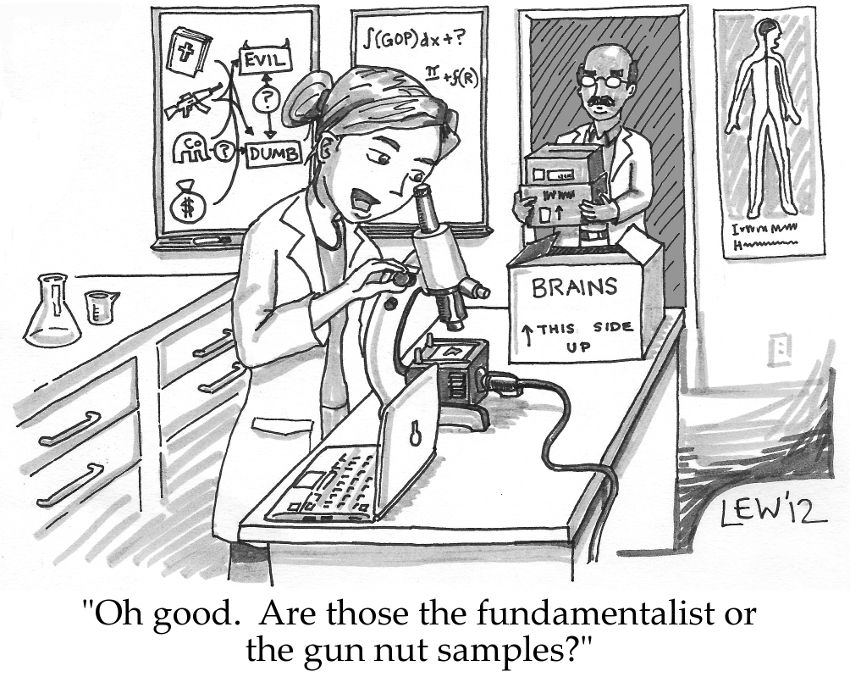
Scientists campaign against Republican, conservative brains

Back in April, I was dismayed to learn that my alma mater was hosting a speaker promoting a new book titled The Republican Brain: The Science of Why They Deny Science and Reality.  (Read Jonah Goldberg’s take on the book here)  It’s become a refrain of mine that no one should be shocked at liberal bias in media or academe. But that a campus would sanction an event branded with such a patent insult is a new low for discourse.  Doubtless, the glorified ad hominem that Republicans are wired to deny reality would go unnoticed by the campus’s “Civility Project,” which rather than treat civility seriously, reinforces notions of victimhood and grievance.

Andrew Ferguson at The Weekly Standard has managed to capture the zeitgeist of liberal academics who try to analyze conservatives. The New Phrenology, as he calls it, has roots as far back as the “F Scale” psychological test of the 1940s. It was meant to gauge one’s conservative tendencies. The “F” stands for Fascism.

Looking at more recent studies of the same vein, Ferguson finds some recurring faults. In a couple of cases the sample groups consisted entirely of college students. Hormonally-driven and still maturing, these folks are hardly suitable representatives for the population at large.  Furthermore, the subjects were also disproportionately Asian-American and female. One study assessed subjects’ conservatism by asking whether they felt “powerful” that day. The methodology leaves much to be desired.

Remember when Farleigh-Dickinson University’s Public Mind Institute reported that watching FOX News makes you dumber? They recently touted the study’s results were “confirmed” with a follow-up. But by asking the same questions as the first time, they repeated the same mistakes. A self-reporting NPR or evening news consumer is going to get a solid block of news, but a watcher of a 24-hour cable news network quite possibly could miss out on substantive programming. And the questionnaire’s focus on Syria favors a misguided, cosmopolitan set that believes the UN might actually be effective. It’s not FOX News but The Public Mind Institute that has made the world dumber with its junk studies.

Meanwhile, one Marcus Arvan has attempted to pin conservatives on the pages of a journal called Neuroethics. The determinism implied in the journal’s title is striking; as if morality were some lightning to be captured in a materialistic bottle. Arvan alleges conservatives share in a “Dark Triad” of personality traits, among them a Machiavellian bent. It’s nothing to worry about. That’s just what people label realists when they don’t like what they have to say.

But on the contrary, anthropologist T.M. Luhrmann finds evangelicals to inhabit a fantasy land.  She sees her native tribe of secular liberals as results-focused, but evangelicals as strangely obsessed with self-improvement and how people could be. Last time I checked, it was liberals who were pie-in-the-sky, swaying to John Lennon’s “Imagine.”  Serious Christians remain firmly rooted in reality, thanks to a cognizance of sin. Among other things, this is the idea that no one, not even ourselves, is perfect or perfectible on this Earth. The Incarnation excluded. Far from enabling delusion, real knowledge of sin and fallenness equips Christians with an ideal, double-edged skepticism. Like the kind that informed America’s great system of governance.

If anyone, it’s secular liberals who ought to be concerned for their own views of reality. Progressives can’t question the very thing they’re progressing toward. There’s no room for genuine critique if there’s a real war on with capitalism, patriarchy, scientific illiteracy, or some other ill of preference. And, as with war, secular liberals demand that problems be dealt with centrally and in totality. This embarrassing prescriptivism should have died with eugenics and all the other awkward progressive-era vestiges long ago.

Still, we are burdened with the unquestioned assumptions of the liberal-scientific consensus. We’re not allowed to question computer models of climate change. But the layman recognizes the hubris in forecasting a city’s weather one month in advance let alone global conditions one hundred years hence. On policy, the consensus demands economy-crushing carbon taxes, lest famines and war break out. But these conditions prevail already.

It’s maddening that the liberal-scientific consensus recuses itself from the possibility of error. Meanwhile, it treats people and the environment as fragile and unable to adapt–in fact, in need of a strong, capable hand–a scientific and liberal hand.  On this view, everything is material, knowable, and solvable. Their knowledge is so certain that even their critics’ reasons for criticism can be deconstructed with empirical precision.

No one likes to deal with this kind of impenetrable certitude. All the more that liberal scientists and academics should abandon their shameful quest to dismiss conservatives with the cudgel of science. Then we can get around to solving real problems.

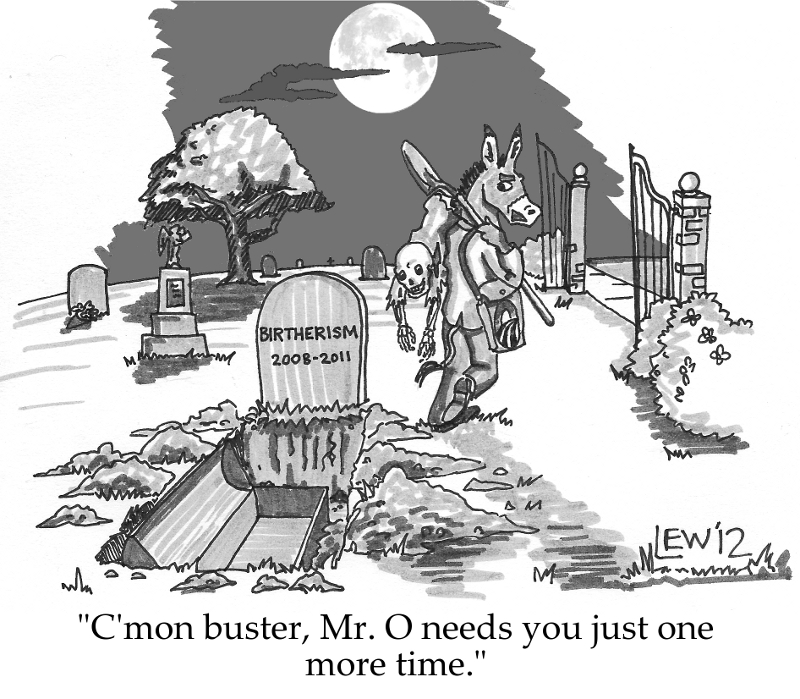
Resurrecting birtherism, questioning leadership

The Obama campaign resurrected the birther bogeyman this week with the release of a video questioning Romney’s ability to lead in light of his ties to Donald Trump.  This is an odd accusation coming from a president who forfeited leadership in shaping Obamacare, his crowning achievement, to his Democratic allies in Congress.  Meanwhile, his best claim as a bipartisan leader is the glorified photo-op of playing golf with John Boehner.  Much good that did.

Ed Klein’s new book, The Amateur: Barack Obama in the White House, reveals just how incapable a commander the president has been. In a recent Michael Medved interview, Klein contrasted Obama’s lack of day-to-day communication with President Reagan’s warm and regular phone calls to Democrat House Speaker Tip O’Neill. Today, Obama’s allies, to say nothing of his opponents, complain they never hear from him.  Maybe he’s been out on the links too much?

The biggest danger President Obama presents is not his race, his place of birth (Hawaii, USA) or his alien religion (secular liberalism). It’s his incompetence. This, combined with his unpopular, stubbornly-held big government liberalism, is why his campaign must constantly churn out red herrings like the birther issue.

Make no mistake.  Romney may not be the warmest character or give you leg-tingles, but his substantial experience heading up real, successful, and reputable enterprises give him a serious advantage over the incumbent, whose rock star status sheltered him and left him clueless as to how an executive should actually operate.

Journalists, academics try to understand God and government

Here’s an interesting and recent headline from the Christian Science Monitor: “Does government do too much? That could depend on your view of God.”

Some folks at Baylor did a study on the intersection of small government conservatism and Christian faith.  When both the journalist and the academic undertake an investigation like this, I think there tends to be an outsider’s bias.  They are kind of scratching their heads, asking “Why on Earth would anyone think this way?”

At least the journalist MacDonald does a fair job by getting a counterpoint from Woodard, an academic with rightward sympathies.  Yet the article, sadly typical of mainstream media work, smuggles in the notion that conservatives are by nature angry.  Researcher Froese conjectures that since small government Christians tend to be poorer and less educated, they are probably anxious and depressed.  According to this line of thought, they are then given to believing in a wrathful and angry God.  But reading on about the study, one really wonders why the secular/liberal types who believe they cannot find the meaning of their lives wouldn’t be even more anxious and depressed.

To me it follows that any Christian who takes his faith seriously will have peace and hope.  I know somewhere there is a statistic that Christians actually achieve higher levels of education than the general population.  But ultimately, the article’s discourse is muddied by juggling so many overlapping identities.

Between the two opposing interpretations that Froese and Woodard offer on small government Christians, I have to commend Woodard’s view.  After all, it would take a fearful or angry liberal to have such an uncharitable view of his Christian neighbors.