Fearing the rhesus revolution

It’s an exciting time.  The Republican National Convention is about to start.  This is Romney’s chance to shine.  But the press has been stuck on the narrative that unwelcome events keep the GOP off message.  This is where media malfeasance has steered us, to meta-news, news about news.  Who is responsible for determining what the media covers?  Whoops, we’re not supposed to ask that kind of question.

The New York Times Magazine commemorates the advent of the Republican convention with a dour examination of the host city, Tampa, Florida.  Writer John Mooallem brings us the saga of a renegade rhesus macaque.  As he tells it, this indomitable monkey has become a sort of resistance symbol and a focal point for anti-government sentiment.

From start to finish, he peppers the piece with liberal complaints.  Opening up, he finds fault with the American flag flying over a local restaurant.  It’s “preposterously large.”  He reveals that, en route to covering the story, he tortured himself by listening to conservative talk radio.  From what I can tell, he’s done this for no other reason than to complain about it in writing afterward.

With respect to the monkey controversy itself, Mooallem makes his sympathies very clear.  He’s supportive of the Florida Fish and Wildlife Commission, who the locals see as “the Gestapo.”  The writer’s sentiment crystallizes in this assessment of the state officers:

But they took a somewhat traditional view: the American people had a right to be protected by their government from wild monkeys. It was disorienting to watch the people of Tampa Bay champion the monkey’s rights instead.

That an idea like freedom might trump the public order deeply troubles him.  To counter such libertarian exuberance,  he quotes one man’s stern warning: “Sometimes, freedom isn’t necessarily a good idea.”  In true liberal fashion, the writer is most at home expressing his convictions as an equivocal miasma.

Nonetheless, he seems to advance a genuine concern about public order and safety.  Mooallem unmistakably condemns Tampans’ refusal to cooperate with the animal control agency.  But I suspect he doesn’t feel the same way about the Holder Justice Department’s bitter reluctance to enforce federal deportation laws.  Per his metric, why shouldn’t the prospect of fellow humans living an uncertain, shadow existence elicit the same kind of concern?

At any rate, pieces like Mooallem’s are the Sunday afternoon grist that Northeastern cultural elites relax by.  Harper’s, Atlantic, The New Yorker, anything that will allow them to look with detached pity and concern upon their benighted countrymen in the far flung regions.

I recall a long-running TV ad from some years ago.  In an effort to get the viewer to subscribe to the weekend edition of the New York Times, a woman would exclaim, “For me, that’s what Sundays were made for!”  Back then, I suspected this woman’s compatriots would profess that Sunday was “made” with a nobler purpose in mind.

With aching essays like the Tampa monkey expose, the folks at the Times demonstrate they are just as aloof of Middle America today as they’ve ever been.

Does floating unfounded allegations of racism help Obama?

The other day I came across a commentary in the Christian Science Monitor that absolutely floored me.  Offered by two academics, McIlwain and Caliendo, its headline questions: “Is a pro-Romney ad racist? Five questions to ask yourself.

Apparently, the coauthors don’t think Democrats can ever make a racist appeal, so they only focus on the Romney campaign.  To them, it’s not a question of if but which of his ads will be racist.  As we’ve seen with Joe Biden’s  “unchained” appeal,” this myopic model leaves voters unable to account for racism when it actually happens.

You can’t find racism from the left if you’re only looking right.  But with advanced degrees in the humanities and social sciences, the coauthors command a toolkit that enables them to pick out the finest notes of that pesky racism “dog whistle.”  Funny though, only a self-selecting pool of liberal academics have the authority or ability to discern them.  Good thing they’ve taken the time to help the rest of us out!

The examples the coauthors provide in their commentary are tenuous at best.  They advance their arguments on mere possibilities.  Does this sound familiar?  Elements of Romney’s ads “could be interpreted” or might “imply” some kind of racism.  A string of possible but weakly supported claims puts the piece just a notch above Harry Reid’s completely groundless claim that Romney didn’t pay ten years’ worth of taxes.

In one section of their commentary, the authors warn against the deployment of stereotypes.  Their metric for determining a potential stereotype is wide, vague, and subjective.  They bar Romney from any avenue of attack, while allowing Obama to proceed. Consider this passage on criminality:

For instance, while the Obama campaign might charge that Romney is a felon – a strong attack to be sure – there is no historical association between whites – as a group – and criminality. That association is present with respect to blacks, however. Thus, the message functions as a stereotype, not merely a criticism of one individual.

Have you ever watched a Hollywood action movie?  The villain is always some rich white guy in a suit!

Or, think of the TV series 24.  Each season, there are two levels of bad guys.  The first wave of villains might be terrorists from a fictitious Middle Eastern country, a Mexican drug cartel, or maybe opportunistic African warlords.  But then, somewhere around hour 10 or 12, the ultimate culprit emerges: always a cold, well-heeled white guy who is an unscrupulous industrialist, a crackpot defense hawk, or otherwise a liberal’s gross impression of Dick Cheney.  And this from a show with supposedly conservative leanings!

Although not matching McIlwain and Caliendo’s cherry picked “historical” or “group” criteria, Team Obama’s felon accusation against Romney exploits a real Hollywood stereotype embedded in the American consciousness.

Indeed, racism was a serious problem fifty years ago, but some folks haven’t gotten the memo that things might have improved just a bit.  This fact is easily missed by those who can’t put down their Critical Race Theory books.

It is sad that unsubstantial claims of racism get undying attention in the media.  The effect, whether intended or not, is to silence genuine criticism and steer the conversation into divisive, unproductive territory.  Just by running McIlwain and Caliendo’s commentary, the Christian Science Monitor sanctions a free tarring of conservatives, a gift to Democrats and their allies.

Paul Ryan: naive, inexperienced?

Good philosophy must exist, if for no other reason, because bad philosophy needs to be answered.

C.S. Lewis

As far as I know, neither I nor Virginia Heffernan is a philosopher in the professional sense, but I would submit that Lewis’s dictum is just as valid for bloggers.  And so it is that I must report on the Yahoo writer’s latest hit piece, because it is bad blogging.

Like her other columns, Heffernan’s latest meanders through obscure pop culture references, though fewer than usual.  This time, the most outlandish example is of some dusty blue book that every American must have owned circa 1970.

The author’s alternately snarky and earnest jaunt down memory lane serves an end of course.  In this case, it is to tie herself to her subject, the estimable Paul Ryan.  He is one year her junior, and as such is the first of Generation X to contend for the vice presidency.

The face of inexperience?

Heffernan proceeds to portray her college years as a perigee where she flirted with but ultimately moved away from a Jack Kempian conservatism.  Looking for bonus points with those harboring an unflattering memory of the Reagan years, she offers television character and teenage Republican Alex Keaton as a possible analog for Mr. Ryan.

By the end of the piece, it is clear than in so many words Heffernan has endeavored to say that compared to herself, Paul Ryan is naive and inexperienced in the ways of the world.  But for all of her musings on Generation X, she’s only managed to grasp the one elementary tool of commendation that the relativistic, existentially-driven Baby Boomers left behind: anecdotal evidence, the mere telling of personal experience.

Heffernan supposes that Mr. Ryan never faced a hard day in his life.  Meanwhile, she had some undescribed encounters that delivered her from a simplistic, uncaring worldview.  Maybe she saw a sad, hungry puppy shivering by the side of the road.  That is why, unlike the experientially impoverished Mr. Ryan,   she was able to grow out of an infatuation with that extreme ideology called fiscal restraint.

What a condescending take.  Did Heffernan fail to research that Paul Ryan discovered his father dead in bed when he was 16?  Or that his Alzheimer’s-stricken grandmother moved in for care shortly thereafter?  Indeed, the teenage Paul Ryan worked at McDonalds.  Those earnings, along with Social Security survivor’s benefits, allowed him to go to college.  And when he got there, he supported himself further with a side job selling hot dogs for Oscar Meyer.  Does this sound like some sort of silver spoon background, or the picture of naivete conjured by fictional teenage Republicans of TV yesteryear?  Contrary to her boast, it is Ryan, not she, who is the old soul.

Rather than offer commentary of value, Heffernan merely pollutes the national conversation with solipsistic bubble gum blogging.  She permits her readers to dismiss the latest Republican candidate as heartless, aloof, and extreme.  And in the same moment, they are left with fond recollections of leg warmers and ’80s prom hair.  Given the state of the entertainment establishment, this is hardly a novel achievement.

As I’ve warned before, Yahoo! News is more an entertainment outpost than an outlet for truth.

Obama’s “Our plan” pitch doesn’t work

With many buzzworthy stories washing over news audiences lately, President Obama’s attempt to claim Bill Clinton’s economic record has not garnered as much attention as it ought.  Nonetheless, ABC dutifully reported the incredible credit grab last Friday, dubbing it “Our Plan.”  As in when the President declared, ““We tried our plan–and it worked.””

Reading the story (linked above), you’ll find the writers were a less than thrilled at poking a hole in “Hope and Change.”  The following gem conveys their reluctance to call the President out on his silly move:

This pitch on occasion has meant that President Obama at times sounds as if he’s claiming some ownership of the Clinton economy – referring to “our plan” — which has allowed Republicans an opening to act as if the crowing he’s engaged in about the Clinton economy is out-of-touch braggadocio about the current economy.

Can you find the several qualifying phrases the writers deploy to effectively neuter their own critique?  They further blunt the impact of their work by twice calling the story’s developments merely “interesting.” The repeated use of this ho-hum descriptor either indicates grade school student authorship, or else is a euphemism for harsher terms the journalists can’t bring themselves to say.  Or maybe both.  You can decide what is more likely.

Whatever the case may be, the President’s team at Health and Human Services  haven’t helped the “Our Plan” claims.  Just a couple of weeks ago,  they watered down the Clinton-era welfare reform work requirements.  This signature achievement, only adopted at the prodding of a Republican Congress, has been generally acknowledged as a policy success.  But with the new HHS changes, we can expect entitlement culture to crowd out any productive behaviors the reform had brought.  Like the greatly expanded food stamp program,  this makes for a significant departure from the Clinton policy environment.

Now let’s look at “Our Plan” by the numbers.  On one level the numbers game is disingenuous.  Obama’s main claim to Clinton’s tax policy hinges solely on the top marginal rate, which he wants to boost from 35 to 39.6 percent.  Any revenue increase, even if dynamically scored, will only be a drop in the deficit bucket.  A host of other variables outside of the control of “Our Plan” will hold more sway over the economy.  But if the game is to be played, there’s a pretty good case to be made against the Democrats.

That 22 million jobs came into being under Clinton’s two terms has been echoed far and wide by Democrat acolytes.  Never mind that Obama’s net created jobs won’t be positive by election day.  But what about unemployment rates?  They’re readily available from the Bureau of Labor Statistics.  Combining Clinton’s eight full years and Obama’s first three, the average annual unemployment rate under “Our Plan” is 6.4 percent.  How much does this cream Bush’s average rate by? It’s the other way around.  At 5.3 percent, Dubya beats “Our Plan” by over a point.  Not that Mitt Romney is running as Bush anyway.

Taking things a step further, let’s attribute the unemployment numbers to Congress instead.  The average annual rate was an ultra low 5.0 percent from 1995-2006, the time Republicans had at least a tenuous hold on both houses.  By comparison, Nancy Pelosi and Harry Reid’s Congress pulled 7.3 percent from 2007-2010.  Whether looking at Congress or the White House, the employment rate tends to be healthy over the broad sweep of recent Republican tenures.  It’s those pesky times of transition to and from Democrat control that correlate to a high rate of joblessness.

When President Clinton speaks at the Democratic National Convention this September, will he be pitching the strained reasoning of “Our Plan?”  As with previously tried campaign themes, I doubt it will have the legs to carry Democrats forward.  Maybe Mr. Clinton will be singing a different song.

Chick-Fil-A and the language of (in)tolerance

A few days ago, Boston mayor Thomas Menino told burgeoning restaurant chain Chick-Fil-A it was not welcome in his city.  Responding to chain president Dan Cathy’s personal opinions–on city letterhead, no less–he decried the restauranteur as “prejudiced,” insisting there’s no room in Boston for “discrimination.”  He concluded that to allow Chick-Fil-A in his city would be an “insult” to gay couples whose marriage ceremonies he proudly presided over.  Fellow mayor Rahm Emanuel soon tried to one up Menino by appealing to “Chicago values,” an incredible claim for a place which, politically speaking, is a values wasteland.

Menino’s letter in particular is unwarranted in its use of charged language.  He and his allies have read base motives into Dan Cathy’s recent comments, which were issued earnestly in a radio interview.  If you listen, it’s clear he’s not hopped up on hate, or motivated by bigotry; his words flow from a reasoned, sincere conviction.  Neither has his company been yet charged of legally-actionable discrimination.  The mayors and their fellow critics are free to dislike Cathy and his firm, but while their claims of prejudice and discrimination go unsubstantiated, they cannot be taken seriously.

Some have justified their indignation by pointing to Chick-Fil-A’s past charitable contributions.  Media reports (here, here, and here) have alternately labeled Cathy, the company, and the donation recipients as “anti-gay” for ultimately opposing same-sex marriage initiatives.  But within these reports, the label goes unexplained and unchallenged.  The reader must naturally take it to be descriptive of one who is against gay people themselves, an utter slander that people of good will ought to reject.

In a similar fashion, the broad, vague charge of “homophobia” came with coverage of Google’s recent “Legalize love” campaign.  To call one homophobic is just as destructive to discourse, as it imparts a motive of irrational fear to the one being described.  In popular usage it is synonymous with hate.

These words ought not to be bandied about by press claiming fairness and objectivity.  Yet, media have a long, bad habit of describing conservatives as phobic and painting them in “anti” terms, as in anti-abortion or anti-spending.  Pro-choice advocates are never referred to as anti-unborn or anti-child.  Deficit spenders are never called anti-frugal.  This is a function of the Orwellian intersection of the tolerance paradigm and positive rights.  Tolerance as presently understood never allows us to question the ever-expanding field of rights, even though reason assures that absurdity must ensue at some point.

Those who want real tolerance have to abandon these loaded terms that implicitly judge the hearts and inner motivations of other individuals.  The hypocrisy of using such labels hurts one’s own cause as much as the conversational climate at large.

Fortunately, the mayors have backed off a bit from their testy declarations.  As the controversy continues to roil, may more people become cognizant of the language used, and realize that same-sex marriage opponents should not be automatically equated with bigots.  We all carry our own personal experiences, shadowboxing with traumas of the past.  Let’s not allow these to cloud an important and necessary conversation.

Water bottles and other campaign debris

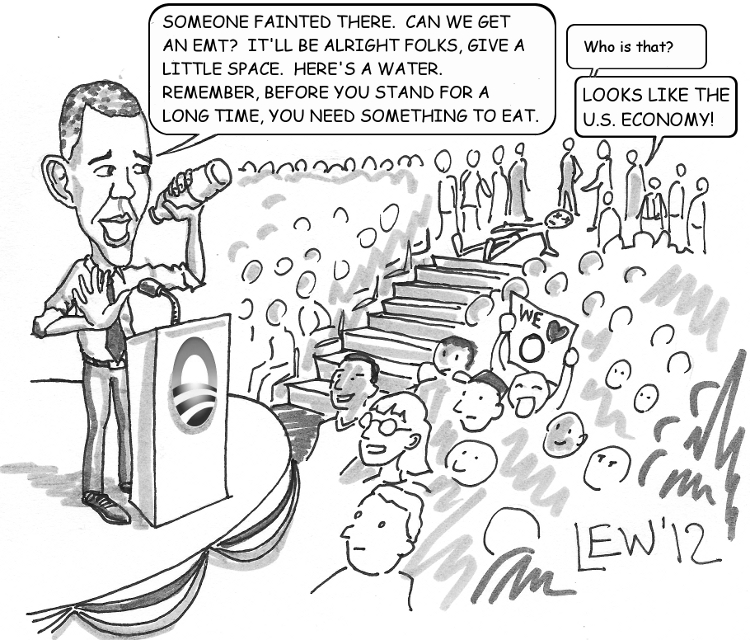
Ever since 2008, conspicuous fainting episodes have occurred with bizarre regularity at President Obama’s campaign rallies.  Some wider attention came earlier this week when Obama, who offers a consistent, canned response to these potentially serious collapses, inadvertently called for a “paralegal” instead of a paramedic. Michael Medved, who has documented this phenomenon since the beginning, has a good point regarding the displays: how does the Commander-in-Chief know it’s just a swoon and nothing more serious?

The fainting routine, with Mr. Obama’s predictable admonition to eat food, drink water, and remain calm,  is quite possibly meant to bolster his image as a confident, competent leader. He can have own mini Bush-with-a-bullhorn moment, giving gentle nanny state prescriptions that earn laughter from the adoring crowd. But one Medved caller this week had an alternate take: with the president habitually 20-60 minutes late to appointments, and belting out stump speeches nearing an hour, it would be no surprise if the fainting fans were genuine and not crowd plants.

Why do mainstream journalists, the “dinosaur media” if you will, turn a blind eye to Obama and his fellow Democrat’s campaign gimmicks?  Who knows what other minutia have gone undocumented while the media combs over Romney’s vacation photos, his financial arrangements, and his 1999-2002 status at Bain?

Of course it’s the substance and not the minutia that matters.  Yet, it was with some pain that I learned of new–if trivial –criticisms from two Hollywood geek icons.  Mark Hamill, the actor who played Luke Skywalker in Star Wars, recently knocked Mitt Romney as “not human.”  His critique hinged on how awkwardly the governor responded to a sip of lemonade.  Really?  Hamill’s observation rivals Matt Damon’s fearful, perhaps bigoted babble from 2008 that managed to mention Sarah Palin, dinosaurs, and nuclear codes in the same breath.

Giving good company to Hamill is Wil Wheaton, who played the star ship’s resident whiz kid on Star Trek: The Next Generation.  He took the occasion of a recent George Bush interview to lament the loss of life and treasure the 43rd president instigated with a “war of choice.”  It’s regrettable the actor doesn’t understand that jihadis have free will or that all wars are embarked upon as a deliberate exercise.

The men who once played space teens on film and television can now–fittingly enough–join Cher, who apparently left Earth so she could avoid breathing the same air as Mitt Romney.  Celebrities’ reflexive gags make nice conservative water cooler talk, but they also indicate just how impervious some sections of the country are to reality.

Let’s return from our Hollywood excursus to Washington, where we get a different taste of the same liberal worldview.  The media, after four days of burying its head in the sand, has reluctantly picked up on President Obama’s “You didn’t build that” gaffe.  And while ABC moved quickly to paint it as out of context, The Wall Street Journal’s James Taranto insists the gaffe was a genuine betrayal of a deeply liberal inner attitude.

If you read the wider quote from Obama, Taranto has solid reasoning: “that” refers to the singular and proximate “business.”  Obama would have said “those” if he were referring to the earlier bridges and roads.  Yet, I would entertain the possibility of a simple slip up, since “you didn’t build that” has more of a rhetorical impact than “you didn’t build those.”  It also reminds us of MC Hammer’s sweet refrain, “U can’t touch this.”

Is all this attention unfruitful nitpicking?  Not inasmuch as it draws focus to the real and gaping philosophical chasm that separates Democrats from Republicans.  Undeniably, economic policy is ultimately driven by a sense of who “owns” growth and success.

What does lack substance is the liberal canard that the rich need to “pay back” for all they’ve been given.  Not that Republicans deny a need for some government in the first place!  High income earners already pay much more than the rest of us under our already progressive tax regime.  And all the while, we can’t deny the abounding opportunity that many of those earners’ businesses provide.

There is no need for top income earners to pay “us” back or forward, for that matter.  But we could use comprehensive tax reform, a closing of loopholes and lowering of rates that Romney and a Republican Congress will deliver if elected.  If only our electorate can navigate the field of campaign season debris first.

ABC News: Romney might be a felon

ABC News is running hard with an unsubstantiated accusation that Mitt Romney might be a felon.  At the time of this post, it’s square and center on their homepage.

Earlier in the day, a less virulent form of the story parlayed–seemingly from out of nowhere–factcheck.org’s smackdown of Team Obama’s outsourcing charge into a suggestion of Romney’s culpability:

But, as fact checkers note, Team Obama does not provide any specific evidence to back up claims that Romney was actively managing Bain between 1999 and 2002.

If they had, Romney could be liable for felony charges in court for lying in sworn statements.

The follow-up story by Matt Negrin makes clear reference to a Boston Globe report and White House campaign fodder suggesting a possible crime.  Yet, Devin Dwyer’s earlier report, deficient in these references, ends up looking like a random mulling of counterfactuals.  If more mainstream journalists followed Dwyer’s pattern, we might see some other hypotheses regularly floated as objective reporting:

If the unemployment rate were two percent lower today, President Obama’s campaign would not be in such rough shape.”

If President Obama attended church regularly, fewer people would be confused about his religion.”

If President Obama had chosen a Fat Tire instead of a Bud Light for the Beer Summit, he might have locked up the LGBT vote.”

Dwyer’s report can be consigned to a bin of recent, poorly written pieces, among which we can include Virginia Heffernan’s universally indecipherable response to Ann Marie Slaughter’s work-life balance essay.  If nothing else, it shows just how eager mainstream reporters are to associate Republicans with criminality.

The AP, Obama, the ‘S’-word and E.J. Dionne

I never get tired of calling out the mainstream media.  Its reporters give us steeply slanted stories and we’re supposed to believe they are fair and objective.  A recent AP piece–not marked by Yahoo! as commentary or analysis–defends President Obama against the “socialist” label while simultaneously slapping down conservatives.

The article’s language allows the writer to circuitously vent his disdain for Obama critics.  In his prose, they “pounce,” “slur,” and “denigrate.”  Other words color the tone for us: contention, epithet, shock value, nonsense, insult.

He weaves quotes from academic experts.  One proclaims he is “weary” of the socialist label.  Another points to a “hysterical outbreak of abuse” and “animosity” coming from a “certain segment of Americans.”  In other words, racist bigots are saying bad things about the President.

Besides saturating his article with inflammatory language, the writer gets smarmy by informing the reader that it was a socialist who wrote the Pledge of Allegiance.  He faults Obama critics for missing a strict definition of socialism, but goes on to quote and mention people who do not fit the bill he uses.

As written, this purported news story is just a string of unsubstantiated quotes and couched words meant to take conservatives down a notch.  But this patronizing corrective is not the first.  I remember NPR running a piece like this just prior to election day 2008.  For years now mainstream journalists have been meticulously removing criticism from the President as if they were remora eels attached to the belly of a giant, lumbering whale.  Hopefully a one-term whale.

These nominally non-ideological reporters work in tandem with analysts and commentators who are open about their Left/liberal leanings.  E.J. Dionne is among the more effective of this clean-up crew.  Whether in his weekly sparring with David Brooks or on the talk radio circuit promoting his new book, Dionne often comes across as sharp, earnest, and even magnanimous.  For many in the political middle that could be swayed, his style threatens to give credence to his thesis that conservatives have moved radically rightward, abandoning what he calls a traditional balance between private and public, individual and community.  Never mind that he conflates government with community or that families, churches, and civic associations don’t neatly fit into his talking points.  For some swing voters, tone and presentation will matter more than substance.

Anyone who wants to stave off the misfortune of another four years of Barack Obama and his liberal, Leftist, progressive, and Democratic friends should consider carefully how they’re talking about him.  “Socialist” may be a cogent term that energizes the base, but it will turn off at least a few independents who are paying attention.

What I’m suggesting is not the abandonment of principle but getting fancy with footwork.  In conversations that count, identify the common ground and frame the choice in those terms: personal responsibility, the dangers of centralization, or whatever it may be.  Make it clear that even if Obama and Democrats don’t satisfy some strict definition of “socialist,” it is a distinction without a difference.

We don’t need to renounce our partisanship like mainstream journalists do; it’s better to confess rather than suppress your bias.  But beyond the statistics, labels, and gotchas that get thrown about, we must connect the dots, clearly articulating why it is we believe what we believe.

Duel of the embattled visages

You know how news websites usually have a most-read stories box.  Sometimes, the Christian Science Monitor inexplicably has an old report at the number one spot.  Earlier this week, a January story critically probing Mitt Romney’s record at Bain Capital was on top.  The lead photo struck me as over the top in conveying the anti-business tone of the article.

Christian Science Monitor

From the side, a harsh light defines the subject’s face.  Squinty-eyed, she stares off into the distance, as if in the midst of a hardscrabble existence.  We know she’s not happy.  Maybe you can imagine the photographer coaching her, “No, not quite.  Try to look a little more . . . off-put.  Turn your head just a little more to the left.  That’s it.”

The photo surely recalls an iconic image from one of the more trying times of last century.

Migrant Mother, Dorothea Lange, 1936. Wikimedia.

I wouldn’t try to question the artistic merit of Lange’s photography.  But given today’s sensibilities, to stumble upon such a spitting facsimile of her work’s form and style ought to puzzle if not disturb us.  In Lange’s time, America was reaching, in ways more benign than in other parts of the world, its own totalitarian zenith.  Government drafted artists en masse to produce, well, propaganda.  And surely, that’s what Lange’s work is: biased, and with a story to tell.  This is not bad in itself, but in our jaded, post-Vietnam, post-Iraq culture, there’s a double standard at work.

It’s routine and accepted for journalists to play up poverty as grinding.  But they can’t allow themselves to show private sector success as uplifting.  Not alarmist enough, or in tow with liberal media execs’ worldview.  When we hear or read “Bain Capital,” we expect to see grizzled profiles rather than glowing families.  Such a sustained slant is pernicious to our way of thinking, and in turn to the way we live.  At least there are those who would straighten the record.

William-Sonoma Republicans: The Exotic Other

I’ve been reading Yahoo! News for years.  Once upon a time, they relayed to the net denizen a spartan diet of AP and Reuters articles.  Now, they’ve cultivated their own crop of value-added content.  The term “value” must be used advisedly here.

You’d think that when it comes to presidential campaigns, journalists should be delving deep into the issues.  But the currents of today’s media markets dictate other priorities.  Take Mitt Romney for instance.  Instead of scrutinizing his policy positions, Yahoo!’s The Ticket blog has waged a systematic campaign of making Romney and his wife Ann look bumbling, aloof, and inscrutable.

Every time the Yahoo! bloggers post, the news spin is so swirly and the story so inconsequential.  In the hope of highlighting his awkwardness, one January post was dedicated in large part to Romney’s hurling bags of Cheetos to unfriendly journalists on his campaign plane.  When the primary came to Arizona, the fact that Romney’s supporters’ signs appeared to be hastily printed on resume paper figured prominently in another post.

And then there were multiple reports on Ann Romney’s Pinterest account.  First, that she followed no other Pinterest members.  Should we really expect more tech savvy from a grandmother in her sixties?  I don’t even have a Pinterest account.  Then, one Viriginia Heffernan took up a wordy post to scrutinize why Mrs. Romney would pin Anna Karenina on her Pinterest board.  Seriously, do we have a misallocation of journalistic resources here?  In magnifying and dragging out these silly details, this crack team of liberal bloggers is hoping to quash Romney’s chances by a death of a thousand embarrassing paper cuts.  The all-too-cool President Obama certainly doesn’t get the same treatment on The Ticket.

To top it all off, one of Heffernan’s latest contributions catalogs for us the traits of what she calls “William-Sonoma Republicans.”  She cites an old story by the Los Angeles Times to launch her own confused musing on The Other: in her case, middle and upper-middle class Republicans who support Mitt Romney.  You can’t help but suspect a bit of journalistic retaliation when she tries to cast this Other as a counterpart to the “sushi-eating, Volvo-driving” latte liberal.  How exotic is this strange group of people who would support Mitt Romney?  Among their most salient traits: they live in large suburan houses, take pride in their living spaces, and–most shocking of all–cook food in their own kitchens!

The nadir of this journalistic exposé comes when the author consults the William-Sonoma website. Noting that it prominently features an Easter sale, she concludes erroneously and with lament that the clientele is meant to be exclusively Christian.  She plays up an ad that suggests W-S customers might like to eat leg of lamb with sea salt and shallot butter.  I’m sure lots of Jews, Muslims, and atheists wouldn’t mind a bite of leg of lamb in April either.  And if having an Easter sale signifies some sort of oppressive exclusion, Heffernan had better not look at the transcript for the White House Easter prayer breakfast.  How far overboard can a liberal blogger go with her disdain for traditional lifestyle and faith?

We shouldn’t blame the media for their failure to cover the substance of the 2012 Presidential campaign.  After all, they have to pay the bills somehow.  Just remember to do your homework before you go the polls in November.  Hint: Yahoo! News won’t help.