Campus thought police

Hate crimes have received a bit of press lately, with the news supernova over Trayvon Martin as well as the recent conviction of Dharun Ravi in the Tyler Clementi case.  Much ink has been spilled on these things already.  I will spare you but to say that hoodies are not a good symbol to rally around, and that Mr. Ravi’s disproportionately harsh sentence tells us just how powerful the politically-driven liberal witch hunt for bullies is.

Now only occasionally do hate and intolerance receive as much attention in the public square as they do on university campuses.  The past couple of years there has been great hand-wringing across the University of California system.  President Yudof issued this open letter in March.  The academic establishment typically shies away from moral and absolutist language, but its use in this letter betrays the community’s critical-thinking blind spot.  In response to one act of vandalism, the UC President sounds more like a back-bending diplomat when he applauds the “rapid and vigorous condemnation of this cowardly act.”  This kind of language is reserved for when some ultra-important party has been ticked off and must be mollified.

That party is a large one, animated in its adherence to the orthodoxy of victimhood.  It is driven by the oppressor-oppressed paradigm, and it continuously demands urgent, corrective action.  As a modern day Sisyphus, the university president or chancellor must repeatedly expend campus time and resources condemning every little act of vandalism and thoughtless transgression.  Furthermore, their chains require them to assure that such crimes will be expunged completely from the grounds of the academy.  But there will always be insensitive yokels ready to wreak havoc, if for no other reason than to elicit a response from the ultra-sensitive communities on campus.

A couple of news items from last fall help us see a fuller picture of the campus orthodoxy that dictates these responses.  After a student column on some regrettable phenomenon called “jungle fever,” The California Aggie editorial board informed its readership that its staff were to undergo “diversity training.”  This prescription can’t help but remind me of Communist-era reeducation camps.  And after some abortion opponents surreptitiously distributed the “180” video on campus, the campus Women’s Resource Center not only condemned the act but felt compelled to offer support to “students identifying as Jewish, Queer, People of Color, Women, Transgender, Romani, and folks with disabilities” who were offended or else menaced by a sense of “erasure.”

There are limits to sensitivity on campus and in the public square.  Authority figures always take it upon themselves to reassure the public through their actions, but these grandiose declarations end up diminishing the sense of agency and empowerment that ought to be cultivated in the individuals of the community.  There is too much coddling of victims and not enough sense of perspective.  If we are to preserve the academy as an arena of critical thought, and if it is to deliver us well-rounded, capable citizens for society, we must shake off the unhealthy campus obsession over hate and intolerance.
A workable green energy solution

We all know the things we’re supposed to spurn the Republican contenders for: vomiting on hearing JFK talk about church and state, offering statehood to a yet-unfounded lunar colony.  The litany against front-runner Mitt Romney is long, if insubstantial: having buddies who are NASCAR team owners, driving two Cadillacs (not Porches or even Mercedes, mind you), being an Etch-a-Sketch candidate.  Since there is no major scandal or outrageous hair-flaming position the man takes, mainstream media must squeeze every ounce it can get out of the latest Romney gaff.  It’s getting old for anyone with half a brain, and fortunately those are the people who tend to show up at the polls.

Republicans have been scrutinized intensely, but what has been coming out of mouths in the Democratic corner?  You wouldn’t know watching NBC or reading Yahoo! News.  Sure, Maxine Waters called Eric Cantor and John Boehner demons.  Nonetheless, it’s the recent speeches of household-name White House officials that are worth looking at.

President Obama kicked things off earlier this month, comparing himself to Ghandi and Nelson Mandela.  He claimed that, as with those men in their noble struggles, the fight is hard and it takes time.  But how is the Democratic agenda in 2012 comparable to the effort for Indian independence or the campaign to end Apartheid?  Does this mean the GOP is as brutal as the British Raj or as unjust as the old South African regime?  This sloppy pandering is reminiscent of the racially-tinged “dollar bill” accusation Obama hurled at McCain and Republicans in his 2008 campaign.  But these remarks get scant media scrutiny when they come from this president.

Next, Secretary of State Hillary Clinton spiced things up at the 2012 Women in the World Summit.  She equated more ardent American conservatives with the more egregious human rights abusers in the Muslim world, slapping them both with the common label of “extremists.”  Opposing compulsory contraception coverage is nothing akin to what women deal with every day in Afghanistan, or Egypt for that matter.  Secretary Clinton scores bonus points for lugging domestic politics into foreign affairs.

Finally, Joe Biden rounds out the good times with a speech given to the UAW in Toledo last week.  The Vice President branded his ticket as one offering a “fair shot and a fair shake.”  With this language we might as well have entered a time warp and come out in FDR’s bad old New Deal.  This is the kind of sloganeering given to those who think capitalism is wrong, broken, or dead.  In its place comes Uncle Sam who “takes care of things” for you.  Just like when you need Vito Corleone to get your landlord off your back.  More like fair shakedowns than fair shake.  This rhetoric values shameless deal-making over the rule of law.

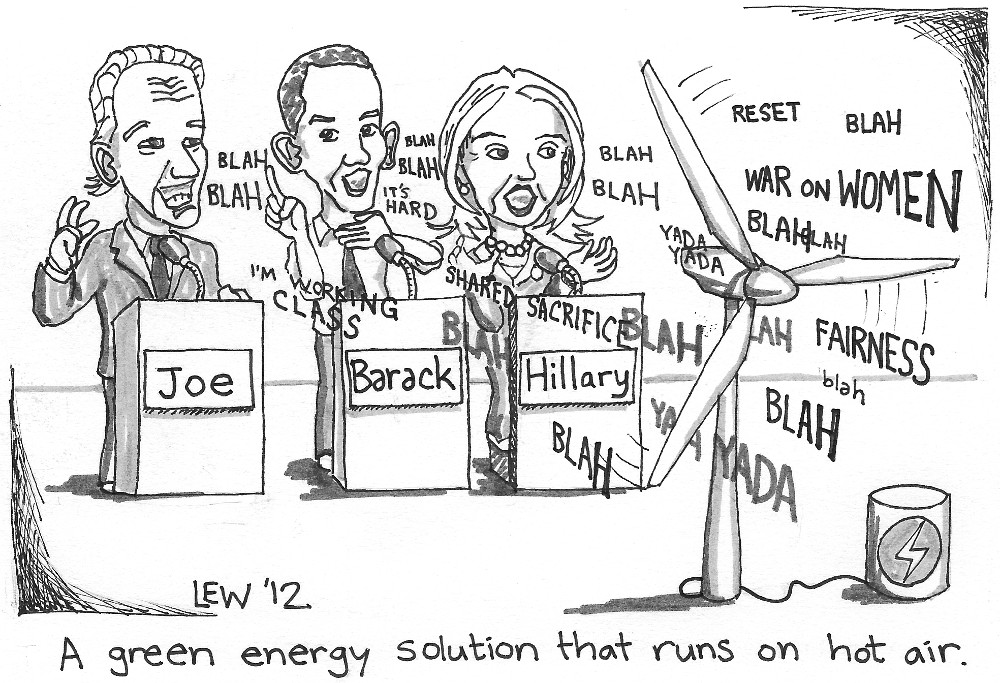
It’s no surprise the highest officials in the land get the soft treatment; they’re liberal and progressive after all.  Their rhetoric should have generated some push back from the mainstream media.  If only we could harness all their hot air, we could generate electricity instead.  Then they could deliver on their green energy solutions promises.

Kony 2012 and Afghanistan

I found last week’s hoopla surrounding the Kony 2012 video annoying and disturbing.  Designed to stir souls to a noble cause, the video is worrisome because it is classic agitprop.  It has ignited among its viewers a strong emotional firestorm that bypasses reason.  (On a sadder note, it seems the global explosion of attention and backlash were too much for the maker of the video.)

Everyone agrees that Kony is a bad man, but I doubt everyone agrees on a real solution.  Neither Facebook posts nor monetary contributions stop an evil man like this.  UN blue helmets don’t do much good either; just ask the residents of Srebenica.  It would take a concerted effort by a competent, modern military force to uproot that kind of evil.  Funny though, when that sort of operation becomes reality, as with the Iraq War, people complain about it.  If only text donations were more widespread back then, maybe Saddam Hussein could have been effaced by the collective wireless bills of the Free World.  And what about the fresher atrocities of Kim Jong Il?  By the time of his death last December, there was no 80 million+ hits YouTube video for his crimes.

For all the talk of “capturing” Kony, I would not be surprised if his capture attempt looked and ended up like last year’s righteous and successfully culminated mission against Osama Bin Laden.

Just a day or two after the Kony 2012 media explosion came the sensational storm of the Afghanistan massacre.  But instead of passion to spark a new war, this story reinforced among the public a desire to end an old one.  I instinctively resist the popular sentiment to pull out that comes from seeing casualties and bloodshed.  When I studied “peace and security” as an international relations major, I discovered the great extent of thought that informs decision-making on questions of peace and war.  Such deadly serious business must not be decided by the fickle whims of the public, but ought to rest in the hands of sober-minded policymakers.  Whether we actually have such trustworthy policymakers in power is another story altogether.

The power to make war is a necessary and classic function of government that is not going away anytime soon.  Indeed, Robert Kagan’s latest book argues specifically for America’s need to maintain a prominent profile in the world’s affairs.  What is ultimately entailed in Afghanistan is hard for me to say, but mere public opinion shouldn’t determine whether we send SEALs to get Kony or send our troops in Afghanistan packing.  Our national security and our troops’ sacrifice are too important for that.

Univocal language

In recent episodes of his Reasonable Faith podcast, William Lane Craig hits hard at physicist Laurence Krauss’s assertions that the universe came from nothing.  It turns out Krauss’ “nothing” is basically vacuum space filled with a sea of crackling energy.  Among other things, it has properties regarding stability of decay and the potentiality of begetting matter. But anything with properties and states of potentiality, even if devoid of matter, is not nothing! This is not the first time a naturalist has deployed a definitional bait-and-switch in the hope of dispatching the annoyingly transcendent Deity.  Each time Dr. Craig refutes these kind of metaphysical transgressions, he reminds us of the necessity of univocal language; that is, the importance of using words whose meanings do not change from one sentence to the next.

One arena that could benefit from this clarity of meaning is the question of rights.  Last month, Greg Koukl highlighted on his radio show a string of stories illustrating the tragic trajectory of human rights.  First, he reported this BBC this headline: “Dolphins deserve same rights as humans, say scientists.”  And then followed the cetacean saga where PETA sued Sea World under the premise that the 13th amendment, protecting against slavery, applies to killer whales.  The thread linking these stories is the desire to assign legal personhood on the basis of what Koukl called functionalism.  When a living being achieves a certain functionality, say certain brain wave complexity, then it deserves rights and protection.  The flip side is that some beings, like human fetuses, may not attain to the criteria, depending on who assigns them.  Koukl illustrated the case powerfully with reference to the recent Journal of Medical Ethics article on “after-birth abortion.”

Without an objective grounding to our moral values, there is total confusion as to rights.  Are they really human rights, or are protections conferred only when certain experts declare personhood?  Can Flipper and Koko the gorilla come along for the ride?  It’s complicated enough just in the realm of Homo sapiens.  Justice Ginsberg, much to her discredit, isn’t on the same page as the rest of us when it comes to human rights.  It seems on her view that the year your constitution was written has considerable bearing on how good it is.  And then, there is the obfuscation that comes from sensational media train-wrecks, as we’ve seen with the privileged, 30-year-old Georgetown law student and rising victimhood star Sandra Fluke.  Fortunately, there are still those who can elucidate the absurdity of when rights go too far.

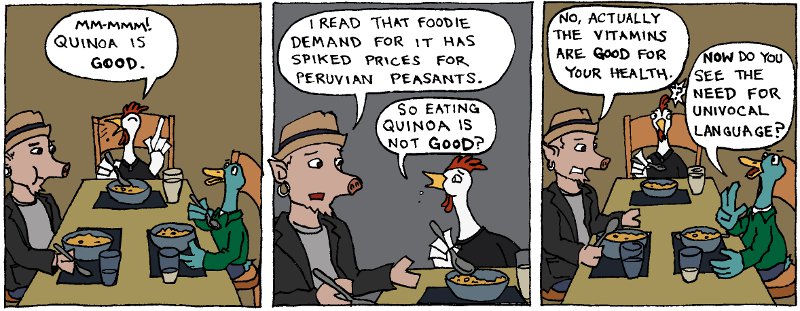
Whether we’re talking about the origin of the cosmos or the foundation of human rights, or just wondering if “quinoa is good,” our debates and discussions will be much smoother when we use our terms univocally.

Get smart on social issues

Social issues have been on a role lately.  Even though conservatives have the winning logic, the Left has the tailwind of popular outrage that comes with the liberal fear of an “American Taliban.”  From Komen’s forced Planned Parenthood backtrack, to the weak Obamacare contraceptive mandate reshuffle, to Rick Santorum’s unnecessary utterances on prenatal tests, neither the media nor the White House have missed a chance to cast a troglodyte pall on any Republican within firing range.

Liberals have the tactical advantage as long as the policy discourse is defined by the paradoxical presumption that government should run citizens’ lives while maximizing their “privacy.”  Rather than get mired in the house-to-house fighting of the culture wars, Republican presidential contenders ought to turn the tables and insist that privacy is best preserved by getting government out of the healthcare business.  Gutting mandates is the real “pro-choice” position.

Winning the presidency requires a positive, sunny disposition, and delivering bad news about people’s personal conduct is the job of elders in robes: pastors and judges.  If you win the presidency, you get a bully pulpit, but more importantly, you can appoint clear-thinking judges who can stem the progressive march to positive-rights oblivion.  The problem is you need to win the presidency first.  Let’s get smarter on how we talk about social issues.

Theocracy from the Left; or, Other people’s money

At the National Prayer Breakfast earlier this month, President Obama played up his Christian faith, declaring “for unto whom much is given, much shall be required.” Attempting to marshal scripture in support of his idea of fairness, he ended up inserting a theological foot into his political mouth by conflating God and government.  In this, Mr. Obama managed to betray an aloofness from mainstream churches as well as raise a troubling portent for civil libertarians.

With the words “much shall be required,” what else did the Central-Planner-in-Chief mean but to put the tax man’s moral authority on par with God’s?  Christians understand that God doesn’t compel anyone to obedience, but leaves each of us to our free will and our conscience.  By contrast, human government must compel its citizens.  Taxes are collected ultimately at the barrel of a gun.  That’s why the founders saw it as essential to limit what is “required” by the government.

During the Bush years, a handful of agitated liberals spawned a new book industry, warning of theocracy arising from the Religious Right.  If history’s any predictor, President Obama’s statement should launch a new wave of dire tomes warning against a theocracy of the Religious Left.  The social justice crowd that rallies behind Obama’s fairness push is out of touch with America’s exceptional ethos and experience: that a people, under the guidance of God and conscience, and free from a central meddler, have built for the world a Shining City on a Hill.

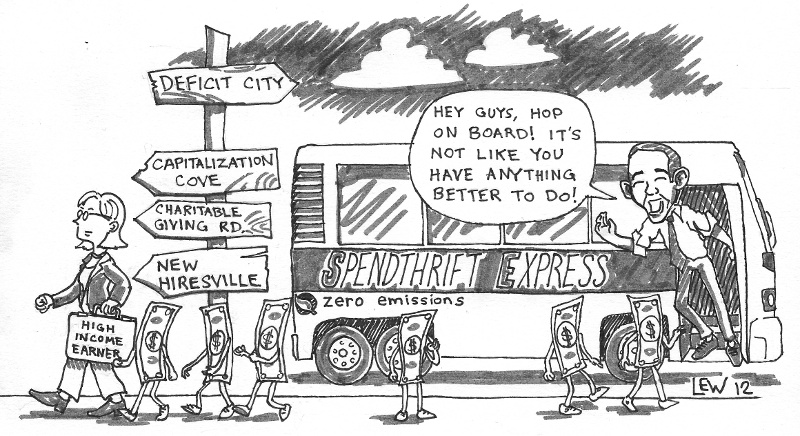
Besides conflating God and government, the President and his tax-the-rich allies have committed another type of unforced error in their moral reasoning.  Mr. Obama, investment wiz Warren Buffett, and retired Google exec Eric Schmidt have each, in recent times, implored that their own taxes be raised.  Their advocacy sweeps up all the fellow earners in their tax bracket, both the willing and unwilling.  How is this kind of appeal sensible?  It’s a perverse, inverted golden rule.  Like saying you personally don’t mind being bludgeoned, so it’s okay to bludgeon your peers.  It seems as if these folks are hoping your brain isn’t turned on.  Or maybe that you won’t notice theirs aren’t.  There’s a certain kind of arrogance in volunteering other people’s money.

So in a couple of ways Obama and company’s moral arguments are really lacking.  But don’t forget the facts about our nation’s recent Great Society redux.  Stephen Moore’s op-ed challenge to the White House fairness narrative provides us with a rich inventory of ways our big government has failed us to date .  Among the more salient is the mounting concentration of national wealth in the suburbs of Washington DC; the top three median income counties in the nation are clustered in the DC metro area.  Such a backslide of civilization would give any shameless, caviar-chomping commissar of Soviet-era Moscow a run for his money.  And we know that whatever part of our nation’s economic lifeblood that does not end up feeding a Falls Church jumbo mortgage tends to get lost in legislative backscratching or bureaucratic head-scratching.

Anyway you dice the tax dollar, Washington isn’t justified in its spending increases.  Given President Obama’s deficit deafness, and Democrats’ contorted fairness distractions, voters need to just say “No!” and oust the tax-grubbing big spenders this November.

Who is that hipster?

Apparently there was a big to-do about Jay Carney’s square glasses last September.  But I missed out on that one somehow.  I don’t see this guy’s face on TV as much as his predecessor Robert Gibbs.  The wall-to-wall coverage of the Republican presidential primary must have something to do with that.  But sure enough, I was reassured of Carney’s uncannily youthful visage while watching Today this morning.

Speaking of White House czars, have you learned about the new video game czar, UW Madison’s Constance Steinkuehler?  Even now, the economic benefits of our farsighted leaders are accruing to us.  Where will the maddening overreach of government end?