Univocal language

In recent episodes of his Reasonable Faith podcast, William Lane Craig hits hard at physicist Laurence Krauss’s assertions that the universe came from nothing.  It turns out Krauss’ “nothing” is basically vacuum space filled with a sea of crackling energy.  Among other things, it has properties regarding stability of decay and the potentiality of begetting matter. But anything with properties and states of potentiality, even if devoid of matter, is not nothing! This is not the first time a naturalist has deployed a definitional bait-and-switch in the hope of dispatching the annoyingly transcendent Deity.  Each time Dr. Craig refutes these kind of metaphysical transgressions, he reminds us of the necessity of univocal language; that is, the importance of using words whose meanings do not change from one sentence to the next.

One arena that could benefit from this clarity of meaning is the question of rights.  Last month, Greg Koukl highlighted on his radio show a string of stories illustrating the tragic trajectory of human rights.  First, he reported this BBC this headline: “Dolphins deserve same rights as humans, say scientists.”  And then followed the cetacean saga where PETA sued Sea World under the premise that the 13th amendment, protecting against slavery, applies to killer whales.  The thread linking these stories is the desire to assign legal personhood on the basis of what Koukl called functionalism.  When a living being achieves a certain functionality, say certain brain wave complexity, then it deserves rights and protection.  The flip side is that some beings, like human fetuses, may not attain to the criteria, depending on who assigns them.  Koukl illustrated the case powerfully with reference to the recent Journal of Medical Ethics article on “after-birth abortion.”

Without an objective grounding to our moral values, there is total confusion as to rights.  Are they really human rights, or are protections conferred only when certain experts declare personhood?  Can Flipper and Koko the gorilla come along for the ride?  It’s complicated enough just in the realm of Homo sapiens.  Justice Ginsberg, much to her discredit, isn’t on the same page as the rest of us when it comes to human rights.  It seems on her view that the year your constitution was written has considerable bearing on how good it is.  And then, there is the obfuscation that comes from sensational media train-wrecks, as we’ve seen with the privileged, 30-year-old Georgetown law student and rising victimhood star Sandra Fluke.  Fortunately, there are still those who can elucidate the absurdity of when rights go too far.

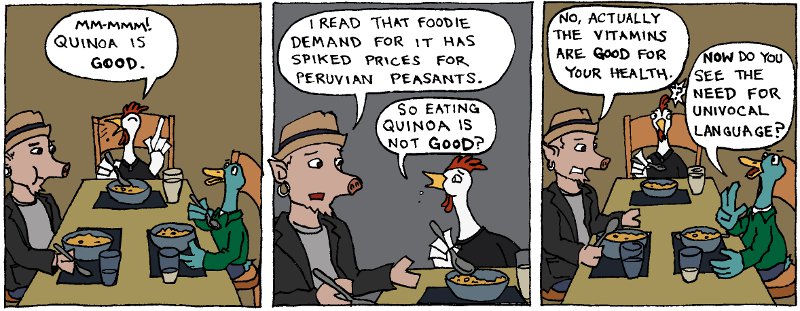
Whether we’re talking about the origin of the cosmos or the foundation of human rights, or just wondering if “quinoa is good,” our debates and discussions will be much smoother when we use our terms univocally.
Of sheeple and super PACs

Just the other week, the charmingly hateful Bill Maher announced he was giving $1 million to a super PAC working to re-elect President Obama.  Despite his past harangues against the Roberts Supreme Court, Mr. Obama has resigned himself to the reality of unlimited campaign spending for now.

The Citizens United decision that ushered in that reality is deeply unpopular with the public. But what is the alternative?  Restrictions on political advertising are inextricably at odds with America’s free speech tradition.  Contrary to popular belief, the first amendment does not aim to protect lap dances, the pitching of tents on university quads, or school children’s ability to endorse “bong hits for Jesus.”  If nothing else, free speech exists so we may amply criticize our incumbent political leaders.  Anyone who remembers Tienanmen square ought to have a natural appreciation for this necessity.

Yet, Americans fear the pernicious effects of too much political speech.  Some are concerned for the quality of the speech, but most trepidation is reserved for the idea that rich people and wealthy corporations will have too much power.  In reality, there is a healthy split between rich Democrats who want to raise their own taxes and rich Republicans who understand the importance of keeping taxes low.  Even from the class war perspective, there is no need to worry that big donors will team up and categorically dominate everyone else.  President Obama’s ample 2012 war chest attests to that.

What of the quality of political speech?  This election cycle, news media consumers cannot help but be acutely aware of the Republican tit-for-tat.  Recall the sensational, anti-capitalist dross that Gingrich supporter Sheldon Adelson financed earlier this year.  But in what past golden era were political campaigns not ugly?  More to the point, the desire to suppress distasteful or distorted speech through legislated, bureaucratic discernment is chillingly Orwellian.

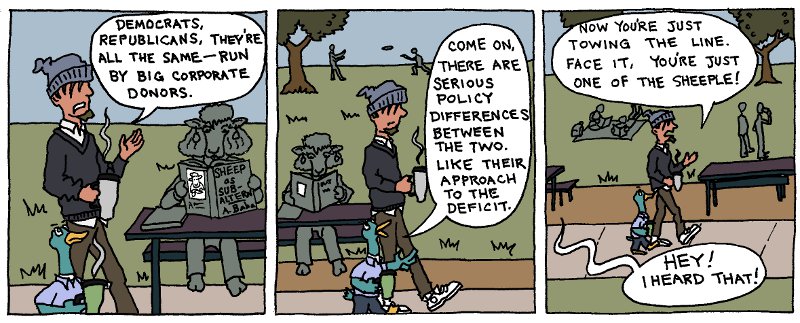
As the unattributable maxim goes, fight bad speech with good speech.  True democrats (lowercase “d”) have nothing to fear, as long we believe our fellow citizens aren’t dumb.  But for some reason this pervasive mentality prevails: that millions of dollars of campaign money automatically translate into bought votes, as if people were uncritical voting robots.  This is classic “sheeple” thinking, a presumptuous judgement that your fellow countrymen are mere followers who are too blind to apprehend the truth you happen to perceive.

We must appreciate our democracy as a marketplace of ideas, where we test confidently a faith that our fellow citizens are endowed with true decision-making ability and are not bought-and-sold sheeple.  To do otherwise would be to shrink into the clutches of tyranny.

Get smart on social issues

Social issues have been on a role lately.  Even though conservatives have the winning logic, the Left has the tailwind of popular outrage that comes with the liberal fear of an “American Taliban.”  From Komen’s forced Planned Parenthood backtrack, to the weak Obamacare contraceptive mandate reshuffle, to Rick Santorum’s unnecessary utterances on prenatal tests, neither the media nor the White House have missed a chance to cast a troglodyte pall on any Republican within firing range.

Liberals have the tactical advantage as long as the policy discourse is defined by the paradoxical presumption that government should run citizens’ lives while maximizing their “privacy.”  Rather than get mired in the house-to-house fighting of the culture wars, Republican presidential contenders ought to turn the tables and insist that privacy is best preserved by getting government out of the healthcare business.  Gutting mandates is the real “pro-choice” position.

Winning the presidency requires a positive, sunny disposition, and delivering bad news about people’s personal conduct is the job of elders in robes: pastors and judges.  If you win the presidency, you get a bully pulpit, but more importantly, you can appoint clear-thinking judges who can stem the progressive march to positive-rights oblivion.  The problem is you need to win the presidency first.  Let’s get smarter on how we talk about social issues.

Theocracy from the Left; or, Other people’s money

At the National Prayer Breakfast earlier this month, President Obama played up his Christian faith, declaring “for unto whom much is given, much shall be required.” Attempting to marshal scripture in support of his idea of fairness, he ended up inserting a theological foot into his political mouth by conflating God and government.  In this, Mr. Obama managed to betray an aloofness from mainstream churches as well as raise a troubling portent for civil libertarians.

With the words “much shall be required,” what else did the Central-Planner-in-Chief mean but to put the tax man’s moral authority on par with God’s?  Christians understand that God doesn’t compel anyone to obedience, but leaves each of us to our free will and our conscience.  By contrast, human government must compel its citizens.  Taxes are collected ultimately at the barrel of a gun.  That’s why the founders saw it as essential to limit what is “required” by the government.

During the Bush years, a handful of agitated liberals spawned a new book industry, warning of theocracy arising from the Religious Right.  If history’s any predictor, President Obama’s statement should launch a new wave of dire tomes warning against a theocracy of the Religious Left.  The social justice crowd that rallies behind Obama’s fairness push is out of touch with America’s exceptional ethos and experience: that a people, under the guidance of God and conscience, and free from a central meddler, have built for the world a Shining City on a Hill.

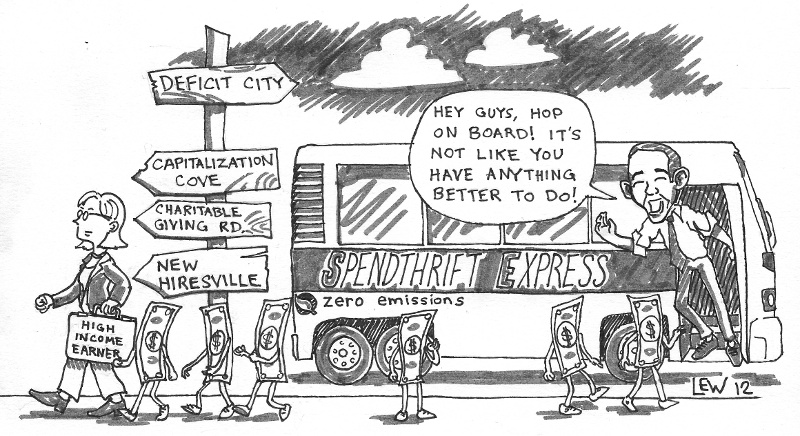
Besides conflating God and government, the President and his tax-the-rich allies have committed another type of unforced error in their moral reasoning.  Mr. Obama, investment wiz Warren Buffett, and retired Google exec Eric Schmidt have each, in recent times, implored that their own taxes be raised.  Their advocacy sweeps up all the fellow earners in their tax bracket, both the willing and unwilling.  How is this kind of appeal sensible?  It’s a perverse, inverted golden rule.  Like saying you personally don’t mind being bludgeoned, so it’s okay to bludgeon your peers.  It seems as if these folks are hoping your brain isn’t turned on.  Or maybe that you won’t notice theirs aren’t.  There’s a certain kind of arrogance in volunteering other people’s money.

So in a couple of ways Obama and company’s moral arguments are really lacking.  But don’t forget the facts about our nation’s recent Great Society redux.  Stephen Moore’s op-ed challenge to the White House fairness narrative provides us with a rich inventory of ways our big government has failed us to date .  Among the more salient is the mounting concentration of national wealth in the suburbs of Washington DC; the top three median income counties in the nation are clustered in the DC metro area.  Such a backslide of civilization would give any shameless, caviar-chomping commissar of Soviet-era Moscow a run for his money.  And we know that whatever part of our nation’s economic lifeblood that does not end up feeding a Falls Church jumbo mortgage tends to get lost in legislative backscratching or bureaucratic head-scratching.

Anyway you dice the tax dollar, Washington isn’t justified in its spending increases.  Given President Obama’s deficit deafness, and Democrats’ contorted fairness distractions, voters need to just say “No!” and oust the tax-grubbing big spenders this November.

Who is that hipster?

Apparently there was a big to-do about Jay Carney’s square glasses last September.  But I missed out on that one somehow.  I don’t see this guy’s face on TV as much as his predecessor Robert Gibbs.  The wall-to-wall coverage of the Republican presidential primary must have something to do with that.  But sure enough, I was reassured of Carney’s uncannily youthful visage while watching Today this morning.

Speaking of White House czars, have you learned about the new video game czar, UW Madison’s Constance Steinkuehler?  Even now, the economic benefits of our farsighted leaders are accruing to us.  Where will the maddening overreach of government end?

World better without religion?

At some point, you’ve likely heard the lament that the world would be better off without religion.  You may have even unwittingly imbibed it this past New Year’s Eve, when Cee Lo Green covered John Lennon’s classic hit “Imagine.” The song starts famously:

Imagine there’s no heaven
It’s easy if you try
No hell below us
Above us only sky
Imagine all the people living for today

And in due course the listener is asked to imagine a world with “no religion too.”  What better way to kick off 2012?  I’m sure Times Square’s officiants Lady Gaga and Michael Bloomberg approve wholeheartedly.

Beyond the pop culture realm, but still in the confines of Manhattan, the Oxford-style debate forum Intelligence Squared US picked up on the same theme this October past.  For some time I’ve heard bits of their debates on NPR, but only recently did I bother to get the podcast.  Naturally floating to the top of my queue was the episode featuring the resolution, “The World Would Be Better Off Without Religion.”

The debate, held before an audience at New York University, was remarkable in that the pro- and con- teams were prohibited from discussing the existence of God.  At first this might seem absurd; whether  God exists or not is patently germane to the question of religion.  But the imposed restriction has the benefit of allowing the debaters to focus neatly on the social ramifications of religion.

Consider what religion is in the restricted sense of the debate: moral beliefs with social consequences, that happen to be theistic. Then listen to the debate participants in action, and the chief complaint becomes clear: people kill and oppress others on the basis of differing moral beliefs.  So, would any hypothetical, religion-free world be better? No.  We would only be exchanging a world filled with a diverse array of theistic moral belief for a world filled with a diverse array of atheistic moral belief.  That people hold moral beliefs, and differ from each other on those beliefs are immutable elements of humanity.  So is the fact that we are social creatures.  We cannot escape each other.  I suppose we can imagine a world of people in secluded pods, or one solely populated by clones, or else a world that is entirely monocultural.  But most people would rightly see such worlds as deeply impoverished and no improvement over our own.  An inescapable part of being human is living in a world with others who hold to different “oughts” and “ought nots.”

Let’s move from possible worlds to the historical record. For thousands of years, religion has presided over mankind, such that any given killer, oppressor, or victim for that matter, could in some sense be tagged by us as “religious.” Only after the Enlightenment do we start to see significant cases of self-identified irreligious individuals.  All we need is one instance where an atheist kills another atheist on the basis of differing morality to obliterate the idea that religion is uniquely harmful.  Consider who swung the ice pick that killed Leon Trotsky.  It seems someone thought he “ought” not have disobeyed Stalin.  Purging religion only allows new types of contentious belief to crop up and take its place. Religion doesn’t kill or oppress people, human wickedness does. Christians rightly recognize this as sin nature.

So, how did the Intelligence Squared debate turn out?  The pro-side, making the case things would be better without religion, persuaded more audience members at the end and thereby won.  Unfortunately, the con- debaters Dinesh D’Souza and Rabbi David Wolpe failed to decisively isolate the social idea of “religion” from man’s underlying wickedness.  But even if they effectively made that case, what other outcome could we expect from public broadcast patrons congregated in a New York university performing arts center?

That the finger of blame could be pointed toward oneself has been thoroughly expunged from our culture today.  It’s easier for some just to chalk our problems up to some conception of a social condition called “religion.”

SOTU 2012: The Tax Loophole Jump

SOTU 2012:The Business Tax Loophole Jump


There were some nice things about Tuesday’s State of the Union Address:  Representative Gifford’s recovery, the accomplishments of our awesome Navy SEALs, and Mitch Daniels’ well-spoken and clever GOP response.  And there were some not so nice things.

Looking at the fiscal picture, President Obama’s speech boiled down to two proposals: shuffling business tax credits and asking for more money on things we already spend a lot on.  Among the various behaviors the President aspires to manipulate through a fresh scrambling of our already deeply convoluted tax code: who businesses hire, how much they pay those employees, what  manufacturers make, and where they make those things.  Has the White House not gotten one of those memos on tax simplification?  What ever happened to the recommendations from the Simpson-Bowles report they commissioned?  All of the new tax credits (read: loopholes) will only distort market behavior.  And market distortions are “what got us into this mess.”

Then there are the new outlays he requested.  First, to create a new bureaucracy, the Trade Enforcement Unit.  I think he is going for the Jack Bauer vote by calling it a unit, as in “Counterterrorism Unit (CTU).”  Its a worthy cause, but can’t it be done by retasking existing agencies?  Next on the list is money to transform community colleges into “community career centers.”  I don’t know what they were before if not that!  Just a place to find a date for Friday night?  Finally, he asked us to fork more money over for teachers.  But it seems like school voucher programs don’t count.  Democrats only accept more money for education when it doesn’t threaten unions.

I don’t think our President has managed to outdo himself in 2012.  Last year’s “Winning the Future” (WTF) theme with $53 billion for high speed rail projects is just too tough to beat.  And that outlandish record will hopefully stand if this State of the Union address is President Obama’s last.