The Obama Dividend

First things first.  Congratulations to President Barack Obama and his supporters on the re-election bid.  And to Mitt Romney, thank you for your tremendous dedication, energy, and effort on behalf of America and the conservative cause.

A couple of weeks ago I wrote about “The Romney Dividend,” the delayed gratitude that came after the October 3 debate.  It was the natural reward for the nomination of such a disciplined, diligent man.  Now that Barack Obama has won re-election–though by a percentage smaller than 2008–it appears there is something of an Obama dividend.  But this one was not born of the President’s character and ideas as much as the perfection of the Democratic party vote-getting machine.

A fine report at the Wall Street Journal looks at the anatomy of the 2012 Obama victory.  Jim Messina and other top advisers sold the President on a risky, early blitzkrieg of negative advertising.  Some have complained that Romney should have responded sooner, but the Journal report indicates that Federal election laws tied the Romney campaigns’ hands until after the August nomination.  Whatever the case, the smear job, which at its worst insinuated that Romney gave one plant worker’s wife terminal cancer, indelibly poisoned Midwest working class voters against the GOP candidate.

That the President won re-election with such an intense, interminable hatchet job is beyond depressing.  Recall how the campaign wound up, even in the days after Hurricane/Superstorm Sandy:  “Don’t boo, vote!” and “Voting is the best revenge.”  Scorn and panic was far and wide on the Left.  Samuel L. Jackson unleashed coarse rhymes and Will Ferrell promised to eat trash if only you would vote Barack Obama.

Remember when the media pegged the Tea Party as driven by hate and fear?  The second Obama term has its foundations on these two base emotions.  Of course each individual has their own calculus going into the voting booth, but how many boneheads were stoked by Michael Moore’s videos featuring elders’ vulgar threats of violence?  And along those lines, how many first-time women voters were really driven by Lena Dunham’s comparison of voting for Obama to great sex?

Where is the civility and decency in our public life?  The same place that Hope and Change got left at.  Perhaps in the rough of some golf course in these great United States.  And now the President thinks he can go from the dirtiest Chicago mudslinging one minute to become the Magnanimous Unifier in the next?

Despite the outrageous situation, we have to hope and pray that the President actually matures and changes as he’s said he has and as polls show Americans demand.  Even if he does not, I steadfastly believe that regardless of color, age, sex or any other way you can slice and dice the electorate, Americans will ultimately be amenable to reason.

Children complain, cry over presidential race

With talk of binders and Big Bird, finger pointing and the like, it’s not uncommon to hear that the presidential election has descended to the level of schoolyard taunts.  Things have gone to the kids more than we know.  And don’t forget that Democrats depend on the “youth vote.”  Now, a slew of videos show American children are thoroughly disaffected by the presidential race.

Remember the creepy children’s choir from 2008 that extolled the virtues of Barack Obama?  That optimism has turned into a dire, depressing, defamatory guilt trip from the future.  Click if you must, but you will probably be disgusted by the despicable–and for the moment defunct–“Future Children Project.”

In contrast to that scripted downer, children are also miffed in more genuine and funny ways.  Consider this video released by conservative funny man Steven Crowder.  He performs a Halloween-inspired experiment on some trick-or-treating kids.  What happens if, say out of “fairness,” we try to redistribute children’s candy?

Now hopefully that video leaves you with a bit of a smile.  But if not, you can commiserate with this young woman who has apparently heard enough of the 2012 presidential election.

Mourdock’s “God intends” comment; or, Much ado about sovereignty

A new abortion/rape gaffe broke out this week, this time from Republican senate candidate Richard Mourdock.  His offending words:

I came to realize that life is that gift from God. And, I think, even when life begins in that horrible situation of rape, that it is something that God intended to happen.

As with an earlier comment by fellow GOP senate candidate Todd Akin, unmitigated outrage poured from certain corners.  But Amy Sullivan, at The New Republic, is to be commended for at least taking some time trying to see through the liberal cloud of anger.

Sullivan is charitable and sympathetic to Christians of various stripes.  But clearly, her beliefs about God are not orthodox.  And like the anthropologist who reported with amazement on a strange tribe called “Evangelicals,” she’s addressing an audience to whom the basic tenets of Christianity are alien and confounding.

We see this most clearly in her disagreement with “the understanding of God as an active, interventionist deity.”  She also believes that Christians often misread scripture, in a way that leads to frustration at God’s unfilled promises.  Now this is a valid observation and an appropriate concern.  We’d do well to heed apologist Greg Koukl’s advice, “Never read a Bible verse.”  The implication is to not read a verse in isolation by itself, but in context, including with an appreciation for the genre of literature being read.

Sullivan illustrates her concern using part of Jeremiah 1:5 where God states, “Before I formed you in the womb, I knew you.”  Her take is that God is describing his own intention as specific to Jeriamiah alone, and that Christians are applying it, without warrant, to their own lives as well.

Later in the piece, she challenges the idea of a sovereign God who is strongly concerned with each of his created beings, proclaiming “it is hard to square this interpretation of Jeremiah 1:5 with miscarriages or stillbirths or fatal birth defects.”  This is leaning hard on the problem of natural evil.

But on Christian orthodoxy, it is true that God “loves you and has a plan for you” despite any natural evil that may befall “you.”  And surely, bodily death will befall us all, whether in the womb or after a century of walking around on this Earth.  At least, God’s salvific intent is clear when Jesus speaks to a broader audience of the shepherd who leaves 99 sheep to find the one (Matthew 18:12-14).

Still, there are those who can’t reconcile that “God intends” much of anything given the fact of evil.  Take Open Theism.  On this view God is winging it, with no certainty of how things will wrap up in an eschatological sense.  But holding this belief robs the Gospel of its power.  Despite God trying his best, Christ’s faithful might still end up in Hell, or ultimate justice might go undone.  We might as well be Vikings stoically anticipating the defeat of the gods.  Contrary to this, we know better as to what “good news” is supposed to mean.

A strongly sovereign God is much more consistent with the Christian message than a weak God who either doesn’t care or isn’t able to act on evil.  Simply combining God’s omniscience and perfect benevolence means he does know each of us in the womb, and has a positive intention for each of us.  It may not be what Aunt Edna saw in her quiet time last Tuesday, but surely, it’s there.

Sullivan’s dismissal of the classically sovereign God paves the way for her pro-choice policy view.  She’s entitled to that view.  But to chalk the orthodox understanding of God up to a widespread, long-running exegetical error seems incredible given the moral stakes.

Obama, Biden inspect “ships that go underwater”

Monday night’s foreign policy debate only continues the existing trend.  Mitt Romney came off as measured, composed, and presidential, while President Barack Obama, pressing with a desperate and full bore attack, looked a little more petty and a little less presidential.

The horses and bayonets dig has backfired, now that folks from Chuck Todd to Tim Cotton have attested to the utility of those helps in modern warfare.

What really got me though was the part about “ships that go underwater.”  Our Commander-in-Chief was by a magnitude of order too self-satisfied in letting off that salvo.  He sounded like he really thought he was talking to a five year old.

A pundit with some military smarts was quick to inform that submarines are referred to in the American Navy as “boats,” not “ships” as the President claimed.  Oh well, what could we expect from a President who doesn’t know how essential bayonets are to the Marine “Corpse?”

Queasy conquistadors

On Wednesday, news broke that a suspect was arrested for plotting to blow up the Federal Reserve in New York.  At first, some political junkies (or maybe just Brian Ross) were asking themselves, was it possibly a deranged gold standard libertarian?  It didn’t take long to learn it was a 20 year old Muslim man who had come to study from Bangladesh.  He identified himself with Al Qaeda.

The way that media and the cultural establishment treat violent Islamic jihad resembles some sort of awkward charades, or maybe musical chairs.  Let it be said here not all Muslims are violent or threatening.  Neither are all acts of jihad, if the term is to be properly understood.  But the relationship between Islam, jihad, and terrorism is another front of America’s culture war that needs work.

It would be nice if our thought leaders–media, politicians, academics–could talk openly about a very real force at war with us, without secretly fearing they’ll have caused some back woods deer hunter to go out and commit a hate crime.  Laura Logan, the CBS reporter who was sexually assaulted in Tahrir Square last year, and has now called attention to Al Qaeda’s significant Afghan resurgence, seems to be one exemplar uncowed by political correctness.

But for the most part, what we are getting from the influential echelons amounts to denial.  The consequence of a life trajectory totally sheltered by this denial is clear: we get a president and an administration that neglects major world threats, seeing places as friendlier than they really are.  Perhaps it’s quick to judge, but this denial seems a direct contributor to the loss of a uniquely skilled ambassador and three dedicated American personnel at Benghazi.

We don’t have to commit ourselves against a sovereign nation, or a people, but we do need to combat the idea that mobilizes terrorists.  This is something the liberal, progressive worldview–which informs so deeply the Obama administration–can’t do.  The cultural impulses of tolerance and relativism translate into a desire to not offend.  Recall the $70,000 the State Department spent in Pakistan denouncing The Innocence of Muslims, or the timely optics of authorities arresting the film’s creator for a less-than-critical parole offense.  A misdirected attitude of insecurity undermines our current efforts to confront violent Islamism.

While we have the cultural and political Left at the reigns, we have the worst of both worlds.  We’re perceived as cruel imperialists and conquerors, but in reality we lack the benefit of fire in the belly.  Rather, we’re queasy and uncertain.

As I heard the news of the man who plotted to bomb the Fed, I thought of an inverse analogy.  Five centuries ago, technologically and organizationally superior European explorers set forth, confounding and conquering populations they came across.  Now, many see much of the Islamic world as stuck in an earlier time.  But it is they who confound the advanced West today.  Effete and paralyzed by existential anxiety, the descendants of the conquistadors have become queasy, unable to seriously countenance the brutality that has reliably characterized human existence.

Folks like Mark Steyn make gobs of money selling this gloomy narrative.  Nothing wrong with that.  Yet, I can’t help but want to turn the page on this tragic story.  It happens that there is a leader who’s ready to move forward with a full-throated restoration of our moral authority.  He wrote a book, No Apology: The Case for American Greatness.  The timing couldn’t be better; you can vote him president on November 6.

The Romney dividend

The Presidential debates are three-quarters of the way through, and all sides are bracing for Monday’s foreign policy clash in Boca Raton.  A lot has happened since the transformative first debate on October 3.  The election is far from over, but at the moment the likeliest candidate for the mythic “October surprise” is Mitt Romney himself.

The governor’s numbers have improved on several fronts this month.  His likeability ratings are above water for the first time, showing an ability to beat back this Summer’s flood of negative ads and spin from the Obama campaign.  On October 17, Gallup had Romney besting Obama by seven points (+7) among likely voters nationally.  And looking at recent electoral map changes, it’s obvious President Obama’s September swing state advantage has effectively evaporated.  RealClearPolitics’s electoral projection even broke in Romney’s favor for the first time this cycle.

What impact will the vice presidential and second presidential debates have on the polls? One might conclude that Romney’s momentum has dissipated upon meeting renewed energy in Obama’s executive.  Biden and the president brought vigor to their exchanges, garnering an arguable draw and an arguable win respectively.  But the take away from these middle two contests won’t help their ticket.

More likely to be remembered than any policy point ticked off were the impressions of character: Biden’s dismissive, cartoonish grin and Obama’s finger-pointing truculence.  Yes, Romney was a fighter in round two too.  But aggression comes off better from the challenger than the incumbent, who should be cheerfully defending a good record.  Through three debates now, the Obama presidential ticket has looked unpresidential.

Meanwhile, Romney has benefited from exceeding long-lowered expectations.  He has risen as a sleeper candidate, one who seemed dogged by a failure to galvanize a devoted base in the primaries.  But recalling his GOP rivals–among them Bachmann, Perry, Santorum, and Cain–could we imagine one delivering on the debates with such a combination of discipline and amiability as Romney?  The October boost we’re seeing redounds to the credit of early Romney supporters.  It is the Romney dividend.

In the pivotal October 3 debate, Americans glimpsed a dedicated work horse who knew what to say and when to say it.  But more importantly, they saw an actual human being, not a robot, or some combination of cardboard, wood, and plastic.  The meme of a stiff and aloof Romney will persist as much as Cowboy Bush did among the hard left, and it will be just as untrue.  Still, Aloof Romney will continue to be exploited where the media find it profitable.

But like a raja who parades at the head of a princely procession, Romney has been broadcasting an image of genuine likability, conviction, and competence onto the masses.  This mutual energy between Romney and the electorate was evident at Thursday’s Al Smith dinner, a neutral forum where elites from both sides of the aisle gathered to civilly toast and roast the two candidates.  Romney was very much in his own skin delivering scripted barbs of humor.   The president, while also good, couldn’t help but evince a bit of his trademark professorial unease.  If only for the laughs, it’s worth watching both routines (Romney and Obama).

Surveying the aftermath of October 3, it appears that Mr. Romney is the Happy Warrior and the president is a bit beleaguered.  Of course, the race remains close. But if all goes well, Romney will continue to connect with and persuade voters, capitalizing on a growing desire to send Mr. Obama packing to an early Hawaiian island retirement.

Ideological values impacted Wednesday’s debate performance

What an incredible event was the first presidential debate.  Going into Wendesday night, there was immense pressure on Mitt Romney to turn in a decisive performance.  He was able to dominate with a coherent message and a sunny disposition.

Anyone who was watching or who caught subsequent analysis knows just how horribly President Obama bombed.  The incumbent spoke four minutes more than the challenger, but wasn’t able to deliver as much of a punch.  If the White House home brew were anything like the President’s debate performance, its slogan would be “less taste, more filling.”

Beyond the optics of performance, or the policy minutia, there’s another take away from Wednesday night: the candidates’ respective ideologies, and their underlying values, clearly impacted the debate outcome.  Romney’s stunning success reflected his high view of work ethic, while Obama’s miserable time grew out of an overinflated sense of self.

Take Mitt Romney’s performance.  The governor showed a profound comfort discussing the intricacies of his past and future policies.  He had done his homework.  Lawyers would say he’d done his due diligence.  Too many academics would dismiss this as a regrettable “bourgeois” trait.

Not only did Romney know his ways around the issues, he knew how to comport himself: he was always smiling and looked directly at those he was addressing.  As job seekers know, good body language is an indispensable element of social capital.  And Romney came off as an applicant who appreciated this.

Contrast Mr. Romney’s preparedness with Mr. Obama’s lack thereof.  As many liberals lamented, the latter completely failed to touch on even basic points of attack, such as the “47%” remark.  Lacking control or mindfulness, he looked down and scowled way too much, and nodded submissively as a child chided by an authority figure.

Al Gore infamously attributed Obama’s poor performance to high altitude.  This blaming of environmental factors is emblematic of a liberal worldview: pinning failure on systemic or external causes rather than on a personal shortcoming of volition or character.

In an amazing encounter with NBC’s Andrea Mitchell, Senator John Sununu called the President “lazy” for his lack of preparedness.  The journalist was stunned, as if the only motivation for such a label could be racism, or some other unjustified bias.  That one’s attitudes and actions might effect one’s outcome is simply out of the question for the Left.

So how exactly did liberal ideology translate into failing performance for President Obama?  The Lilly Ledbetter Fair Pay Act is illustrative here.  Progress under Ledbetter depends on whether or not a lawyer can sue to rectify the wrong in your life.  But it’s not as if women couldn’t sue before; the time to file was merely extended by the act.  It was an empty gesture.

In his closing statement, President Obama echoed the sentiment of Ledbetter by reminding the middle class “I’m fighting for you every day.”  Here again, progress requires an external savior to take up your cause.  And as with Ledbetter, this actual  promise to “fight” is a mere gesture.  His inability–through four years now–to even sit down and negotiate with Republican congressional leaders on key issues testifies to the inefficacy of his proposition.

Apparently, President Obama had been biding his time before the debate, as if he himself were awaiting a savior: his own celebrity.  As with Generation Y–a.k.a. the Millennials–who so strongly support him, whether or not Jay Z was on the iPod seemed to take precedence over the grittier details of policy.  And in Millennial style, the President on Wednesday displayed an annoyed arrogance, the kind that rests on the unwarranted belief of one’s own “superior intelligence.”

This is the crux of liberal hubris, that the world gets better because one knows best, and a mere lift of the fingers will make it so.  Even competition is moot, because in a progressive society, a lawyer can sue your competitor or the IRS can collect what the cosmos owes you.  In fact, lugging your own teleprompter to a presidential debate is par for the course, as some Obama fans at UW Madison seem to believe.

In stark contrast, Mitt Romney’s stellar performance testified on behalf of a better set of beliefs: a sober understanding of the hard work, preparation, and effort that he and all Americans must steel themselves for if things are to get better.  This is what real progress requires.  November will be a test of whether, as a whole, America understands this simple truth or not.

GOP bombs Womenistan

The other day after work I heard a report by Ari Shapiro on All Things Considered.  He was gauging voter sentiment in the swing state of Colorado.  One interviewee who made the cut was a female business owner.  She expressed her indecision thusly (emphasis mine):

“I don’t know that I can, in good conscience, vote for the Republican Party. I mean, it just – it seems to me that they don’t think much of women. But I don’t know if I can vote for the Democrats, because I don’t know that they think much of small business people. So, you know, the things that I hear from both sides, they do affect me. But there is, you know, it’s like a tug of war at this point. I don’t know who to vote for.”

I wish Ari Shapiro would have had the mind or maybe the time to pursue the vague yet provocative claim that Republicans “don’t think much of women.”  What must GOP women make of this statement?  The real story should be how Democrats’ continue to cobble their coalition with the same shopworn, cartoonish tropes for the past four decades.

It’s my fervent hope that voters such as the woman interviewed will think clearly and come to shake off the manipulative “war on women” narrative when they enter the booth come November.

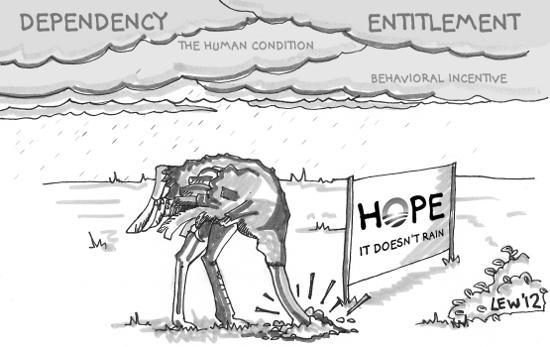
Dependency and entitlement: whose head stuck in the sand?

The 47% video has highlighted a sharp difference in worldview between conservatives and advocates of fairness/social justice.  The deep outrage we’ve seen within the latter group suggests an unwillingness to accept that entitlement and dependency are real phenomena stemming from human experience.

Just as with Mr. Obama’s “You didn’t build that” snippet, we could get lost in parsing what Mr. Romney meant.  But the stakes are different here.  If Mr. Obama is culpable for his quote, it is more a matter of worldview than of character.  But if Mr. Romney is guilty in the way sensationalists claim, then we must believe that he has a shriveled heart that is little more than a black lump of coal.  This is just absurd given his sacrifices and dedication to family, church, and country.  So we can and ought to dismiss this cartoon version of Romney.

The real question is not whether all of the 47% feel entitled and are dependent, but whether anyone in the group could be characterized as such.  Of course no one really thinks grandma or a worker retired on disability suffer from a sense of entitlement.  But this is precisely the interpretation mainstream journalists have been running with all week.

Such a hard prosecution is one half an insidious double standard.  On the one hand, the commentariat is completely okay suggesting that affluent Mr. Romney is out of touch, doesn’t care or relate to everyday struggles, or even that he wants to “pull the ladder up” behind him.  On the other hand, it’s utterly unthinkable to suggest that even one poor or working class person might be beholden to entitlement or dependency.  Per the dictates of political correctness, to do so would be an unconditional surrender to the worst bias and stigma.

This rule cannot persist.  Lest we go the way of Greece, our public discourse must accommodate some way of talking about these very real problems.  Rich, poor, and middle class folks are created equal in a real sense.  Across the dividing lines, all have intuition and faculties of reason.  The discipline of economics operates on the assumption that we are all rational creatures, agents who, whether consciously or not, respond to incentive.  We couldn’t escape it even if we tried.  Yet, big government politicians and guilt-ridden journalists would rather ditch this common sense understanding of humanity for the comfortable materialist fantasy that they took up at university and never quite abandoned.

There are all sorts of ways to describe the perils of incentive that effect the wide umbrella of welfare and entitlement transfers the federal government offers: rent seeking, moral hazard, tragedy of the commons, crowding out, rising expectations.  People’s behavior changes in response to conditions.  The sputtering, moribund economies of many European social democracies attest to what happens when workers secure the right to too generous a menu of entitlements.

Those who have seized on the 47% comments have highlighted a dangerous state of denial in our country.  Dependency and entitlement are heavy clouds that threaten to burst cultural and economic disaster on us.  The way some react to these words though make it seem as if their heads are stuck in the sand.

Mitt eats vegan burrito in his “Darkest Hour”

In the wake of the great, surreptitiously recorded Romney fundraiser video, the media continue their long stumble in the wilderness. Rather than press on policy, they pursue the “process story.” Just look to the Washington Post, which in declaring “Mitt Romney’s Darkest Hour,” proceeds to analyze how analysis will lead to soul searching and second-guessing (these in themselves being more analysis). This is supposed to doom Romney–but not definitively.

At Yahoo News, Holly Bailey continues her embedded coverage on the Romney plane. She maintains the edgy style that Ron Fournier sullied the Associated Press brand with in 2008: ditching the pretense of neutrality for moody framing devices and the liberty to issue gut calls.  Ever out to paint Romney as dry and lame, the most valuable detail in one of Bailey’s recent reports was what Romney had for breakfast: a vegan burrito.

What madness is this: using so many words to say nothing at all. Good thing newsprint today is made of electrons instead of wood pulp.  It lessens the waste.  All too many journalists dwell on trivia while major questions, such as what President Obama really intends to do about this anemic recovery, go unasked, let alone unanswered.

Higher up at Yahoo News, the slide continues apace. Once, stories from AP, AFP, and Reuters populated the front page. Now, almost every “news” link there takes the reader to one of Yahoo’s many branded blogs.  And from the looks of things, the leanings of recently sacked political editor David Chalian are still intact. It was he who remarked over an open mic during the Republican National Convention, “They are happy to have a party with black people drowning.”

Away from the open mic, writers signal subtle derision toward the Least Favored Candidate.  A blogger at Christian Science Monitor’s Decoder Wire responds to Romney’s 47% remarks with an “Umm, OK.”  Follow that with a cherry-picked characterization of the governor as a “plutocrat.”

So is the revelation of the 47% video Romney’s “Darkest Hour?” Conservatives seem to be shrugging it off well enough. Per Bailey’s report, Romney was all smiles, burrito eating aside.

One might point to pseudo-conservative David Brooks’ disappointment with Romney.  He compared  the governor to Gilligan’s Island character Thurston Howell, III.  This led MSNBC’s Dave Weigel to tweet, “When you’ve lost David Brooks, you’ve lost middle America.” A responding tweet set the record straight: “BS. When you’ve lost Brooks, you’ve lost weaselly coastal elites.” After all, David Brooks is the Alan Colmes of All Things Considered: a weak ideological opponent trotted out to slake the blood lust of a partisan audience.

The mainstream media will continue to bury Romney with process stories as long as the news industry’s systemic jet stream will allow it.  But neither apocalyptic visions, ad hominem attacks, nor mundane meal descriptions will satisfy undecided voters who want to make a real, informed decision come November.  Those who look beyond the superficial potshots to answer questions of character and policy will find Mr. Romney to be wholly worthy as our next commander-in-chief.