The Gipper on Obama’s Cold War mind warp

How about that Democratic National Convention?  While the Left heaped praise on Bill Clinton’s speech, media generally opined that President Obama’s was muted and relatively unimpressive.  No promise of a sweeping agenda, but a plea to hang on because things are moving in the right direction.  Never mind that, per the historical record, the recovery should be moving much more briskly.

One of the most memorable moments of the President’s speech came when he attacked Mitt Romney for being “stuck in a Cold War mind warp.”  As he tells it, Governor Romney wants to return to a time of “blustering and blundering.”  This is a rather unfortunate way for President Obama to describe the most significant–and a greatly triumphant–chapter in American history.

Think of the man who had the biggest role in leading America to victory in that nearly five decade showdown between freedom and tyranny: Ronald Reagan.  His greatest speech (transcript and YouTube) was called “A Time for Choosing.”  In it, he reminded Americans of their country’s exceptional worth and the tremendous stakes of a prolonged conflict with the Soviet Union.  In retrospect, Americans today can rightly claim a fulfillment of what Reagan called “our rendezvous with destiny.”

But for the media and Democrats, “blustering and blundering” suffice for a label.  The tendency on the Left has always been to trivialize national security concerns.  At the heart of the liberal worldview, communists, jihadis, and so on are ultimately well-meaning, misunderstood types.  But Reagan had it right.  There have been and will continue to be dire times when serious foes will work to end our way of life.  Appropriately, these moments are “a time for choosing.”

This past Spring, Mr. Obama made a choice of sorts when he announced his flexibility for Mr. Putin after the election.  Granted, Russia is not the committed ideological foe it once was, but it has hardly been a global Boy Scout either.

There is another way in which Obama erred by his “mind warp” comment.  The Cold War was not just an arms race, but the ultimate game of statist one-upmanship.  Recall Lyndon Johnson’s “Great Society.”  The world’s superpowers were out to win prestige in every arena, including who could build the biggest, shiniest welfare state.  In large part, the heavy expenditures and extensive central planning required for this contest buried the Soviet bloc.  Even social democracies like the once mighty Great Britain had to change their tack.

In America, the 1970s shocks of the OPEC crisis and stagflation disabused many of the welfare state utopia.  President Reagan proclaimed the following decade: “In this crisis, government is not the solution to our problem; government is the problem.”  And in the 1990s President Clinton conceded, “the era of big government is over.”  And in the time since, conservative governments from Scandinavia to Canada have improved their economic fortunes by shifting policy to the right.

Of course there are those who still haven’t gotten the memo.  It would seem that President Obama, who has yet to demonstrate meaningful concern for the debt, is one such person.  When it comes to engorging the superstructure of the welfare state, Mr. Obama has shown himself to be the one stuck in a Cold War mindset.
The half-life of racism

Attorney General Eric Holder made a bit of a splash when speaking at Columbia earlier this year.  He told the audience at his alma mater that he could not imagine a time when the need for racial preferences like affirmative action would cease.

So at what point does racism stop mattering in American life?  Perhaps you’ve entertained this question before.  If government, civil society and churches have been laboring against this great sin for decades, is there anything to show for it?

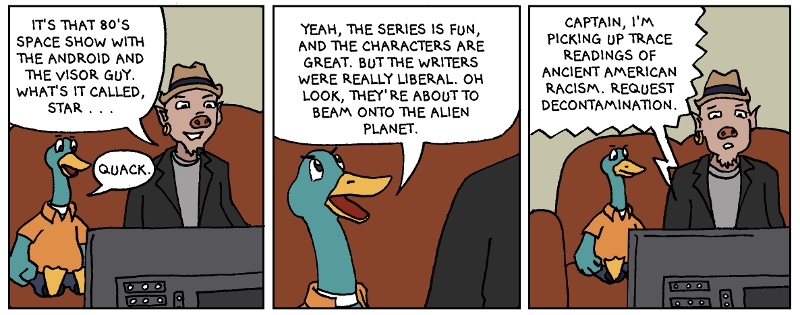
Surely, in 300 years, after our great-grandchildren are deceased, the old, nasty attitudes so prevalent before the Civil Rights era will have been expunged.  But if not, there will be sophisticated equipment–maybe like a Star Trek tricorder–to empirically identify any remnants.

For now, we are lucky to have wagging tongues like Chris Matthews to tell us when someone is being racist.  Or, we can just as well heed the dire warnings of speakers at this year’s Democratic National Convention.

Anyone who genuinely seeks a substantive discussion of issues, such as our raging national debt or the proper scope of federal government, has required a little patience in dealing with smokescreens thrown up by progressives and Democrats.  We know these as racism, the war on women, homophobia and so on.

The identity politics fiefdom built on these “wedge” issues is troubling in how it treats people in need as abstractions, not individuals.  The long history of progressive prescriptions affirms the ineffectiveness of promises perennially extended toward these abstracted victims.  President Johnson launched a “War on Poverty” in the 1960s, but the numbers of poor and dependent have reliably increased in the decades since.  Why should we think that President Obama, in spending ever more sums on the same problems, will change that?

While some conditions haven’t improved, there has been tremendous progress on societal attitudes.  Among those born after the tumult of the 1960s, the ideal of “equality” crowns the paramount virtue of “tolerance.”  But many remain beholden to the hope that just a little more money to social programs, a little more Ad Council propaganda, will actually change conditions for the abstraction.

What if these well-intended moves crowd out the healthy habits and cultural capital necessary to the success of the individual?  These, not the wasteful expenditures of federal welfare programs, are what can change conditions on the ground.  But to assess this soberly will require a little distance from the crooning promises of “Hope and Change” or MSNBC’s alarmist cries of “racism!”

Would it be safe to say that, in America today, we’re beyond the half-life of racism or patriarchy?  Existential struggle against oppression need not trump every policy consideration.  As I noted recently, a diverse lineup of thought leaders in media and at this year’s Republican National Convention have given us hope that we’re past that point.  For the sake of true progress, and the issues that really matter, I hope November will reflect a similar move among the population at large.

Fearing the rhesus revolution

It’s an exciting time.  The Republican National Convention is about to start.  This is Romney’s chance to shine.  But the press has been stuck on the narrative that unwelcome events keep the GOP off message.  This is where media malfeasance has steered us, to meta-news, news about news.  Who is responsible for determining what the media covers?  Whoops, we’re not supposed to ask that kind of question.

The New York Times Magazine commemorates the advent of the Republican convention with a dour examination of the host city, Tampa, Florida.  Writer John Mooallem brings us the saga of a renegade rhesus macaque.  As he tells it, this indomitable monkey has become a sort of resistance symbol and a focal point for anti-government sentiment.

From start to finish, he peppers the piece with liberal complaints.  Opening up, he finds fault with the American flag flying over a local restaurant.  It’s “preposterously large.”  He reveals that, en route to covering the story, he tortured himself by listening to conservative talk radio.  From what I can tell, he’s done this for no other reason than to complain about it in writing afterward.

With respect to the monkey controversy itself, Mooallem makes his sympathies very clear.  He’s supportive of the Florida Fish and Wildlife Commission, who the locals see as “the Gestapo.”  The writer’s sentiment crystallizes in this assessment of the state officers:

But they took a somewhat traditional view: the American people had a right to be protected by their government from wild monkeys. It was disorienting to watch the people of Tampa Bay champion the monkey’s rights instead.

That an idea like freedom might trump the public order deeply troubles him.  To counter such libertarian exuberance,  he quotes one man’s stern warning: “Sometimes, freedom isn’t necessarily a good idea.”  In true liberal fashion, the writer is most at home expressing his convictions as an equivocal miasma.

Nonetheless, he seems to advance a genuine concern about public order and safety.  Mooallem unmistakably condemns Tampans’ refusal to cooperate with the animal control agency.  But I suspect he doesn’t feel the same way about the Holder Justice Department’s bitter reluctance to enforce federal deportation laws.  Per his metric, why shouldn’t the prospect of fellow humans living an uncertain, shadow existence elicit the same kind of concern?

At any rate, pieces like Mooallem’s are the Sunday afternoon grist that Northeastern cultural elites relax by.  Harper’s, Atlantic, The New Yorker, anything that will allow them to look with detached pity and concern upon their benighted countrymen in the far flung regions.

I recall a long-running TV ad from some years ago.  In an effort to get the viewer to subscribe to the weekend edition of the New York Times, a woman would exclaim, “For me, that’s what Sundays were made for!”  Back then, I suspected this woman’s compatriots would profess that Sunday was “made” with a nobler purpose in mind.

With aching essays like the Tampa monkey expose, the folks at the Times demonstrate they are just as aloof of Middle America today as they’ve ever been.

Desperation drives divisive “War on Women” narrative

The Todd Akin controversy has buoyed Democrats’ “War on Women” narrative to a prominence not seen since last winter.  But even prior to Representative Akin’s “legitimate rape” utterance, the party and its allies have been stoking an unfounded fear that Republicans are out to take women’s reproductive rights away.

Consider this 30 second Moveon.org TV spot from a couple weeks ago.  Go ahead and click, it’s a must-see.  The theme is class war, but there’s an out-of-the-blue jab about birth control at the end.  If the NRA is guilty of drumming up a fear of “gun grabbers,” MoveOn.org has one-upped them with the invention of the “pill grabber.”  The childish tone and groundless substance of the ad–it cites a recent, highly speculative Tax Policy Center study–insult the intelligence of all but the most ardent leftists.

Another ad from early August, approved by President Obama, features a montage of women who “think” Romney is “out of touch” and “extreme.”  One chides, “this is not the 1950’s.”  All the while a wind instrument registers gentle yet overwrought notes of concern.  A woman concludes the ad by saying “I think Romney would definitely drag us back.”  With these words, what else can the viewer envision but a grunting troglodyte, club in hand, taking women forcibly to his patriarchal cave?

And now with the Akin kerfuffle, Sandra Fluke has egged on Obama supporters with the idea that Romney and Ryan are in “lockstep” with the Missouri Representative.  But this allegation cannot stand after a Factcheck.org refutation of a recent Obama “Truth Team” claim.

Yet a real undercurrent of popular fear exists.  We glimpse it in Virginia Heffernan’s recent piece on Akin’s comments.  She offers this take on John Edward’s divisive “two Americas” rhetoric:

The twist is that in this election year one America is female and the other male. In the female one, rape—nonconsensual sex as designated by the party that didn’t give consent—is everywhere, wrecking lives and making sexual harmony impossible. In the male America, “rape” is a subject of jokes and pontification. It’s a trope to be employed wantonly with the boys and judiciously when you’re trying to seduce women.

Herein Heffernan amalgamates the gross offense of comedian Daniel Tosh with that of politician Todd Akin.  She condemns American men to the prevalent stereotype of the perennial adolescent.  Anything they say on the matter of rape must be a joke or mere “pontification.”  For the sake of civil discourse, we must refuse the implication that race, sex, or any other status can on its own disqualify one’s views from consideration.

For those who would transcend sensationalism in an attempt to understand what Akin said, The Wall Street Journal’s James Taranto has shed some light.  Here at least is an effort by a brave man to do more than call Akin’s remarks “antediluvian” or reflexively blame “junk science.”  Taranto does better to label the doomed Senatorial candidate “Middle Ages Man.”

Make no mistake.  Akin went beyond his ken of understanding and properly merited a massive rebuke from his own party.  Given the swift and wide disowning this week, is there really some greater malevolent shadow at work among men, Republicans, or whoever else Democrats have being pointing fingers at?

The AP has been excessively charitable in interpreting Democrats’  fear-based, divide-and-conquer strategy as “pointillist” in nature.  But when the party and those who imbibe their views regularly invoke images of cavemen, boorish adolescents, and pill grabbers, it’s not out of line to conclude that, far from “Hope and Change,” it is desperation that drives today’s Democratic party.

Shared sacrifice

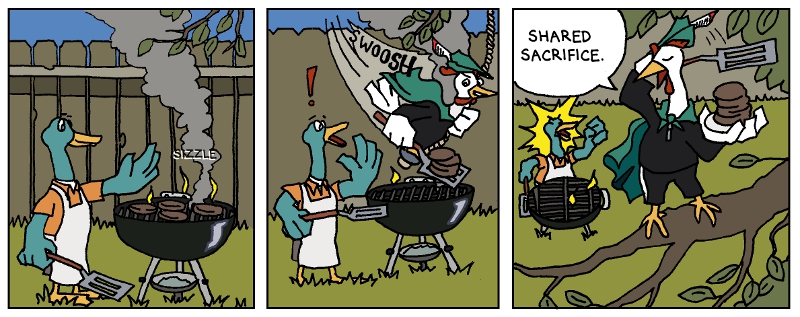
President Obama unfurled a new school yard taunt this week, calling his challenger “Romney Hood.”  The moniker piggy backs on a study crafted by definitively left-leaning groups that presume to know the details of Romney’s future budget proposals.  Supposedly, Mitt Romney will balance the budget on the backs of the middle class.

But if anyone is taxing the middle class, it’s surely President Obama.  After all, the Supreme Court ruled in June that the penalty component of his Affordable Care Act is for all intents and purposes a tax.  Many who will be paying the new tax will be younger, less-established workers, the up-and-coming who are in many ways at the heart of economic growth.  That is, unless a Republican President and Congress are able to intervene at the start of 2013.

Is the “Romney Hood” label even fitting?  Maybe if you interpret the hugely successful capitalist as Atlas Shrugged pirate Ragnar Danneskjöld, a man who steals from corrupt “people’s republics” and bequeaths gold bars to cloistered industrialists.  However, the “tax cuts” that President Obama perennially refers to are not stealing from anyone.  Continuing with the ten-year-old, boring, existing rate is merely allowing high income earners to keep more of what is rightfully theirs.

If we examine the President’s rhetoric about income and wealth, it’s clear he has little real regard for the deep American tradition of ownership, particularly that which comes from “earned success.”  Consider his 2008 retort to Joe the Plumber, that all he wants to do with the little extra taxed income is “spread the wealth around.”

In 2010, and even into 2012, the President repeatedly sprinkled his speeches with references to “shared sacrifice.”  This is meant to conjure up thoughts of selflessness and nobility: folks who step up and offer voluntarily for a good cause.  But how are new taxes “sacrifice” when they are ultimately collected at the barrel of a gun?  This rhetoric ought to be seen as embarrassing and sloppy by all observers.  The rights to the fruits of one’s own sweat and toil, time and treasure are ultimately discarded by such a line of reasoning.  Utterly chilling.

If what we’re concerned with is a green-hooded robber running around in the woods and seizing wealth, we should be more wary of the man who has spent the last three and a half years in the Bully Pulpit than we should be of his challenger.

Chick-Fil-A and the language of (in)tolerance

A few days ago, Boston mayor Thomas Menino told burgeoning restaurant chain Chick-Fil-A it was not welcome in his city.  Responding to chain president Dan Cathy’s personal opinions–on city letterhead, no less–he decried the restauranteur as “prejudiced,” insisting there’s no room in Boston for “discrimination.”  He concluded that to allow Chick-Fil-A in his city would be an “insult” to gay couples whose marriage ceremonies he proudly presided over.  Fellow mayor Rahm Emanuel soon tried to one up Menino by appealing to “Chicago values,” an incredible claim for a place which, politically speaking, is a values wasteland.

Menino’s letter in particular is unwarranted in its use of charged language.  He and his allies have read base motives into Dan Cathy’s recent comments, which were issued earnestly in a radio interview.  If you listen, it’s clear he’s not hopped up on hate, or motivated by bigotry; his words flow from a reasoned, sincere conviction.  Neither has his company been yet charged of legally-actionable discrimination.  The mayors and their fellow critics are free to dislike Cathy and his firm, but while their claims of prejudice and discrimination go unsubstantiated, they cannot be taken seriously.

Some have justified their indignation by pointing to Chick-Fil-A’s past charitable contributions.  Media reports (here, here, and here) have alternately labeled Cathy, the company, and the donation recipients as “anti-gay” for ultimately opposing same-sex marriage initiatives.  But within these reports, the label goes unexplained and unchallenged.  The reader must naturally take it to be descriptive of one who is against gay people themselves, an utter slander that people of good will ought to reject.

In a similar fashion, the broad, vague charge of “homophobia” came with coverage of Google’s recent “Legalize love” campaign.  To call one homophobic is just as destructive to discourse, as it imparts a motive of irrational fear to the one being described.  In popular usage it is synonymous with hate.

These words ought not to be bandied about by press claiming fairness and objectivity.  Yet, media have a long, bad habit of describing conservatives as phobic and painting them in “anti” terms, as in anti-abortion or anti-spending.  Pro-choice advocates are never referred to as anti-unborn or anti-child.  Deficit spenders are never called anti-frugal.  This is a function of the Orwellian intersection of the tolerance paradigm and positive rights.  Tolerance as presently understood never allows us to question the ever-expanding field of rights, even though reason assures that absurdity must ensue at some point.

Those who want real tolerance have to abandon these loaded terms that implicitly judge the hearts and inner motivations of other individuals.  The hypocrisy of using such labels hurts one’s own cause as much as the conversational climate at large.

Fortunately, the mayors have backed off a bit from their testy declarations.  As the controversy continues to roil, may more people become cognizant of the language used, and realize that same-sex marriage opponents should not be automatically equated with bigots.  We all carry our own personal experiences, shadowboxing with traumas of the past.  Let’s not allow these to cloud an important and necessary conversation.

Water bottles and other campaign debris

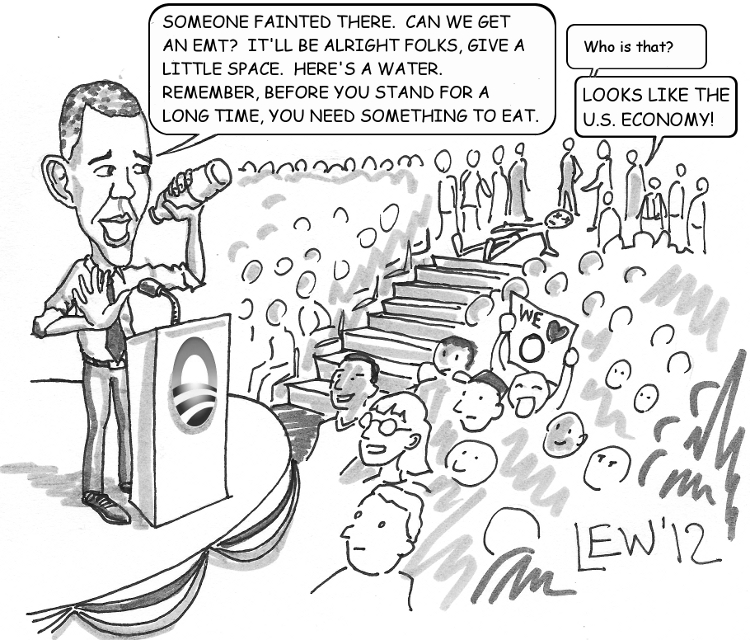
Ever since 2008, conspicuous fainting episodes have occurred with bizarre regularity at President Obama’s campaign rallies.  Some wider attention came earlier this week when Obama, who offers a consistent, canned response to these potentially serious collapses, inadvertently called for a “paralegal” instead of a paramedic. Michael Medved, who has documented this phenomenon since the beginning, has a good point regarding the displays: how does the Commander-in-Chief know it’s just a swoon and nothing more serious?

The fainting routine, with Mr. Obama’s predictable admonition to eat food, drink water, and remain calm,  is quite possibly meant to bolster his image as a confident, competent leader. He can have own mini Bush-with-a-bullhorn moment, giving gentle nanny state prescriptions that earn laughter from the adoring crowd. But one Medved caller this week had an alternate take: with the president habitually 20-60 minutes late to appointments, and belting out stump speeches nearing an hour, it would be no surprise if the fainting fans were genuine and not crowd plants.

Why do mainstream journalists, the “dinosaur media” if you will, turn a blind eye to Obama and his fellow Democrat’s campaign gimmicks?  Who knows what other minutia have gone undocumented while the media combs over Romney’s vacation photos, his financial arrangements, and his 1999-2002 status at Bain?

Of course it’s the substance and not the minutia that matters.  Yet, it was with some pain that I learned of new–if trivial –criticisms from two Hollywood geek icons.  Mark Hamill, the actor who played Luke Skywalker in Star Wars, recently knocked Mitt Romney as “not human.”  His critique hinged on how awkwardly the governor responded to a sip of lemonade.  Really?  Hamill’s observation rivals Matt Damon’s fearful, perhaps bigoted babble from 2008 that managed to mention Sarah Palin, dinosaurs, and nuclear codes in the same breath.

Giving good company to Hamill is Wil Wheaton, who played the star ship’s resident whiz kid on Star Trek: The Next Generation.  He took the occasion of a recent George Bush interview to lament the loss of life and treasure the 43rd president instigated with a “war of choice.”  It’s regrettable the actor doesn’t understand that jihadis have free will or that all wars are embarked upon as a deliberate exercise.

The men who once played space teens on film and television can now–fittingly enough–join Cher, who apparently left Earth so she could avoid breathing the same air as Mitt Romney.  Celebrities’ reflexive gags make nice conservative water cooler talk, but they also indicate just how impervious some sections of the country are to reality.

Let’s return from our Hollywood excursus to Washington, where we get a different taste of the same liberal worldview.  The media, after four days of burying its head in the sand, has reluctantly picked up on President Obama’s “You didn’t build that” gaffe.  And while ABC moved quickly to paint it as out of context, The Wall Street Journal’s James Taranto insists the gaffe was a genuine betrayal of a deeply liberal inner attitude.

If you read the wider quote from Obama, Taranto has solid reasoning: “that” refers to the singular and proximate “business.”  Obama would have said “those” if he were referring to the earlier bridges and roads.  Yet, I would entertain the possibility of a simple slip up, since “you didn’t build that” has more of a rhetorical impact than “you didn’t build those.”  It also reminds us of MC Hammer’s sweet refrain, “U can’t touch this.”

Is all this attention unfruitful nitpicking?  Not inasmuch as it draws focus to the real and gaping philosophical chasm that separates Democrats from Republicans.  Undeniably, economic policy is ultimately driven by a sense of who “owns” growth and success.

What does lack substance is the liberal canard that the rich need to “pay back” for all they’ve been given.  Not that Republicans deny a need for some government in the first place!  High income earners already pay much more than the rest of us under our already progressive tax regime.  And all the while, we can’t deny the abounding opportunity that many of those earners’ businesses provide.

There is no need for top income earners to pay “us” back or forward, for that matter.  But we could use comprehensive tax reform, a closing of loopholes and lowering of rates that Romney and a Republican Congress will deliver if elected.  If only our electorate can navigate the field of campaign season debris first.

Two Trons, Four Freedoms

After Governor Scott Walker’s June recall victory, blogging compatriot Cosmoscon shared some choice tweets from the Left.  One that really grabbed me was this spurious Abraham Lincoln quote:

“If any man tells you he loves America, yet hates labor, he is a liar.”

The line is simultaneously funny and sad.  The adversarial unions we know today were scarcely extant, let alone popularly identified by the “labor” moniker, in President Lincoln’s lifetime.  It’s ironic that a movement sheltering so many of the work-averse (rubber rooms, anyone?) would brandish a quote that, properly construed, endorses hard work.  True to that irony, those at the bleeding-edge of the quest for expanded labor rights end up calling for a fantastically impossible feat: the abolition of work itself.

“Labor” is not the only word that lends itself to sociopolitical confusion.  People sometimes get caught up in an equivocal use of the word “free.”  On the one hand, it means for some agent the liberty of movement, thought or action.  On the other, it can refer to a null price of acquisition, that is zero cost, gratis.  Occasionally, the vital distinction between these two meanings is blurred in the popular imagination, as with the 2010 blockbuster Tron: Legacy.

Two Trons

The original Tron, released in 1982, came on the heels of serious Soviet Bloc upheaval; just the year before, the Polish Solidarity labor union secured a degree of independence from Communist control.  This dramatic feat of defiance would have been fresh in the minds of moviegoers.  Tron is not merely anti-authoritarian but anti-Communist.  A theistic theme evinces in the eponymous hero’s mantra, “I fight for the users!”  The oppressed programs know they’ve been endowed with purpose greater than the totalizing and centralizing dictates issued by the Master Control Program.  Incredibly for Hollywood, the story ends up affirming property rights: the protagonist Kevin Flynn eventually regains credit for his programming masterpieces, which had been stolen from him.  There’s no mistake that when the characters speak of “freedom,” the classically libertarian ideal is in mind.

Fast forward to the compromised 2010 sequel, Tron: Legacy.  Early in the film, we find that in Flynn’s mysterious absence, his software company has burgeoned into a Microsoft-like leviathan, profiting by frequent commercial releases of an utterly worthless operating system.  Flynn’s son wants to honor his disappeared dad’s ideal of “freedom.”  But the story writers have revised this to mean advocacy of freeware, as in products distributed for zero cost.  On this paradigm, the work of producing software does not arise from the need to make a living, as in labor, but from boredom, altruism, or some other motive conceived in leisure.  In the sequel, the meaning of “freedom” lurches Left.  It’s not just freedom of thought and action, but freedom from the need to even make a living.

How did Hollywood minds pull off this coup?  If you’ve seen the film, you know Flynn’s discovery of the Isomorphs: supreme, benevolent beings that emerge spontaneously from the digital vacuum and portend to cure all the world’s ills.  They are cinematic incarnations of Ray Kurzweil’s singularity prophecy.  Flynn’s cries in the wilderness about freeware and perfection of the human race are of course mere functions of the film’s indulgence of the fantastic.  Yet, among anarchists and cyberpunks, “libertarian Marxists” and singularity disciples, are those who really place faith in the idea that one day nice machines will magically do everything for us.

Four Freedoms

This confusion over freedom didn’t start yesterday.  Looking back in history, even our top policymakers were prone to conflation.  In his 1941 State of the Union address, President Franklin Delano Roosevelt proclaimed to Americans the Four Freedoms:

1. Freedom of speech and expression
2. Freedom of worship
3. Freedom from want
4. Freedom from fear

This progressive vision rallied a nation soon to be at war, but it is also a disastrous marriage between negative rights–government’s promise to do no ill–and positive rights, government’s guarantee to ensure good outcomes.  The sum of human experience and the duration of America’s Constitutional enterprise both attest to this: that it is practical and necessary for government to extend negative rights, but impractical and immoral to extend positive ones.

It may have been attractive to early progressives to follow Bismarck’s example in marshaling the state’s power to slake rising expectations.  But past the mid-century twentieth century high tide of statism, advocates of liberty, from Whitaker Chambers to Ayn Rand, F.A. Hayek to Ronald Reagan, began to rally against the absurdity of positive rights.  That rally is alive and well today in the American conservative movement.

Unfortunately, too many remain beholden to Roosevelt’s proposition that it is government’s job not just to leave us free in our speech and worship, but to save each of us from the vagaries of poverty, hunger, and emotional distress.  These expectations ignore the finitude of government’s ability to help; no single human institution can guarantee positive rights to all.  The pursuit of happiness is necessarily a prerogative of individuals and their free and natural associations.

The best governments respect human nature, extending negative rights while withholding positive ones.  Disgruntled publics that demand otherwise, to be free from austerity and to be free from market forces, are really asking to be free from personal responsibility.  Absurd on its face, this kind of agitation always merits a facepalm.

Constitutional curve ball

For politicos, the Obamacare decision was something of a “Where were you when . . . ?” moment.  Surprisingly, Chief Justice John Roberts–not Justice Anthony Kennedy–was among the upholding majority.  And the mischievous wording of Robert’s majority opinion memorably made the breakneck news cycle stop for just a couple minutes as reporters rushed to divine the arcane document on live television.   CNN even embarrassed itself (and FOX less so) with a Dewey defeats Truman blunder, but I doubt it will be remembered as long as the original.

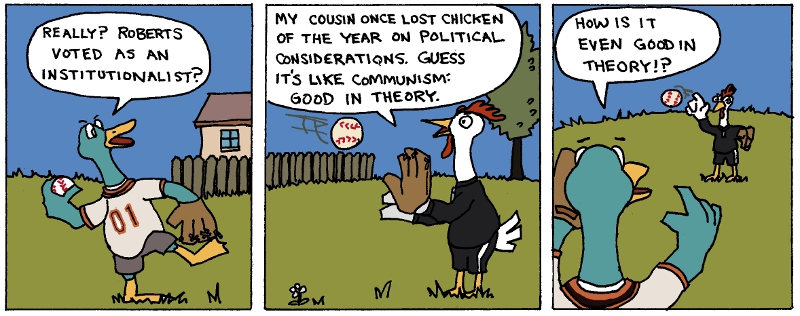
Throughout the day I caught a few whiffs of this idea that Roberts’s institutionalist inclination was coming through.  That is, he voted the way he did to spare the Supreme Court from allegations it had succumbed to an intractable polarization along party lines .  It was batted around on NBC’s live coverage, and resurfaced for the evening’s All Things Considered.  Hard liberal Robert Reich presciently cited this institutional loyalty a day in advance.  Supposedly, John Roberts is not even the first chief justice to spike his vote in the hope of saving the court’s influence.

If this protective phenomenon of institutionalism is real, isn’t it self-defeating in practice?  It would seem the court is compromising its deliberative process in order to not appear compromised.

Yet, short of Justice Roberts being interrogated with truth serum, the institutional motive will probably remain just speculation.  There’s been profuse coverage and the decision’s dissection will only become more detailed and complete over time.  I cannot pretend to be an expert on jurisprudence, so I trust those who say Roberts had good reason for pegging the mandate as a tax.  Indeed, it may have been more a pebble in Democrats’ shoes than a charitable move.

It seems at this point that the GOP has been invigorated considerably by the shock that for some is also accompanied by a sense of betrayal.  I’m surprised that there are still holdouts coming out of the woodwork to support Governor Romney.  It’s like those Japanese soldiers who only surrendered to American forces in the age of disco.  What a trauma that must have been.

The response on the Right, including over one million spontaneous dollars taken in by Romney’s campaign today, is encouraging for those who hope to roll back the collectivist tide.  It seems conservatives have their own way of going “Forward.”

Democracy of the dead

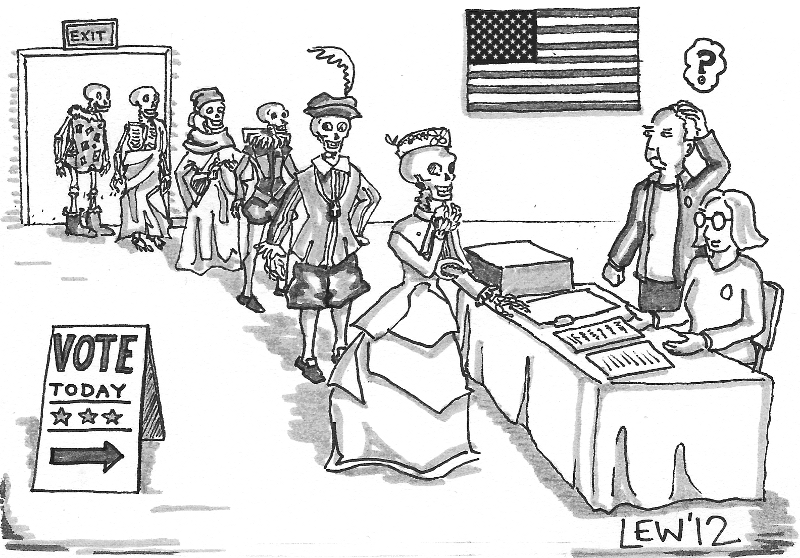
What is democracy of the dead?  No, it has nothing to do with zombies voting Democrat.  Although recently a dead dog did receive a voter registration form.  What I’m referring to comes from that emir of aphorisms, G.K. Chesterton.  Consider this idea from Orthodoxy (also available as a free PDF):

Tradition may be defined as an extension of the franchise. Tradition means giving votes to the most obscure of all classes, our ancestors. It is the democracy of the dead. Tradition refuses to submit to the small and arrogant oligarchy of those who merely happen to be walking about.

That those many souls who came before us might not have been complete fools is a refreshing perspective in our age of progress for progress’ sake.

Chesterton–himself now among the dead–enriches our idea of tradition with literary wit.  Meanwhile, Thomas Sowell  provides us a more rigorous understanding, by way of broad philosophical survey in A Conflict of Visions.  Looking to English arch-conservative Edmund Burke, Sowell posits “the constrained vision” : a philosophy that directs human society to seek “cultural distillations of knowledge” within the confines of a “tested body of experience.” The idea is not a mere impulse to conserve tradition, but an acknowledgement that wisdom flows down naturally and systemically through culture, from one generation to the next. Between Chesterton’s democracy of the dead and Sowell’s constrained vision, we glimpse what may be the most appropriate definition of conservatism.

Not everyone is so fond of tradition. There are those invested in seeing each generation break free from the tyrannical chains of its ancestors. Consider this inscription at the Jefferson Memorial:

I am not an advocate for frequent changes in laws and constitutions. But laws and institutions must go hand in hand with the progress of the human mind. As that becomes more developed, more enlightened, as new discoveries are made, new truths discovered and manners and opinions change, with the change of circumstances, institutions must advance also to keep pace with the times. We might as well require a man to wear still the coat which fitted him when a boy as civilized society to remain ever under the regimen of their barbarous ancestors.

Progressives should be quite fond of Thomas Jefferson’s thinking here. He speaks of humanity’s “progress” and how it will “advance” from a “barbarous” state.  Just as he took scissors to his least favorite parts of the Bible, there are those today all too eager to make their own redactions to the traditional moral fabric.  Take New Atheist Sam Harris.

In a 2011 debate on the foundations of morality, Harris dismisses the God of the Bible as a mere “Iron Age god of war.” His epochal delineation recalls the popular formulation that certain Abrahamic belief systems may have been tolerable enough for goat herders or a pastoral society, but are utterly unsuitable for our modern age.  A bit later in the same debate, Harris insists that anyone today could come up with a moral code superior to the Mosaic law if given five minutes’ thought.  So much for his estimation of past wisdom.

Whether inspired by the Enlightenment or the New Atheists, there’s no question modernist arguments hold serious sway over the contemporary mind.  But postmodern sensibility won’t tolerate the sweeping assumptions.  For all the aspersions the modernist might cast on the dead of generations past, the postmodernist would be right to call him “judgmental.”

The critique is rooted in history.  From gas chamber genocide to the threat of thermonuclear annihilation, the distinctives of the twentieth century disabuse us of the naivete that mankind is steadily rising above some past state of barbarity. To characterize people long-gone as “barbarous” or less thoughtful than those living today is to ignore a twin loss of epistemic and moral confidence the world has yet to recover from.

Where does that leave us?  We were never without hope.  Harris’ debate opponent, philosopher and Christian apologist William Lane Craig insists on the way: backward, not forward.  Modernity is overly confident in its presuppositions.  Postmodernity is quite useful at deconstructing worldviews, but not so helpful with building up a shared body of knowledge.  If we want to access the lasting truths about human existence, how to live, and how society was meant to be, we need to recover a premodern worldview.

Just think.  We’re all here kicking and alive today.  All those dead and buried folks of past generations must have gotten something right.