Atkin built that: Obama-MC Hammer mashup

Back in July I noted that “You didn’t build that” reminded me of MC Hammer’s “U Can’t Touch This.”  In case you caught a deep desire to see those two things mashed up, fear not.  It has been done.

This video by Hugh Atkin was shared by fellow WordPress blogger Nice Deb yesterday.


“U Didn’t Build That” is a pop culture and political humor gem.  I really love the dig at red-headed stepchild Google+.

Some justice might be done if the video could garner maybe even 10% of the views of internet meme juggernaut Gangnam Style.  A little levity to crack the armor of progressives’ Shining Knight would do wonders for a nation beholden to such an ugly and seemingly interminable political news cycle.

Carter’s Turn

You may recall that a couple of years ago President Barack Obama reached out to claim a piece of the Reagan legacy.  TIME even declared that 44 had a “bromance” with the Gipper.  How sweet.

Just a couple of weeks ago, President Obama was buoyed by Bill Clinton’s fiery, crowd-winning speech at the DNC.  But now with several U.S. embassies besieged or breached in recent days, it’s the memory of Jimmy Carter’s presidency that’s sticking to our present commander-in-chief.

President Obama’s recent Egypt-is-neither-ally-nor-enemy gaffe is especially remarkable given that Egypt’s allegiance to the U.S. has been a cornerstone of Middle East peace since the Carter administration.

Yes, Carter’s tenure was pretty awful.  But we should not forget that he deregulated some American industries in his time.  If you’ve enjoyed an affordable airline flight or a tasty microbrewery beer lately, you can be thankful for the few pro-market decisions he made.

In Obama’s three and a half years, we’ve seen a stiff reluctance to help American enterprise.  And in the foreign policy realm, he really hasn’t made the world like America any better.  His Nobel Peace Prize is still waiting for its justification.

Instead of leaving our economy or our national security to chance, let’s opt for a surer hand in November.  Let’s elect Mitt Romney.

Imbibe your worldview

Boy are politics ugly right now.  Let’s take a little break and grab a drink.  Maybe a coffee, a cola, or just some good old H2O.

Some months ago, as I was driving along my usual northern California avenues, I spied a beer delivery truck with a remarkable exhortation on its side: “Follow your folly . . . ours is beer.”  I thought to myself, there is a worldview captured in an advertising slogan.  The words are pithy and compelling to some targeted subset.  Whether they have an immediate, gut impact, or seep into our subconsciousness after repeated exposure, we’re not supposed to think too hard on them.

I thought it’d be fruitful to record more of these kinds of slogans as I came across them.  I haven’t been especially diligent in the task, but I’ve collected a couple more.  For whatever reason, they’re all tied to beverages.

Some mornings when I need a little pick me up, I get a coffee at the student-run campus coffee house.  Who knows how many times I blankly stared past the words on the paper insulating sleeve before they registered: “Brew what you believe.”  In this case, the convictions have something to do with the value of organically-grown products and “fair trade” practices.

Many folks support this kind of enterprise because they want to help impoverished, small-time farmers in the least-developed countries (LDCs).  But these boutique brands often do more harm than good by orienting producers toward transient, unsustainable, and distorted markets.  Accordingly, I am not really keen on the coffee vendor’s slogan.

So is there some drink-related catch phrase to which I might yet give mental assent?  Currently, Pepsi has a nice billboard on my morning commute.  You may be familiar with their latest marketing message: “Live for now.”  There is a certain appeal to this, if you’re at all aware of the “mindfulness” techniques and philosophy that have made their way from Eastern metaphysics and praxis into Western mind-body understanding.  Certainly, focusing on the present has a salubrious effect against anxiety and stress.  But then again, there is great value in looking to learn from the past and planning for the future.  Pepsi needs to clarify their position before I’m sold.

For now, the closest thing I might find to a beverage brand whose mantra I’d endorse would be the Credo House of Theology.  Yes, I visited Dan Kimball’s cool coffee-house-attached-to-a-church a few weeks ago, but from how Greg Koukl describes it, Credo sounds pretty dreamy to me.  So if they would package their own coffee and hatch a clever slogan, I’d go with that.

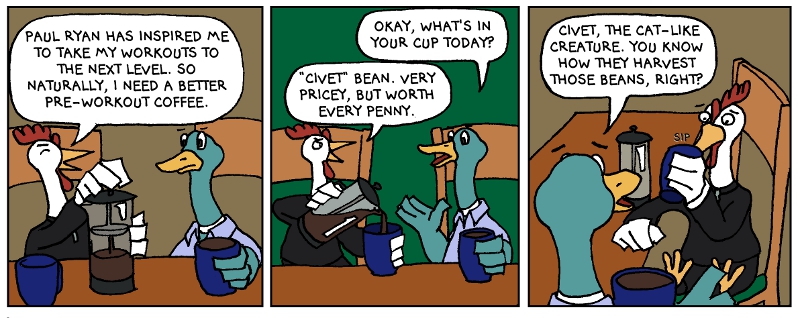
As for our chicken friend’s new java fix in today’s comic, you might find a little delight in the trademark expression of one civet bean vendor: “Kopi Luwak: Good to the last dropping.”

Can you think of any pithy worldview branding that has managed to capture your allegiance?

The Gipper on Obama’s Cold War mind warp

How about that Democratic National Convention?  While the Left heaped praise on Bill Clinton’s speech, media generally opined that President Obama’s was muted and relatively unimpressive.  No promise of a sweeping agenda, but a plea to hang on because things are moving in the right direction.  Never mind that, per the historical record, the recovery should be moving much more briskly.

One of the most memorable moments of the President’s speech came when he attacked Mitt Romney for being “stuck in a Cold War mind warp.”  As he tells it, Governor Romney wants to return to a time of “blustering and blundering.”  This is a rather unfortunate way for President Obama to describe the most significant–and a greatly triumphant–chapter in American history.

Think of the man who had the biggest role in leading America to victory in that nearly five decade showdown between freedom and tyranny: Ronald Reagan.  His greatest speech (transcript and YouTube) was called “A Time for Choosing.”  In it, he reminded Americans of their country’s exceptional worth and the tremendous stakes of a prolonged conflict with the Soviet Union.  In retrospect, Americans today can rightly claim a fulfillment of what Reagan called “our rendezvous with destiny.”

But for the media and Democrats, “blustering and blundering” suffice for a label.  The tendency on the Left has always been to trivialize national security concerns.  At the heart of the liberal worldview, communists, jihadis, and so on are ultimately well-meaning, misunderstood types.  But Reagan had it right.  There have been and will continue to be dire times when serious foes will work to end our way of life.  Appropriately, these moments are “a time for choosing.”

This past Spring, Mr. Obama made a choice of sorts when he announced his flexibility for Mr. Putin after the election.  Granted, Russia is not the committed ideological foe it once was, but it has hardly been a global Boy Scout either.

There is another way in which Obama erred by his “mind warp” comment.  The Cold War was not just an arms race, but the ultimate game of statist one-upmanship.  Recall Lyndon Johnson’s “Great Society.”  The world’s superpowers were out to win prestige in every arena, including who could build the biggest, shiniest welfare state.  In large part, the heavy expenditures and extensive central planning required for this contest buried the Soviet bloc.  Even social democracies like the once mighty Great Britain had to change their tack.

In America, the 1970s shocks of the OPEC crisis and stagflation disabused many of the welfare state utopia.  President Reagan proclaimed the following decade: “In this crisis, government is not the solution to our problem; government is the problem.”  And in the 1990s President Clinton conceded, “the era of big government is over.”  And in the time since, conservative governments from Scandinavia to Canada have improved their economic fortunes by shifting policy to the right.

Of course there are those who still haven’t gotten the memo.  It would seem that President Obama, who has yet to demonstrate meaningful concern for the debt, is one such person.  When it comes to engorging the superstructure of the welfare state, Mr. Obama has shown himself to be the one stuck in a Cold War mindset.

The half-life of racism

Attorney General Eric Holder made a bit of a splash when speaking at Columbia earlier this year.  He told the audience at his alma mater that he could not imagine a time when the need for racial preferences like affirmative action would cease.

So at what point does racism stop mattering in American life?  Perhaps you’ve entertained this question before.  If government, civil society and churches have been laboring against this great sin for decades, is there anything to show for it?

Surely, in 300 years, after our great-grandchildren are deceased, the old, nasty attitudes so prevalent before the Civil Rights era will have been expunged.  But if not, there will be sophisticated equipment–maybe like a Star Trek tricorder–to empirically identify any remnants.

For now, we are lucky to have wagging tongues like Chris Matthews to tell us when someone is being racist.  Or, we can just as well heed the dire warnings of speakers at this year’s Democratic National Convention.

Anyone who genuinely seeks a substantive discussion of issues, such as our raging national debt or the proper scope of federal government, has required a little patience in dealing with smokescreens thrown up by progressives and Democrats.  We know these as racism, the war on women, homophobia and so on.

The identity politics fiefdom built on these “wedge” issues is troubling in how it treats people in need as abstractions, not individuals.  The long history of progressive prescriptions affirms the ineffectiveness of promises perennially extended toward these abstracted victims.  President Johnson launched a “War on Poverty” in the 1960s, but the numbers of poor and dependent have reliably increased in the decades since.  Why should we think that President Obama, in spending ever more sums on the same problems, will change that?

While some conditions haven’t improved, there has been tremendous progress on societal attitudes.  Among those born after the tumult of the 1960s, the ideal of “equality” crowns the paramount virtue of “tolerance.”  But many remain beholden to the hope that just a little more money to social programs, a little more Ad Council propaganda, will actually change conditions for the abstraction.

What if these well-intended moves crowd out the healthy habits and cultural capital necessary to the success of the individual?  These, not the wasteful expenditures of federal welfare programs, are what can change conditions on the ground.  But to assess this soberly will require a little distance from the crooning promises of “Hope and Change” or MSNBC’s alarmist cries of “racism!”

Would it be safe to say that, in America today, we’re beyond the half-life of racism or patriarchy?  Existential struggle against oppression need not trump every policy consideration.  As I noted recently, a diverse lineup of thought leaders in media and at this year’s Republican National Convention have given us hope that we’re past that point.  For the sake of true progress, and the issues that really matter, I hope November will reflect a similar move among the population at large.

Muffin consumption pivotal issue in 2012. Really?

A writer who teaches at Columbia managed to file another subjective, liberal polemic with the New York Times the other day.  In the piece, the author invokes the memory of her deceased, Korean immigrant father to denounce . . . you guessed it, Mitt Romney.

And the decisive issue for Asian immigrants in 2012?  How one eats a muffin.

This time, the opinion writer drags us along an arc strewn with references to airline peanut packets and Burberry scarves, whatever those are.  She arbitrarily parks the words “Anglo-Saxon” in the vicinity of Ann Romney’s name, in a bald attempt to evoke from her readers whatever animus may have been deposited by past ethnic studies professors.

As for breakfast habits, the writer would have us believe that, for miserly immigrants like her father, they’re a game changer:

I can only imagine what he would have had to say about a presidential candidate so heedless he eats only the top off a muffin. No matter how loyal a Republican, my father would likely have declared Mr. Romney a very silly, profligate man — not the kind of man to be trusted with his precious tax money. Perhaps his vote would have gone to a Democrat for the first time ever. Politico has declared the Asian-American vote “key for both parties.”  Will muffin-top-gate cause other immigrant parents to join their Democratic-leaning children?

This passage, besides being an unrealistic fantasy, betrays the totalizing tendency of liberals.  That is chiefly, the conflation of private behavior with public obligations.  If a police officer tucks in his daughter at night with a tender kiss, does he become too gentle to chase and pin down a violent suspect the next day?  In the same way, how a businessman spends his own earnings has no connection with his performance at his day job.

Indeed, it was President Clinton who called Romney’s business record “sterling.”  Car elevators and the alleged discarding of muffin bottoms don’t erase the over 100,000 jobs and healthy profit Romney generated at Bain; neither do they negate his tremendous service to the Salt Lake Olympics.

And since we’re counting, let’s not forget all the penny-pinching, middle class markers of Mr. Romney: his “cheap” kitchen light bulb fix, the family vacations in a wood-paneled station wagon, and his regular trips flying economy class, even at the risk of air rage fisticuffs.

The appropriate scrutiny for this election is not on what a businessman does with privately-purchased muffins, but what a public steward like President Barack Obama has done with the people’s money.  An added $6,000,000,000,000 to the debt, the failed $800 billion stimulus (check the graph here), support of green flops like high speed rail and Solyndra, and an otherwise total lack of leadership on the federal budget make a better case for profligacy than any half-eaten baked breakfast good ever could.

If we’re going to talk muffin waste, Barack Obama has wantonly discarded untold dumpster loads of them, in the belief that he could always tax the muffin-rich or inflate his way out of the muffin debt.

So there we have it.  A mainstream publication continues to avail itself as a platform for utterly unconvincing liberal carping.  It would have been genuinely interesting to have an honest exposition of what ideas animated the writer’s allegiance to the Democratic party.  For now, the consuming public must be content with a couched, self-referential diatribe of cross-generational rebellion.  That, and whatever else the enlightened editors toss our way.

2016 and RNC: increasingly visible, minority conservatives buck liberalism

This past weekend, I saw Dinesh D’Souza’s 2016: Obama’s America.  It was playing on some 1,000 movie screens.  And this upcoming weekend, it will open up on a thousand more.  There’s been considerable coverage now that it’s broken into the weekly box office top ten.  Not only that, it’s at least the fifth highest grossing political documentary of all time.  Watch out, Michael Moore!

I have offered some critical words about D’Souza’s past work.  Just the cover of his 2011 tome, The Roots of Obama’s Rage, comes off as a psychoanalytical potshot.  But given the election year excitement and buzz, I thought I’d give 2016 a try.

Dinesh D’Souza travels the world to learn about Obama’s roots. 2016themovie.com

The film is well-produced, and acclaimed Hollywood veteran Gerald Molen can be thanked for that.  The music, not overbearing or manipulative as we might expect for a political documentary, lends an air of excitement and intrigue befitting the cosmopolitan journey.  After all, this is D’Souza’s “reading” (as my wife put it) of Obama’s globetrotting, cross-cultural upbringing.

D’Souza lays out a comprehensive case in the course of 90 minutes; undoubtedly, he has done his homework.  Polished graphics and dramatic cuts of D’Souza retracing Obama’s footsteps through Indonesia, Hawaii, and Kenya add grit and a kinetic potency to his “anticolonial” thesis.

A recent AP Fact Check–which Breitbart’s Big Journalism has answered–takes exception to some of D’Souza’s claims.  But the finer points of what Obama was exposed to at prep school or what his father’s old associates believe about Israel pale in comparison to the the core fact that the AP fact checker perhaps willfully overlooked.  This is the odd trajectory his white, American, maternal side of the family put him on.

Looking beyond the film for a moment, we can see the root of that strange trajectory.  President Obama’s maternal grandfather, Stanley Dunham, named his daughter after himself.  Of course, people mostly know her by her middle name Ann.

Back in the film, we see Ann’s radical values–adopted early in life–play out.  She rejects her Indonesian husband Lo Lo Soetoro because he cozies up to an American oil company and comes to oppose communists.  This telling is hardly the kind of “logical stretch” that AP’s fact check would have you believe the film is built on.

D’Souza’s most important revelation may be Obama’s “founding fathers.”  How he comes to know one of these guiding lights is particularly telling.  Young Barack’s grandfather Stanley Dunham  introduces a peculiar personal friend to be his mentor: card-carrying Communist (no. 47544) Frank Marshall Davis.

At one point in the film, D’Souza refers to Obama’s ideas as “alien.”  As cringe-inducing as this may sound, it is not a prelude to a radical right rant.  Neither is it a racist code or dog whistle.  After all, D’Souza is a mixed race immigrant from the global South.  That Barack Obama is black is merely an asterisk to the long-raging ideological struggle that lent his mother and grandfather strange ideas most Americans reject.

As important as D’Souza’s revelations are, we’ll find in 2016 a deeper significance.  It’s a film where a South Asian immigrant stars in a winsome, provocative telling of his own life as it contrasts with Obama’s.  During one prominent segment, D’Souza invokes the expert testimony of a fellow biracial academic, Shelby Steele.  Liberal Hollywood doesn’t hand us such a substantive, diversely-cast film everyday.  Sure, there’s Harold and Kumar, if Asian-Americans being depicted as stoners is somehow a good thing.

What 2016 accomplishes by featuring such thought-provoking minority conservatives is something neither the media, academia, nor the rest of our liberal cultural elites can stand.  This film is a very “brown” critique of the liberal worldview, and something I deeply appreciate as the son of a Southeast Asian immigrant myself.  Just as D’Souza relates his own college experience to spotlight the strange thinking of some Americans, I can recall absurd liberal expectations that I encountered as a college student of color.

Minority conservatives are to be found not just on screen, but on stage, at the Republican National Convention.  Speakers like Nikki Haley, Artur Davis, Condoleezza Rice and Susana Martinez have this year voiced their rejection of liberalism while affirming all that makes America powerful, decent, and good.

Nothing threatens the liberal worldview more than when its objects of sympathy and concern stand up, call it for what it is, and reject it.  As important as it will be in getting out the 2012 conservative vote, 2016 is,  perhaps more significantly, another nail in the coffin of liberal ideas whose time has passed.

Fearing the rhesus revolution

It’s an exciting time.  The Republican National Convention is about to start.  This is Romney’s chance to shine.  But the press has been stuck on the narrative that unwelcome events keep the GOP off message.  This is where media malfeasance has steered us, to meta-news, news about news.  Who is responsible for determining what the media covers?  Whoops, we’re not supposed to ask that kind of question.

The New York Times Magazine commemorates the advent of the Republican convention with a dour examination of the host city, Tampa, Florida.  Writer John Mooallem brings us the saga of a renegade rhesus macaque.  As he tells it, this indomitable monkey has become a sort of resistance symbol and a focal point for anti-government sentiment.

From start to finish, he peppers the piece with liberal complaints.  Opening up, he finds fault with the American flag flying over a local restaurant.  It’s “preposterously large.”  He reveals that, en route to covering the story, he tortured himself by listening to conservative talk radio.  From what I can tell, he’s done this for no other reason than to complain about it in writing afterward.

With respect to the monkey controversy itself, Mooallem makes his sympathies very clear.  He’s supportive of the Florida Fish and Wildlife Commission, who the locals see as “the Gestapo.”  The writer’s sentiment crystallizes in this assessment of the state officers:

But they took a somewhat traditional view: the American people had a right to be protected by their government from wild monkeys. It was disorienting to watch the people of Tampa Bay champion the monkey’s rights instead.

That an idea like freedom might trump the public order deeply troubles him.  To counter such libertarian exuberance,  he quotes one man’s stern warning: “Sometimes, freedom isn’t necessarily a good idea.”  In true liberal fashion, the writer is most at home expressing his convictions as an equivocal miasma.

Nonetheless, he seems to advance a genuine concern about public order and safety.  Mooallem unmistakably condemns Tampans’ refusal to cooperate with the animal control agency.  But I suspect he doesn’t feel the same way about the Holder Justice Department’s bitter reluctance to enforce federal deportation laws.  Per his metric, why shouldn’t the prospect of fellow humans living an uncertain, shadow existence elicit the same kind of concern?

At any rate, pieces like Mooallem’s are the Sunday afternoon grist that Northeastern cultural elites relax by.  Harper’s, Atlantic, The New Yorker, anything that will allow them to look with detached pity and concern upon their benighted countrymen in the far flung regions.

I recall a long-running TV ad from some years ago.  In an effort to get the viewer to subscribe to the weekend edition of the New York Times, a woman would exclaim, “For me, that’s what Sundays were made for!”  Back then, I suspected this woman’s compatriots would profess that Sunday was “made” with a nobler purpose in mind.

With aching essays like the Tampa monkey expose, the folks at the Times demonstrate they are just as aloof of Middle America today as they’ve ever been.

Desperation drives divisive “War on Women” narrative

The Todd Akin controversy has buoyed Democrats’ “War on Women” narrative to a prominence not seen since last winter.  But even prior to Representative Akin’s “legitimate rape” utterance, the party and its allies have been stoking an unfounded fear that Republicans are out to take women’s reproductive rights away.

Consider this 30 second Moveon.org TV spot from a couple weeks ago.  Go ahead and click, it’s a must-see.  The theme is class war, but there’s an out-of-the-blue jab about birth control at the end.  If the NRA is guilty of drumming up a fear of “gun grabbers,” MoveOn.org has one-upped them with the invention of the “pill grabber.”  The childish tone and groundless substance of the ad–it cites a recent, highly speculative Tax Policy Center study–insult the intelligence of all but the most ardent leftists.

Another ad from early August, approved by President Obama, features a montage of women who “think” Romney is “out of touch” and “extreme.”  One chides, “this is not the 1950’s.”  All the while a wind instrument registers gentle yet overwrought notes of concern.  A woman concludes the ad by saying “I think Romney would definitely drag us back.”  With these words, what else can the viewer envision but a grunting troglodyte, club in hand, taking women forcibly to his patriarchal cave?

And now with the Akin kerfuffle, Sandra Fluke has egged on Obama supporters with the idea that Romney and Ryan are in “lockstep” with the Missouri Representative.  But this allegation cannot stand after a Factcheck.org refutation of a recent Obama “Truth Team” claim.

Yet a real undercurrent of popular fear exists.  We glimpse it in Virginia Heffernan’s recent piece on Akin’s comments.  She offers this take on John Edward’s divisive “two Americas” rhetoric:

The twist is that in this election year one America is female and the other male. In the female one, rape—nonconsensual sex as designated by the party that didn’t give consent—is everywhere, wrecking lives and making sexual harmony impossible. In the male America, “rape” is a subject of jokes and pontification. It’s a trope to be employed wantonly with the boys and judiciously when you’re trying to seduce women.

Herein Heffernan amalgamates the gross offense of comedian Daniel Tosh with that of politician Todd Akin.  She condemns American men to the prevalent stereotype of the perennial adolescent.  Anything they say on the matter of rape must be a joke or mere “pontification.”  For the sake of civil discourse, we must refuse the implication that race, sex, or any other status can on its own disqualify one’s views from consideration.

For those who would transcend sensationalism in an attempt to understand what Akin said, The Wall Street Journal’s James Taranto has shed some light.  Here at least is an effort by a brave man to do more than call Akin’s remarks “antediluvian” or reflexively blame “junk science.”  Taranto does better to label the doomed Senatorial candidate “Middle Ages Man.”

Make no mistake.  Akin went beyond his ken of understanding and properly merited a massive rebuke from his own party.  Given the swift and wide disowning this week, is there really some greater malevolent shadow at work among men, Republicans, or whoever else Democrats have being pointing fingers at?

The AP has been excessively charitable in interpreting Democrats’  fear-based, divide-and-conquer strategy as “pointillist” in nature.  But when the party and those who imbibe their views regularly invoke images of cavemen, boorish adolescents, and pill grabbers, it’s not out of line to conclude that, far from “Hope and Change,” it is desperation that drives today’s Democratic party.

Does floating unfounded allegations of racism help Obama?

The other day I came across a commentary in the Christian Science Monitor that absolutely floored me.  Offered by two academics, McIlwain and Caliendo, its headline questions: “Is a pro-Romney ad racist? Five questions to ask yourself.

Apparently, the coauthors don’t think Democrats can ever make a racist appeal, so they only focus on the Romney campaign.  To them, it’s not a question of if but which of his ads will be racist.  As we’ve seen with Joe Biden’s  “unchained” appeal,” this myopic model leaves voters unable to account for racism when it actually happens.

You can’t find racism from the left if you’re only looking right.  But with advanced degrees in the humanities and social sciences, the coauthors command a toolkit that enables them to pick out the finest notes of that pesky racism “dog whistle.”  Funny though, only a self-selecting pool of liberal academics have the authority or ability to discern them.  Good thing they’ve taken the time to help the rest of us out!

The examples the coauthors provide in their commentary are tenuous at best.  They advance their arguments on mere possibilities.  Does this sound familiar?  Elements of Romney’s ads “could be interpreted” or might “imply” some kind of racism.  A string of possible but weakly supported claims puts the piece just a notch above Harry Reid’s completely groundless claim that Romney didn’t pay ten years’ worth of taxes.

In one section of their commentary, the authors warn against the deployment of stereotypes.  Their metric for determining a potential stereotype is wide, vague, and subjective.  They bar Romney from any avenue of attack, while allowing Obama to proceed. Consider this passage on criminality:

For instance, while the Obama campaign might charge that Romney is a felon – a strong attack to be sure – there is no historical association between whites – as a group – and criminality. That association is present with respect to blacks, however. Thus, the message functions as a stereotype, not merely a criticism of one individual.

Have you ever watched a Hollywood action movie?  The villain is always some rich white guy in a suit!

Or, think of the TV series 24.  Each season, there are two levels of bad guys.  The first wave of villains might be terrorists from a fictitious Middle Eastern country, a Mexican drug cartel, or maybe opportunistic African warlords.  But then, somewhere around hour 10 or 12, the ultimate culprit emerges: always a cold, well-heeled white guy who is an unscrupulous industrialist, a crackpot defense hawk, or otherwise a liberal’s gross impression of Dick Cheney.  And this from a show with supposedly conservative leanings!

Although not matching McIlwain and Caliendo’s cherry picked “historical” or “group” criteria, Team Obama’s felon accusation against Romney exploits a real Hollywood stereotype embedded in the American consciousness.

Indeed, racism was a serious problem fifty years ago, but some folks haven’t gotten the memo that things might have improved just a bit.  This fact is easily missed by those who can’t put down their Critical Race Theory books.

It is sad that unsubstantial claims of racism get undying attention in the media.  The effect, whether intended or not, is to silence genuine criticism and steer the conversation into divisive, unproductive territory.  Just by running McIlwain and Caliendo’s commentary, the Christian Science Monitor sanctions a free tarring of conservatives, a gift to Democrats and their allies.